
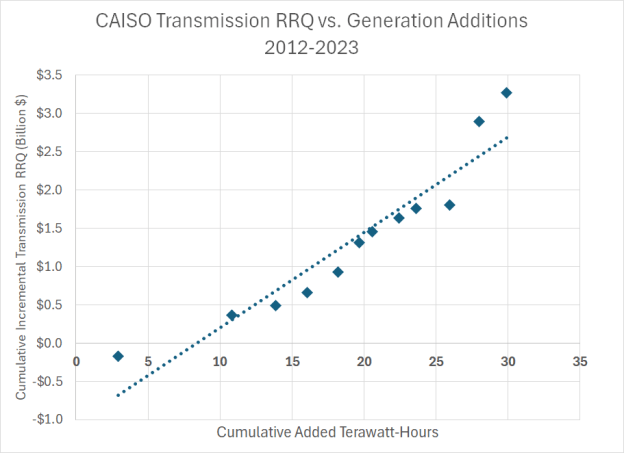
The California utilities have added substantial new generation over the last two decades while peak demand and energy loads have remained fairly constant. Based on Energy Information Administration data for 2012 to 2023 in the California Independent System Operator (CAISO) area, 75.7% of the generation added other than plant repowering is for renewables meeting the state’s Renewable Portfolio Standard.[1] Most of these new plants are located remotely from the majority of customer loads so transmission lines must be built to deliver that energy.
Over the same period from 2012 to 2023, the total annual transmission revenue requirements for the three investor-owned utilities (IOU) in the CAISO (i.e., PG&E, SCE and SDG&E), rose from $2.217 billion to $5.487 billion or 147%.[2] That is 7.8% per year. The chart below compares the increase in transmission revenue and the addition of generation over that period.

Transmission spending is driven largely by additions of generation. This fact is particularly evident when transmission costs rise so rapidly despite no significant load growth. For this reason, the marginal or incremental cost should be expressed in dollars per kilowatt or kilowatt-hour. And because 76% of the new generation is for renewable energy, not for peak reliability, kilowatt-hours of energy is the best metric.
Using these two data sources, we updated the incremental or marginal cost for transmission using the change in annual revenue requirements as a proxy for the direct cost. The chart at the top shows how transmission revenue requirement increases relate to generation additions. Based on this analysis, the marginal cost of transmission is $125 per megawatt-hour or $0.1246 per kilowatt-hour.[3] Given that retail transmission rates for the three IOUs have on average increased 250% to $0.04016 per kilowatt-hour, this result is consistent with the economic principle that marginal costs are above average costs when average costs are rising.
[1] EIA 923, https://www.eia.gov/electricity/data/eia923/, and EIA 861, https://www.eia.gov/electricity/data/eia861/
[2] CPUC, AB 67 Reports to the Legislature.
[3] The R-squared is 0.881, and the standard error is $0.0138 per kilowatt-hour.
 Economics Outside the Cube
Pingback: Discerning what drives rate increases is more complex than shown in LBNL study | Economics Outside the Cube
Pingback: A key policy tool intended to promote energy efficiency is instead being used against saving energy | Economics Outside the Cube