Author Archives: Richard McCann

Unknown's avatar

About Richard McCann

Partner in M.Cubed, an economics and policy consulting firm.

Analyses of California’s extended cap and trade program

california

I believe that California’s passage of the extended cap and trade program was a generally good compromise. Most importantly, it decoupled the cap and trade market from separate legislation to regulate local emission impacts. As I wrote earlier, earlier proposals failed on this aspect.

Here’s the two best analyses I’ve seen so far, one legal and the other economic (by a former Michigan classmate), of the legislation.

A response to Environmental and Urban Economics on impact of climate change on counties

6_29_17_brian_economicdamagescience2017_720_381_s_c1_c_c

I follow Matthew Kahn, now at USC, post on June 30 about the how the “Lucas Critique” undermines a recent study forecasting how counties across the U.S. might be affected differentially by climate change. Quoting the New Palgrave Economic Dictionary, “The ‘Lucas critique’ is a criticism of econometric policy evaluation procedures that fail to recognize that optimal decision rules of economic agents vary systematically with changes in policy.” In other words, individuals within the economy are able to anticipate changing events, including government decisions, and can mitigate the impacts of those events when compared to continuing with the status quo. Kahn puts great faith in the Chicago School premise that individuals can readily adapt to all conditions without government or collective decisions.

However, Kahn ignores two important points. First, he misses the distributional focus of the study, and instead focuses on the overall efficiency gains from the net changes. That’s not the point of the study. We can see on example that land can’t be moved from one county to another, so landowners can’t adapt in anticipation of climate change without significant investment to protect their land. Homeowners will lose value in their homes, and others will find their asset value stranded. Sure, the overall economy will adapt and certain counties may gain enough to offset those losses, but residents within the net loss counties will be worse off. Economics for too long has focused solely on net gains without parsing the impacts and considering how to manage better outcomes for the losers. (I see this failure as one aspect of dissatisfaction driving Trump voters–which brings me to my second point.)

And second, if the Lucas Critique was truly valid, coal miners in Appalachia would have long abandoned their towns as they saw the decline of coal, and the need to satisfy West Virginia coal miners would not be driving national policy today. Instead, we see that people are myopic and these changes are likely to have significant consequences.


State supreme court upholds AB 32, consistent with state-defined property rights

fig2

The California State Supreme Court refused to rehear a state appellate court decision that upheld the validity of the cap and trade program (CATP) established in Assembly Bill 32 (2006). Those challenging the program claimed that (1) the program required firms to acquire allowances to operate and (2) that the auction receipts were budgeted into state programs like other tax revenues. However, the Court’s decision was a victory for those who believe that stronger property rights can lead to an improved environment.

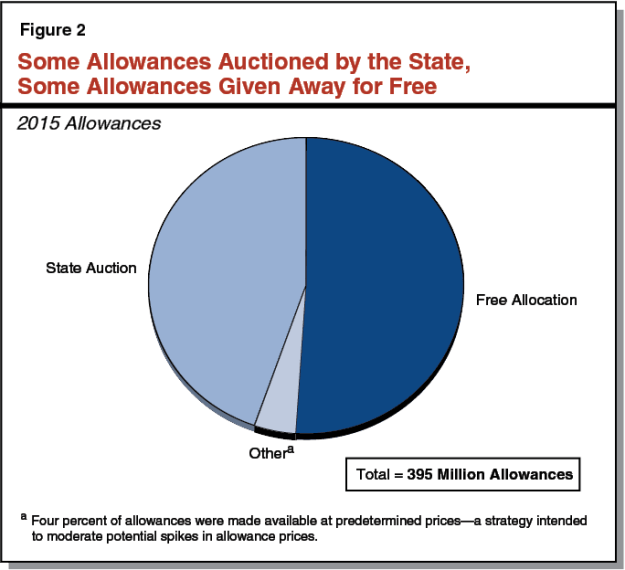
The AB 32 CATP defined the property rights for individual firms and for the public in allowed GHG emissions into the atmosphere.  CARB also allocated allowances for free to these firms and set rates of declining annual emission totals (with some upward adjustments to accommodate interstate and international competitiveness). This is akin to delineating the acreage that a property owner has, and then setting out a rate at which the property owner must dedicate a portion to public use, while still allowing the owner to continue to use that land. The U.S. Supreme Court just upheld the ability of state governments to regulate land use in this manner. The CATP essentially allows an owner to continue to use the land in same manner by acquiring usage rates from other owners who may find it more lucrative to sell their allowances rather than use them. Under AB 32, the state auctions some of those allowances to make for a liquid market, while other allowances are traded bilaterally amongst firms. The bottom line is that CATP established property rights in GHG emissions, just as California established water property rights in 1914.

If the CATP had been declared to be another tax, then any disbursement of government property that generated revenues, e.g., sale of excess office space or forest land, could also be considered a “tax” subject to a two-thirds vote approval by the State Legislature under the state constitution. I doubt that the plaintiffs in this case (led by the Chamber of Commerce) intended that sale of state property would require a two-thirds supermajority vote.

Repost: A catalog of studies on whether renewables create grid instability | Greentech Media

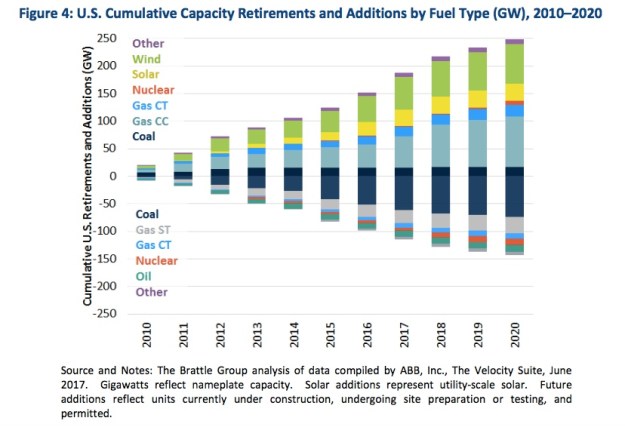
GTM compiles the studies done over the last month in anticipation of the release of the study ordered by Energy Secretary Rick Perry to examine how increased renewable energy threatens grid reliability.

Source: The Rising Tide of Evidence Against Blaming Wind and Solar for Grid Instability | Greentech Media

Creative Pie Slicing To Address Climate Policy Opposition | Energy Institute at Haas

Severin Borenstein’s post raises an important issue that economists have ignore for too long. I posted the following comment there:

We gave politicians the tool of benefit-cost analysis which they have used to justify their policy objectives, but we completely failed to drive home the requirement that those parties who are on the losing end need to be compensated as well. I looked in my edition of Ned Gramlich’s book on Benefit-Cost Analysis (who taught my course), and the word “compensation” is not even in the index! Working on environmental regulations, I regularly see agency staff derive large positive ratios for the “general public” and then completely dismiss the concerns of particular groups that will be carrying all the burdens of delivering those benefits. If we’re going to teach benefit-cost analysis, we need to emphasize the “cost” side as much as the “benefit” that politicians love to extol.

Source: Creative Pie Slicing To Address Climate Policy Opposition |

Another reason SB 775 is a bad idea: Virginia to establish cap-and-trade program in push to regulate carbon emissions | Utility Dive

California’s SB 775 would prohibit interaction with other states’ cap and trade programs. The best alternative to a federal program is a network of state markets.

“A cap-and-trade program in Virginia would be the third in the U.S., and buck direction from the White House to pull back on carbon regulation.”

Source: Virginia to establish cap-and-trade program in push to regulate carbon emissions | Utility Dive

Opening up California’s utility procurement process could lead to lower power prices

auction

California passed AB 57 in 2002 to make the power procurement process for electric utilities confidential (as well as subject only to upfront review rather than ongoing prudence standards). The result has been overly high prices locked in for decades.  A new study on the relative gains to landowners who sell the development rights for oil and gas development in Texas shows that using auctions creates more competition among multiple bidders than bilateral negotiations. As a result, landowners get higher prices for their development rights through an auction. The corollary is that California’s electric utilities probably could lower their power purchase costs by moving to public auctions instead. Yet another reason to repeal AB 57.

Building Drought Resilience in California’s Cities and Suburbs from PPIC

Then And Now: California's Drought Officially Declared To Be Over

M.Cubed partner David Mitchell is the lead author on this PPIC report that reviews the responses by urban agencies to the California’s recent drought and looks at the lessons learned. He’s speaking during a webinar on June 16 at noon. In addition, he co-authored an opinion article for the Sacramento Bee.

Clean energy too big to be shut down by Trump – San Francisco Chronicle

I’ve been struck by the lack of panic in the energy industry about President Trump’s decision. This article goes into that underlying confidence that the momentum appears unstoppable.

WASHINGTON — President Trump’s decision to abandon the Paris Accord will slow the battle against climate change in the U.S., but there’s too much momentum in the nation’s clean-energy economy to shut it down, energy experts say.

Source: Clean energy too big to be shut down by Trump – San Francisco Chronicle

U.S. likely near full employment already

us-employment-rate-data-and-trends-january-2017-12-638

The recent jobs report may be indicating that any additional stimulus such as tax cuts or infrastructure investment will be ineffectual, or even counterproductive.