Category Archives: Risks of climate change

Even if we don’t know if the magnitude is large, can we afford to be wrong?

Getting to the harder question about stranded assets

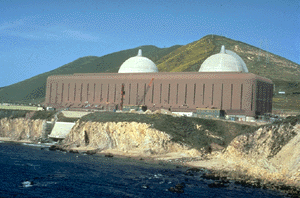
diablocanyon

John Farrell at the Institute for Self-Reliance argues that existing utility fossil-fuel plants should not be given “stranded assets” status. While his argument about “stranded assets” makes sense from a society wide economic sense, it doesn’t conform with the utility regulation world in which “stranded assets” is actually relevant. Having gone through California’s restructuring and competitive transition charge (CTC) (I’m the only person outside of the utilities to conduct a complete accounting of the CTC collection through 2001), it’s all about what’s on the utility’s books and what the regulatory commission agrees is an acceptable transfer of risk. And based on what happened with Diablo Canyon in 1996 (the correct treatment would have recognized that PG&E had collected its entire investment at the regulated rate of return by 1998—I did that calculation too), it’s not promising.

So I suggest focusing on the shareholder/ratepayer risk sharing arrangement and how that should be changed in the face of the oncoming utility 2.0 transformation as a more fruitful path. We have to change the underlying paradigm first. That there are benefits from retiring generation assets is not a hard argument to win—that was the case in 1996 in California. The harder one is that the past regulatory compact should be changed and that it won’t somehow impact future investment in the distribution utility.

Ideas on adopting world carbon prices

Two news items showed up today on the idea of adopting a worldwide carbon price to reduce GHG emissions. The general idea is to use one of three approaches: 1) world cap & trade allocations (which has been the underlying notion in negotiations so far); 2) setting a specific carbon price or tax through treaty; or 3) using trade tariffs by a coalition of participating nations to incent non-participating ones to control their emissions. There is evidence that pricing carbon is effective in reducing emissions.

The U.S. Secretary of Energy called for a world carbon price implemented through one of the first two methods listed here.

The new American Economics Review has an article that shows that a trade tariff regime imposed by a coalition can induce other nations to control their emissions.

The Strategic Value of Carbon Tariffs
Christoph Böhringer, Jared C. Carbone and Thomas F. Rutherford
We ask whether the threat of carbon tariffs might lower the cost of reductions in world carbon emissions by inducing unregulated regions to adopt emission controls. We use a numerical model to generate payoffs of a game in which a coalition regulates emissions and chooses whether to employ carbon tariffs against unregulated regions. Unregulated regions respond by abating, retaliating, or ignoring the tariffs. In the Nash equilibrium, the use of tariffs is a credible and effective threat. It induces cooperation from noncoalition regions that lowers the cost of global abatement substantially relative to the case where the coalition acts alone. (JEL D58, F13, F18, H23, Q54, Q58)
Full-Text Access | Supplementary Materials

Preserving biological diversity in Costa Rica

We just returned from a trip to Costa Rica, including the cloud forest in Monteverde. We even got to see the wonderful Quetzal (see above) and hear the Three-wattled bellbird. That region is increasingly dependent on eco-tourism to support it biological reserves. Most of those are privately owned, with the national parks appearing to be more “rural preservation” zones than the ecological protection areas that we have in the U.S. The question is whether relying so heavily on eco-tourism is a desirable and sustainable path for preserving the biological diversity in such a resource-rich area?

Tourism can have a big environmental footprint from travel modes as well as pushing the local labor force from productive agriculture to service jobs. Already, 300,000 people annually visit a community with 5,000 residents. Several people in Monteverde mentioned that they were reluctant to support improving road access (which is difficult now) because it could bring in more visitors, particularly cruise-ship buses that are typically not as interested in a “close to nature” experience.

One option is to train the workforce to provide the means of maintaining and observing the local ecosystem. This could include both nature guides for eco-tourists, scientific observation and analysis, and habitat restoration.

Another question is whether the local workforce should be trained to transform the habitat to match the climate change that is likely to occur in the region? Human activities such as cattle grazing and crop and forest cultivation tend to impede natural transformations that might mitigate climate change impacts in the local ecology. We might have to acknowledge that existing local habitats will change and certain species will disappear, but that we should move to substitute appropriate habitat for other species to escape to from their disappearing habitat.

Are the benefits of an RPS correct?

Lawrence Berkeley Lab released a report estimating the economic benefits from the renewable portfolio standards (RPS) around the U.S. Two surprising findings were:

  • ratepayers saved up to $1.2 billion in wholesale power costs (on top of a $1.3-$3.7 billion reduction in natural gas costs from reduced overall demand); and
  • air quality benefits were about equal to GHG reductions in economic value.

Both of these claims require a deeper review because they run contrary to previous analyses.

Based on PG&E’s Power Charge Indifference Adjustment (PCIA), the renewables contracts that it holds are increasing its rates by almost 2 cents per kilowatt-hour. It is only recently that renewable contract prices have started approaching conventional resource costs, so it’s hard to understand how an RPS could have already reduced electricity rates. (I do see that this will eventually be the case.)

Typically the emission reduction benefits from GHG reductions are several multiples of those from criteria air pollutants (e.g., NOx and volatile organic compounds (VOC or ROG) that produce ozone; particulate matter (PM 2.5)). For example, ClimateCost has issued studies estimating reduced energy impacts and health benefits compared to air quality benefits that show much larger GHG benefits.

A real game changer in EVs?

General Motors announced the new Chevy Bolt with a 200-mile range at $30,000 after federal incentives (and less with state incentives). This range works for most households as a primary car (versus a commuter with a 40-50 mile range) and it’s in the price range of many other alternatives.

The question is whether EVs are environmentally beneficial yet in the eastern U.S. Car technology may be getting ahead of the electricity grid.

The shaky foundation of benefit-cost analysis

A post by Tim Brennan at RFF on the uncertain foundations of benefit-cost analysis. (Another RFF post explores the question of whether policies should influence preferences.) The bottom line: that we can’t rely on a cut-and-dried economic analysis to define the “most efficient” policy action.

His conclusion is that we need to turn back to policymakers to decide, rather than relying on the “high priests” of economists:

The best alternative may be to use a fair and open democratic process to choose those who would change (or ignore) revealed preferences. This sounds more radical than it is; we do it all the time. We elect officials who directly or indirectly make choices according to noneconomic values based on ethical rights or distributive justice. Moreover, we also cannot forget that though economics takes preferences as given, they have to come from somewhere. Manipulating preferences is already part of public policy, most notably using education to inculcate preferences to be good citizens as well as to acquire useful skills. Although the puzzles mentioned here are real, we may not have the choice to ignore them, much as we might prefer to do so.


Is high speed rail the right answer for reducing GHG emissions?

I’m not the only one asking whether California’s High Speed Rail (HSR) project is the best way to reduce climate change risk. Dick Startz from UC Santa Barbara confirmed in the LA Times my observation that creating an electric vehicle through-way along I-5 probably can serve the same purpose for much less cost, while delivering GHG reductions much sooner.

As I pointed out, the HSR GHG reduction analysis incorrectly assumes that the mix of motor vehicles will remain gasoline-dominated past 2030. Even an updated analysis cited by HSR proponents ignores the likely penetration of non-hybrid EVs required to meet the state’s emission reduction goals (prepared in a different study by UC Berkeley–shouldn’t a university more fully coordinate it’s related research?) Shouldn’t the HSR Authority be coordinating it’s studies with the planning parameters being used by the Air Resources Board in preparing its GHG reduction plans? Other studies have shown the HSR is not particularly cost effective.

Widespread and effective charging networks are being developed that makes a high speed EV corridor feasible. Access to such a corridor might even encourage EV diffusion. As Startz writes, we should be looking for solutions from this century rather than the last.


Cap & trade and market design

Bob Sussman at Brookings writes favorably about the resurrection of cap and trade for GHG regulation as a viable policy option with the Chinese planning to implement a program and the US EPA Clean Power Plan encouraging market trading mechanisms in two forms of compliance. Yet as I read this (and also think about proposals to increase water trading to solve California’s ongoing drought), I can see an important missing element in these discussions–how can these markets be designed to gain success?

In 1996, I wrote “Environmental Commodities Markets: ‘Messy’ Versus ‘Ideal’ Worlds” that explored the issues of market design and political realities. As I’ve written recently, we are not always good at fully compensating the losers in environmental policy making, and these groups tend to oppose policies that are beneficial for society as a result. And market incentive proponents seem to always propose some variation on one of two market designs: 1) everyone for themselves in searching for and settling transactions or 2) a giant periodic auction.

In reality, carefully designing market institutions that work for participants is key to the success of those markets. Daniel Bromley wrote about how just “declaring markets” in Russia and Eastern Europe did not instantly transform those economies, much to our chagrin. The RECLAIM emissions market has woefully underperformed because SCAQMD didn’t think through how transactions could be facilitated (and that failure prompted my article.) Frank Wolak and Jonathan Kolstad confirmed my own FERC testimony that the disfunction of the RECLAIM market led to higher electricity prices in the California crisis of 2000-01.

For a presentation a few years ago, I prepared this typology of market structure that looks at the search and match mechanisms and the price revelation and settlement mechanisms. This presentation focused on water transfer markets in California, but it’s also applicable to emission markets. Markets range from brokered/negotiated real estate to dealer/posted-price groceries. Even the New York Stock Exchange, which is a dealer/auction probably works differently than how most people think. There are differences in efficiency and ease of use, often trading off. As we move forward, we need more discussion about these nuts and bolts issues if we want truly successful outcomes.

Market Typologies

Reblog: Leaking Coal to Asia

Maximillian Auffhammer at UC’s Energy Institute @ Haas focuses on the issue of exporting coal from the Port of Oakland, but he turns to the issue I highlighted recently–the path to accomplishing environmental objectives should travel through compensating those who are worse off from such policies.

Source: Leaking Coal to Asia

A political-economic analysis of the Red State-Blue State dichotomy on climate change policy

Matthew Kahn at UCLA lists his research addressing why voters and politicians in low-energy cost / high-carbon emitting areas oppose GHG reduction policies. He shows how protecting the status quo is in their interests, including for lower-income suburban dwellers. Proponents of climate change policies should consider how to compensate the range of “losers” from adopting these policies. Using carbon tax revenues to offset other taxes or as income-based rebates is one type of solution. I’ve pointed out previously that ignoring the need to compensate those who have reduced welfare from a policy choice both improves economic efficiency and reduces political opposition.