Category Archives: Water resources management

How to allocate our scarce most precious resource

Thoughts on “California’s Water System Built for a Climate We No Longer Have” | KQED Science

We just looked at the frequency of different water conditions over the last 15, 35 and 110 years. Over the longer period, wet, “normal” or average, and dry years have occurred in about equal shares, at about one-third each. But over the last 35 years dry conditions have occurred in about half of the years. Over the last 15 years, wet conditions have declined to less than 20% of the years.

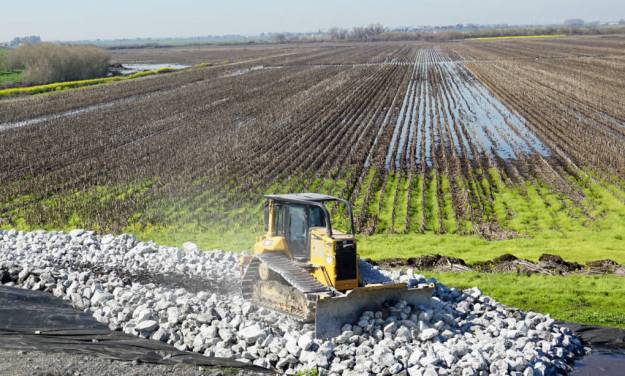
We’re also working with Sustainable Conservation on a program that will incentivize growers to use diverted floodwaters to recharge groundwater aquifers below their fields.

California is likely to see more extreme floods and drought with climate change, but the state’s water infrastructure may not be ready.

Source: California’s Water System Built for a Climate We No Longer Have | KQED Science

Reblog: Paul Brown on the “optimization trap” and innovation | MAVEN’S NOTEBOOK

Paul Brown talks about how chasing “optimization” is a fruitless distraction, which I happen to agree with. We should be focused on exploring the consequences of different pathways and how to mitigate significant vulnerabilities.

Source: WATER SMART INNOVATIONS: Speeding up innovation in the water industry | MAVEN’S NOTEBOOK | Water news

Economic Analysis of the 2016 California Drought for Agriculture | California WaterBlog

by Josué Medellín-Azuara, Duncan MacEwan, Richard E. Howitt, Daniel A. Sumner, and Jay R. Lund The drought continues for California’s agriculture in 2016, but with much less severe and widespread i…

Source: Economic Analysis of the 2016 California Drought for Agriculture | California WaterBlog

Maven’s Notebook: Fishing groups win lawsuit to overturn Delta water delivery contracts

This could have far reaching implications about how CVP contracts are renewed.

From the law offices of Stephan C. Volker: On July 25, 2016 the Ninth Circuit Court of Appeals ruled in favor of the Pacific Coast Federation of Fishermen’s Associations (“PCFFA”) and the San Fra…

Source: MAVEN’S NOTEBOOK – Water news

Maven’s Notebook: “Normative science has a corrosive effect on the entire scientific enterprise”

‘Normative science’ has a corrosive effect on the entire scientific enterprise, says Dr. Robert Lackey These days, scientists in environmental science, natural resources, ecology, conse…

Source: MAVEN’S NOTEBOOK – Water news

Cataloging calls for “water markets”

It’s trendy now to propose water transfers between regions and agriculture to urban uses as the primary solution to California’s drought. While this may not be the “silver bullet” that the proponents believe, I’m starting to catalog the articles I find making these proposals. I’ll hold my commentary until later.

Here’s a San Diego Union-Tribune piece from Erik Telford at the Franklin Institute.

Here’s a Sacramento Bee article from Christopher Thornberg at Beacon Economics.

Here’s another Bee article by Jay Lund, Ellen Hanak and Buzz Thompson at PPIC. And another post by Jay Lund on the many uses.

More from the Bee by Lawrence J. McQuillan and Aaron L. White at the Independent Institute.

A proposal by EDF with five recommendations.

Let me know about others.


An economically attractive environmental solution in peril

The agreement to take down PacifiCorp’s dams on the Klamath River is in peril. In 2006 we showed in a study funded by the California Energy Commission that decommissioning the dams would likely cost PacifiCorps ratepayers about the same as relicensing. That mitigated the economic argument and opened up the negotiations among the power company, farmers, tribes, environmentalists and government agencies to came to an agreement in 2010 to start decommissioning by 2020.

The agreement required Congress to act by the end of 2015 and that deadline is looming. Unfortunately, there are still opponents who mistakenly believe that the project’s hydropower is cheaper than the alternatives. In fact, the economics are even more favorable today whether PacifiCorp uses natural gas or renewables to replace the lost power. And this analysis ignores the benefits to the Klamath fisheries from decommissioning. It’s too bad that bad simplistic economics can still get traction in the legislative process.

Why ag “savings” might not be the solution to urban water woes

Over the last couple of years, I’ve come across several examples of how increased agricultural irrigation efficiency hasn’t led to water savings. When interviewing a farmer in San Joaquin County about managing agricultural pumping loads, he described how he had invested $2,000/acre in a microdrip system for his tomato and melon fields. To avoid his subterranean systems, his farm has a GPS repeater that guides his tractors within a few inches. Another consultant described how they couldn’t find any flood irrigated tomato fields, a standard method in 2007, for a comparison survey for drip effectiveness. Fresno County tomato yields increased more than 25% from 2007 to 2012, and individual field yields have increased 50%.

The result is that growers are using the water they have to increase productivity. They also have moved into more permanent crops which deliver higher revenues per acre-foot. For example, almond acreage has more than doubled since 1995. And little additional water has been freed up for urban or environmental uses.

With the increased value of water to agriculture, urban agencies have lost much of their competitive edge in pursuing water transfers. In 2014, Westlands Water District paid Placer County Water Agency an unheard of $325/AF, and there were reports of some transfers costing several thousand dollars per AF to protect orchard investments. The urban agencies use to largely have this playing field to themselves, but that era looks to be ending.

The evolution of California’s water transfer market (albeit a bit dated)

Eric Cutter and I wrote a paper in 2002 that extended my dissertation chapter exploring how the state’s agricultural water management institutions, i.e., special districts like irrigation and California water districts, affected water transfer participation. We had built the first extensive transfer database in 2000 (On-Tap) for USBR and CDWR, using secondary sources, and used that analysis for the paper. Ellen Hanak of PPIC reconstructed a data set from primary sources a couple of years later, and updated it in 2012, so this data has been superseded. (Her 2012 coauthor Liz Stryjewski is now a consulting associate with M.Cubed.)

The paper discusses two important aspects not often touched upon: 1) the search and transaction settlement mechanisms are important to market success, and 2) the nature of the institutions managing agricultural water can affect willingness to participate. Another important aspect is that California already has about 10 MAF in long-term permanent water transfers embedded in the CVP and SWP contracts. The 2 MAF in short-term and more recent long-term transfers are on top of those already occurring. So California has already has a viable market contrary to ill-informed observations by others; the question is whether that market can and should be expanded further.

UCLA professor’s comments not helping California’s drought problem

An environmental horticulturalist for UC Cooperative Extension in Los Angeles, Don Hodel, has been getting a lot of press recently criticizing the State Water Board’s urban water restrictions. He advises that the Water Board should have advised targeting changes in watering practices rather than limiting supplies, and claims that urban restrictions were unneeded, implying that agriculture should bear the entire brunt. Unfortunately, he’s made at least two grievous errors in his assessment.

First, Hodel fails to understand that the actual implementation of the reductions is to be done by the local water utilities, not the Water Board. The Board only provided the targets, and the stick if the targets aren’t met. Hodel needs to complain to the utilities if he thinks they aren’t doing their job.

But of course, he’s equally naive about the huge problem of communicating about changing irrigation practices to millions of urban customers across hundreds (yes) of distinct water utilities. Of course, these utilities have been trying to get their customers to improve outdoor watering, but just getting their attention is a big enough problem.

Second, his real agenda is to imply that urban horticulture is more valuable the state’s agricultural industry. Urban agencies have only so much contractual and physical access to water supplies. To not cutback deliveries would require transferring water from farmers. But there’s at least two problems with that, the first being that agricultural water is much more valuable than Hodel imagines and second is that it’s not easy getting the water from northern to southern California.

It turns out that those farmers have been doing an exceptional job at improving their irrigation practices; the problem is that they’ve used that efficiency to increase output rather than to save water. The original proponents of agricultural water efficiency didn’t anticipate this response and the surplus didn’t materialize for urban users or the environment.

And even so, moving water from farm areas and treating it for domestic uses adds substantially to the cost of water. It’s the primary reason why urban water costs well in excess of $2,000 per acre-foot while agricultural water is much less than $500 per acre-foot. Water isn’t a particularly fungible good, and proponents of water transfers as the “solution” ignore this issue (along with the problems of market design and function.)

These types of moments are when I wished that journalists were better informed and able to filter out the uninformed “experts.”