Tag Archives: California

Nishi and Our Obligations to Other Californians

I wrote this column for the Davis Vanguard in a series about the future of economic development for Davis:

nishi-scene-1

The University of California created what Davis is today. When UC Davis became a full-fledged campus in 1959, the State of California began the process of pouring resources into this city to develop a top notch university. UC Davis is now acknowledged as the top agricultural academic institution in the world.

We can see what the university has brought us all around. If you want to imagine what Davis would look like without UCD, go to Woodland or Dixon. We have a vibrant downtown with many community activities. We have one of the top rated school systems in the state. And our property values reflect the premium of those benefits. Davis is a very desirable place because of UCD. You have chosen to live here because of these amenities that cannot be readily found elsewhere in the Central Valley.

State taxpayers have contributed billions of dollars over the years to the campus, and students have brought resources from around the state, keeping the local economy vibrant. In return, the state has not asked Davis explicitly for any contributions or cooperation. Yet there are obligations that come with hosting UCD. Other state residents are counting on UCD, and its host city, to provide an educational gateway to both UC students and concomitant economic and cultural growth statewide.

How do we meet that obligation? By providing a fair share of housing to students, and affordable housing for faculty and staff. By incubating new businesses that spin off innovations developed on campus. And by cooperating with UCD in its long-range plans. Yes, we need to ask reasonable cooperation from the University in return (which does not always come readily. For example, I opposed the final configuration of West Village, and believe part of its difficulties arise from that configuration.) But that does not mean that we can oppose all UCD-related development.

So how does the Nishi Gateway Project relate to this obligation? UCD cannot and should not host all housing and spin offs on campus. Students need to learn how to live on their own outside of the protective UC womb. And UCD should not be directly involved in commercial activity because that puts the state directly in the role of promoting certain profit-making enterprises. Instead, the city needs to host housing and businesses. Other college towns successfully accomplish these tasks.

Davis is the only significant university town without a large research park; this puts UCD at a distinct disadvantage for attracting research dollars and researchers. And UCD is at a disadvantage recruiting faculty. Many assistant and associate professors have spouses working in technical fields, and universities usually help them find jobs as part of recruiting. Davis lags in offering these opportunities. Nishi will create jobs for this younger adult segment, both for incoming faculty’s families and for graduating students. Davis is already experiencing a hollowing out of our young adults population; we need to reverse this trend to keep the town vibrant.

Nishi offers a mix of research and development space and housing close to campus that meets most of our standards for sustainability and impacts. It may not offer the “perfect and optimal” configuration, but no one can ever achieve that standard, simply because that definition varies in the eye of the beholder.  Creating affordable housing is about much more than just designating a few units for lower income residents. A constrained housing market guarantees higher prices—just ask San Francisco and Manhattan. The best way to make housing more affordable in Davis is to offer more housing. Nishi does this in the context of a relationship with our biggest employer.

Some suggested that alternative locations exist for this development, that residents will be exposed to excessive pollution, or that we will be losing agricultural land. First, the process of assembling the parcels needed for this scale of project is much more difficult and expensive than opponents realize. Controlling the land is key to success. Second, I have not heard anyone objecting to the new housing developments along Olive Lane, yet they experience the same environmental exposures; the same can be said about much of South and West Davis. And third, farming is no longer economically viable on Nishi. Its isolation makes agricultural activities too expensive—it is time to move on.

Instead, we need to ask if this development is not approved, what will be built instead? We have already seen the type of developments popping up in West Sacramento, Roseville, Elk Grove and even “north North Davis”, i.e., Spring Lake in Woodland. As Davis suppresses growth here, less desirable developments pop up there. Are we really “thinking globally, acting locally” when we close down any new developments by demanding perfection? We cannot return to the bucolic days of the University Farm. Let’s keep real control of our future instead of pushing it off to someone else.

Richard McCann is a member of the City’s Utilities Rates Advisory Committee and Community Choice Energy Advisory Committee. He is a partner in M.Cubed, a small environmental and resources economic consulting firm. His opinions are solely his own and are not endorsed by URAC or CCEAC.

Community choice spreading across California

Yolo County and the City of Davis became the latest community to approve a CCE (for community choice energy, an alternative moniker to the legalistic community choice aggregation). I sat on the advisory committee assessing options and the business case is strong for the viability of this option. This is the leading edge of a wave of CCEs across California. The combination of market conditions, falling renewable power costs, recognition of changes in the electricity market, and dissatisfaction with the incumbent utilities is pushing broad community coalitions to take the leap.

ca-cca-map-solo-10-10-16-e1476219431587To date three communities have operating CCE’s, with MCE starting first in 2010. MCE is made up of not only Marin County, but also Napa County, and the City of Richmond and Benecia. It also is considering adding new members. It currently has 17 voting communities. Sonoma Clean Power followed in 2014, and is considering adding Lake and Mendocino counties.  The City of Lancaster started in late 2015 in SCE’s service territory. Peninsula Clean Energy, composed of San Mateo County and its cities, kicked off service in 2016.  In addition, San Francisco has approved a CCE but has had various political barriers to getting off the ground.

Here’s a couple websites that show maps and lists of what counties and cities are pursuing CCAs (the lists are slightly different).


Other communities in the midst of either approving or implementing new CCEs include:

Alameda County

Contra Costa County – considering joining Alameda or MCE, or going it alone

Humboldt County as Redwood Coast Energy Authority – considering joining SCP or going alone

South Bay Cities of Los Angeles County as South Bay Clean Power

Los Angeles County

Monterey, Santa Cruz and San Benito Counties and their cities as Monterey Bay Community Power

Riverside and San Bernardino Counties – issued RFP for joint study

San Diego County

City of San Diego – issued RFP for a study

City of Solana Beach

Santa Clara County and 11 cities as Silicon Valley CCE Partners – starting late 2016

City of San Jose – exploring joining SVCCEP or going alone

Santa Barbara CountySan Luis Obispo County and Ventura County – released study on feasibility and options

City of Walnut Creek – considering joining with Contra Costa or going alone


All of this activity has serious implications for IOU purchasing and contract management going forward, CPUC regulation and overall procurement transparency. The IOUs and CPUC have operated in black box to date claiming that confidentiality is necessary to prevent market manipulation. Yet with all of these CCEs likely operating as open books, everyone will have the market information that the IOUs claim is so vital to protect. This is likely to open up IOU PPAs to greater scrutinty–attention that neither the IOUs or the CPUC probably want.

Reaction to Is “Community Choice” Electric Supply a Solution or a Problem?

Severin Borenstein at the Energy Institute @ Haas wrote a good summary of the issues around community choice aggregation.

Source: Is “Community Choice” Electric Supply a Solution or a Problem?

I am on the City of Davis’ Community Choice Energy Advisory Committee and have been looking at these issues closely for a year. I had my own reactions to this post:

First, in California the existing and proposed CCEs (there are probably a dozen in process at the moment to add to the 3 existing ones) universally offer a higher “green” % product than the incumbent IOU, most often a 50% RPS product. And although MCE and SCP started out relying on RECs of various types to start out, they all are phasing out most of those by 2017. I think most will offer a 100% product as well.

The reason that these CCE’s are able to offer lower rates than the IOUs at a lower RPS is that the IOUs prematurely contracted long for renewables in anticipation of the 2020 goal. In fact, the penalty for failing to meet the RPS in any given year is so low, that the prudent strategy by an IOU would have been to risk being short in each year and contract for the year ahead instead of locking in too many 20+ year PPAs. At least one reason why this happened is that the IOUs require confidentiality by any reviewers and no connections to any competing procurement decisions. As a result the outside reviewers couldn’t be up to speed on the rapidly falling PPA prices. The CPUC has made a huge mistake on this point (and the CEC has rightfully harassed the CPUC over this policy.)

CCE’s also offer the ability to craft a broader range of rate offerings to customers–even flat 20 year rates that can compete with solar roofs on the main issue that customers really care about: price guarantees. In addition, CCE’s are more likely to be to nimbly adjust a rapidly changing utility landscape. CCE’s are much less likely to care about falling loads because their earnings aren’t dependent on continued service.

It’s also to recognize the difference between local government general services (e.g., safety and public protection, social services, regulation, etc.) and enterprise services (e.g., utilities of all sorts). In general, the latter are as efficient as IOUs (except LADWP which illustrates the INefficiency created by overlarge organizations). So one can’t make a broad generalization about local government problems and how they might apply in this situation. The fact is that almost all of the existing and new CCEs are or will be JPAs, which are often even leaner. (Lancaster is the exception.)

Finally, Severin made this statement:

“Whatever regulatory mandates, managerial mistakes, or incompetence occurred in the past, customers switching to a CCA should not be allowed to shift their share of costs from past decisions onto other ratepayers.”

I have to disagree to a certain exent with this statement. Am I forced to pay for the past incompetencies of GM or GE or any other corporation? Yes, utilities have a higher assurance of return on their investments, but no where is it written that it is “ironclad.” Those utilities had an assurance first as the sole legal provider and then as the provider of last resort, but that’s eroding. In California, the CTC was a political deal to get the IOUs out of the way. The fact is in California that the CPUC abrogated its responsibility to oversee these decisions on behalf of ratepayers with the encouragement of the IOUs. If the IOUs want to retain their customers, then they should be forced to compete with the CCEs (and DA LSEs.) It’s time to reopen this matter.

And to add a bit more:

The logic of this statement is that ANY customer who leaves the system, including moving to another area, state or nation, should have to continue to pay these stranded costs. Why should we draw the line arbitrarily at whether they happen to still get distribution services even though the generation services have been completely severed? Particularly if someone moves from say, San Francisco to Palo Alto, that customer still relies on PG&E’s transmission system and its hydro system for ancillary services. Why not charge that Palo Alto customer a non-by-passable charge? And why shouldn’t it be reciprocal? Relying on “political practicality” is not an answer. Either ALL customers are tethered forever, or no customers are required to meet this obligation.


Thinking outside the box on the CPUC’s future

3peev_t658

Assemblymember Mike Gato (D-LA) is proposing a constitutional amendment to dissolve the CPUC–blowing up the box! The CPUC currently regulates energy utilities, telcom, transportation and water. That’s a tall order to ask five people to competently understand all of those arenas. And on the flip side, many have recognized that the state has too many “cooks in the kitchen” regulating energy, and it’s only gotten worse with increased climate change regulation. The CPUC hasn’t done much to burnish its reputation with the scandal of Mike Peevey’s “rulings for sale” and the inadequate responses to the San Bruno and Porter Ranch disasters. Closing up shop and starting over may be the best solution.

Getting to the harder question about stranded assets

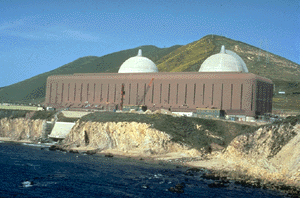
diablocanyon

John Farrell at the Institute for Self-Reliance argues that existing utility fossil-fuel plants should not be given “stranded assets” status. While his argument about “stranded assets” makes sense from a society wide economic sense, it doesn’t conform with the utility regulation world in which “stranded assets” is actually relevant. Having gone through California’s restructuring and competitive transition charge (CTC) (I’m the only person outside of the utilities to conduct a complete accounting of the CTC collection through 2001), it’s all about what’s on the utility’s books and what the regulatory commission agrees is an acceptable transfer of risk. And based on what happened with Diablo Canyon in 1996 (the correct treatment would have recognized that PG&E had collected its entire investment at the regulated rate of return by 1998—I did that calculation too), it’s not promising.

So I suggest focusing on the shareholder/ratepayer risk sharing arrangement and how that should be changed in the face of the oncoming utility 2.0 transformation as a more fruitful path. We have to change the underlying paradigm first. That there are benefits from retiring generation assets is not a hard argument to win—that was the case in 1996 in California. The harder one is that the past regulatory compact should be changed and that it won’t somehow impact future investment in the distribution utility.

Getting EV owners to participate in electricity storage

Cataloging calls for “water markets”

It’s trendy now to propose water transfers between regions and agriculture to urban uses as the primary solution to California’s drought. While this may not be the “silver bullet” that the proponents believe, I’m starting to catalog the articles I find making these proposals. I’ll hold my commentary until later.

Here’s a San Diego Union-Tribune piece from Erik Telford at the Franklin Institute.

Here’s a Sacramento Bee article from Christopher Thornberg at Beacon Economics.

Here’s another Bee article by Jay Lund, Ellen Hanak and Buzz Thompson at PPIC. And another post by Jay Lund on the many uses.

More from the Bee by Lawrence J. McQuillan and Aaron L. White at the Independent Institute.

A proposal by EDF with five recommendations.

Let me know about others.


Is high speed rail the right answer for reducing GHG emissions?

I’m not the only one asking whether California’s High Speed Rail (HSR) project is the best way to reduce climate change risk. Dick Startz from UC Santa Barbara confirmed in the LA Times my observation that creating an electric vehicle through-way along I-5 probably can serve the same purpose for much less cost, while delivering GHG reductions much sooner.

As I pointed out, the HSR GHG reduction analysis incorrectly assumes that the mix of motor vehicles will remain gasoline-dominated past 2030. Even an updated analysis cited by HSR proponents ignores the likely penetration of non-hybrid EVs required to meet the state’s emission reduction goals (prepared in a different study by UC Berkeley–shouldn’t a university more fully coordinate it’s related research?) Shouldn’t the HSR Authority be coordinating it’s studies with the planning parameters being used by the Air Resources Board in preparing its GHG reduction plans? Other studies have shown the HSR is not particularly cost effective.

Widespread and effective charging networks are being developed that makes a high speed EV corridor feasible. Access to such a corridor might even encourage EV diffusion. As Startz writes, we should be looking for solutions from this century rather than the last.


Reblog: If you like your time-invariant electricity price, you can keep it

Severin Borenstein at the Energy Institute at Haas makes the case for giving customers the choice of TOU or fixed price rates. I’ve commented several times on the Energy Institute blog about this approach, and blogged myself about the need for this option.

Source: If you like your time-invariant electricity price, you can keep it

An economically attractive environmental solution in peril

The agreement to take down PacifiCorp’s dams on the Klamath River is in peril. In 2006 we showed in a study funded by the California Energy Commission that decommissioning the dams would likely cost PacifiCorps ratepayers about the same as relicensing. That mitigated the economic argument and opened up the negotiations among the power company, farmers, tribes, environmentalists and government agencies to came to an agreement in 2010 to start decommissioning by 2020.

The agreement required Congress to act by the end of 2015 and that deadline is looming. Unfortunately, there are still opponents who mistakenly believe that the project’s hydropower is cheaper than the alternatives. In fact, the economics are even more favorable today whether PacifiCorp uses natural gas or renewables to replace the lost power. And this analysis ignores the benefits to the Klamath fisheries from decommissioning. It’s too bad that bad simplistic economics can still get traction in the legislative process.