Tag Archives: Davis

Davis to look at Community Choice Energy

After calling a halt to the deeper exploration of an electric publicly-owned utility, the city has turned to an easier mountain to climb in community choice energy aggregation (now remonikered to CCE). The original POU study briefly looked at the CCE option and moved past (and in my opinion used too generic of an approach to assess the POU path with some incorrect assumptions and didn’t consider the rapidly changing electricity market). Several direct access providers have approached the city and interested parties about helping implement a CCE. The citizen’s committee will look at whether a CCE opens up new value for the city and its citizens, and whether to go it alone or to join another CCE. Marin Clear Energy and Sonoma Clean Power both have participation rates over 90%. I will be sitting on that committee as an appointee via the Coalition for Local Power. (I also sit on the Utilities Rates Advisory Committee which has an appointee.)

Perhaps one of the most attractive features is that Davis can gain control of the energy efficiency funds available from the public good charge by preparing a plan specific to the city. Fortunately, the framework for that plan is already underway with a prompt from the Georgetown University Energy Prize.

Smart, clean and local energy technologies for Davis

Second in a series published in the Davis Enterprise on how the City of Davis can address its energy future:

Smart, clean and local energy technologies for Davis

Looking at a locality’s options as the energy marketplace changes

Here’s the first in a series of articles that I am coauthoring about how the new direction in the energy utilities marketplace can affect the choices for a locality like the City of Davis. This one is with Gerry Braun. This first article reviews the findings of study conducted last year that focused on a more traditional utility models, and then sketches the most salient options. This and future articles with other co authors will include:

  • What are the options going forward for Davis and what have we looked at.
  • Describing decentralized energy systems
  • How a decentralized energy system might fit into achieving local goals (e.g., climate action plan) and affect economic activity.
  • Barriers to achieving local goals in this future scenario.
  • Comparisons of potential business models to overcome those barriers.

Making Community Solar Gardens Work

California has been quite successful at encouraging the development of (1) large utility-scale renewables through the renewables portfolio standard (RPS) and other measures and (2) small-scale, single structure solar generation through the California Solar Initiative (CSI) and measures such as net energy metering (NEM).  However, there have been numerous market and regulatory barriers to developing and deploying the “in-between” community-scale and neighborhood-scale renewables that hold substantial promise.

Community-scale and neighborhood-scale distributed generation (DG) includes some technologies that simply are not cost-effective at the small scale of a single house or business, but are not large enough to justify the transaction costs of participating in the larger wholesale electricity market.  These resources, such as “community solar gardens”, can meet the demands of many customers who cannot take advantage of adding renewables at their location and can also reduce investment in expensive new transmission projects. Examples of these types of projects are parking structure-scale solar photovoltaics, solar-thermal generation and space cooling, and biogas and biomass projects, some of which could provide district heating.  Technology costs are falling so rapidly that these mid-scale projects are becoming competitive with utility-scale resources when transmission cost savings are factored in. SB 43 (Wolk 2013) recognizes that the promise of mid-scale renewables has not been realized.

In response to SB 43, each of the large investor-owned utilities–PG&E, SCE and SDG&E–have filed proposed tariffs with names such as Enhanced Community Renewables Program or Share the Sun. I filed testimony in the PG&E and SCE cases on behalf of the Sierra Club addressing shortcomings in those programs that would inhibit development of community solar gardens. SDG&E’s proposal, while not perfect, better meets the law’s objectives. After the hearings, the CPUC postponed a proposed decision from the July 1 deadline to October.

SB 43’s requirement that the investor-owned utilities “provide support for enhanced community renewables programs” is a critical step forward for California’s distributed energy goals.  The CSI is the state’s premier distributed generation program.  In SB 43 the Legislature expressed its intent that the “green tariff shared renewables program seeks to build on the success of the California Solar Initiative by expanding access to all eligible renewable energy resources to all ratepayers who are currently unable to access the benefits of onsite generation.”  SB 43 advances the success of the CSI into the area of multifamily residential and multitenant commercial properties and introduces all types of renewable energy resources.  Customers who, for various reasons, cannot benefit from the current net metering programs, will be able to benefit through SB 43.

The Legislature clearly intends for this program to lead to a transformation in the energy market akin to the success for single customers of the CSI. This necessary market transformation extends to multifamily and commercial lease properties that are currently beyond the CSI and Self Generation Incentive Programs (SGIP). The Commission should ensure that utilities’ programs under SB 43 provides the market transformation that is necessary for this underserved segment.

State regulations calls for all new residential dwellings to consume zero-net energy (ZNE) by 2020, and all new commercial properties by 2030.  Fully implementing the market transformation identified in SB 43 is one of the obvious means to achieve this target.  The CSI option has already facilitated many examples of feasible ZNE single-family homes using renewables well ahead of the 2020 deadline.  There are several market barriers to integrating renewables in a similar manner on multifamily and commercial leased properties and on single-family that are not favorably located or that have other impediments.

A properly-designed community solar garden program should provide a critical work-around for the split-incentive problem that has plagued local renewable development in California.  The split-incentive problem arises from the fact that multi-tenant structures, both commercial and residential, may not be able to implement solar or other renewable resources due to the fact that lessees are not the owners of the shared space where renewables could be sited.  The problem of split-incentives between landlords and tenants has long been recognized, and has been the focus of energy efficiency programs.

As a corollary, the Commission should provide individual developers and property owners the opportunity to integrate energy efficiency and DG measures to achieve the best mix for meeting environmental and economic goals. Each project is unique so that a “one size fits all” approach that requires sale of all output into the wholesale market with buyback from customers who may have no connection with the project will only discourage enhanced development.

For distributed generation to expand in California there must be a cost-effective path for residential and commercial tenants, as well as not-well-situated buildings, to install solar and other renewables and share the costs among other customers. The focus to date has been on either utility-scale or single-building scale projects, but the most promise may be in mid-scale projects that can serve a community or a neighborhood cost-effectively through a combination of scale economies and avoided transmission and distribution investment.  But to achieve this objective requires changes from current utility practices.

An update: Here’s the link to the decision on this CPUC case issued in January. And here’s the link to scoping memo for the phase of this proceeding.

The URAC could not agree on a recommendation to the Davis City Council on a preferred rate option. We probably had too many options with too many proposals for most members to sort through. In retrospect, we probably should have used pairwise comparisons to narrow down the choices for a final vote.

URAC members now have the option to submit a statement in support of a rate proposal. Frank Loge and I previously composed a statement on why summer water costs are higher, a portion of which I posted here. We will submit another statement in support of seasonal rates.

The proponents of Measure P have argued that voters the completely supported all of their reasons for rejecting the original rates, but the reality is quite varied, ranging from concerns about rate increases to rejecting the original water to concerns about the complexity of the new rate structure to resentment over the “look back” provision in the new rates to objections over summer prices. Given the razor thin margin and the low turnout, addressing anyone of these issues would have lead to rejection of Measure P. And now even Measure P proponent Bob Dunning has said that he will accept higher summer rates.  With that in mind, here’s our comments to be sent to the new City Council:

Fellow URAC Member Frank Loge and I wrote about why Davis water supplies cost more in the summer and why simple economic principles lead to those costs being allocated to the highest period of use—the summer in this case.  We want to expand on that statement of economic principles to suggest that the Council adopt seasonal rates with a summer premium.

Davis has extolled itself as being environmentally progressive. We have adopted an aggressive plan to reduce our greenhouse gas emissions and we have required proposed housing developments to adopt stringent standards that minimize environmental impacts. We should extend that commitment to how we use our water.

Moving to a surface water supply is an environmentally responsible way to reduce the impact of our wastewater discharges and the GHG emissions created by pumping water with electricity. However, we don’t get a free pass on using this new water source. The greatest environmental stress on the Sacramento-San Joaquin Rivers Delta occurs in the summer months when river flows ebb. The SWRCB already has ordered curtailments for junior water rights holders (which includes Conaway Ranch) and may order further summer cutbacks. We need to set water rates that reflect our commitment to reducing our footprint on the environment. That means charging a premium on summer water use when environmental costs are higher.

These higher environmental costs are consistent with other system costs including infrastructure and water rights, so the Council can rely on the draft rates constructed with to reflect those underlying seasonal cost patterns. According to analysis prepared by Bartle Wells and presented to the URAC, 55% of total system costs are higher during the summer than the winter period. In addition, current water pumping costs also are higher during the summer as that PG&E commercial time-of-use rates go up during the summer. Under the draft seasonal rates, summer volumetric charges would be 46% higher than winter.

These rates should not be tiered for two reasons. First, examining single family residential (SFR) use by decile shows that all but the lowest rank uses about twice as much water in the summer as in the winter. That means all customers are creating higher summer costs, both financial and environmental, and all should be signaled to conserve. Second, recent studies have shown that tiered rates have not delivered on promised conservation. While the highest users who see a high price may conserve, the lowest users see a below-average price that causes them to overuse water. The two effects offset each other. Using tiers to address concerns about low-income and senior customers causes such benefits to leak to wealthier customers who don’t need the assistance—this issue is best addressed through other rate assistance programs outside of setting the standard rate.

Finally, the Council should look closely at the amount of fixed charges included in the rates. While a large portion of the costs may appear fixed in the short run from an accounting standpoint, from an economic standpoint (which the appropriate stance for setting rates) the City has invested in much of the infrastructure and water rights to meet long-term variations in demand. This means that the water supply and even some of the local distribution system costs are actually variable costs. The Water Advisory Committee (WAC) found that 87% of system costs fall into this variable category and we haven’t seen information to cause us to revise this estimate.

Of concern though is that the City can’t ignore the financial accounting of costs, most importantly debt service.  Debt rating agencies that drive bond interest rates want a higher fixed revenue component. For investor-owned water utilities in California, particularly smaller ones, which rely on higher variable revenues than most municipal utilities, the swings in revenues have caused financial distress of late.

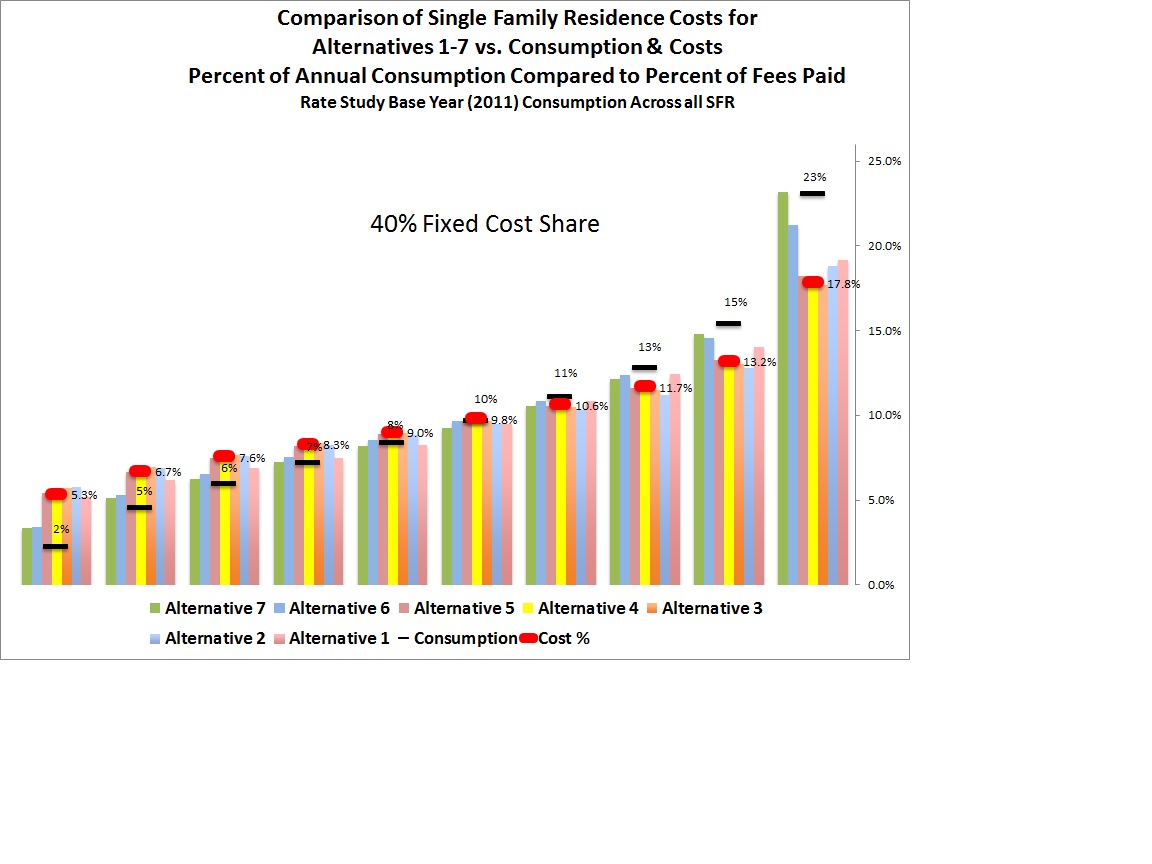
The City must balance the desire to match rates to costs with the need to meet financial commitments. This can be done in one of two ways. The first is to establish a hydrologic conditions or “drought” balancing account that accrues revenues in low-cost “wet” years and is drawn down in high-cost “dry” years. Establishing such an account, however, means that rates are likely to be higher in most years than if the rates had a higher fixed cost component due to higher financing costs. The City essentially has to carry two components of debt, the first to pay for the new water supply system and the second to fund the balancing account. The second method is to increase the amount collected in fixed charges each year so that the variation in revenues doesn’t cut into debt service. Bartle Wells has recommended a minimum of 40% in fixed charges that is consistent with practices with other municipalities. We don’t have a strong preference for either approach, but the Council should be aware of its choices.

Below are two charts I prepared during the URAC meeting (and shared) that compare bill shares across usage deciles for SFR customers. The first chart shows allocations with 40% fixed costs, the second with 13% fixed costs. Note that the consumption shares are steeper than the cost shares due to the fixed costs. At 0% fixed costs, cost and consumption allocations would be identical. It’s important to note that consideration of fairness must not be a simplistic analysis of average water consumption, but also must consider the other investments and costs incurred to deliver that water.

CostAllocation-40P Cost allocation by Decile with 13% Fixed Costs

One final note: the City may not have been in this position if it had more clearly communicated the CBFR rate structure to the community. Measure P passed by only 2%–a swing of 144 votes would have defeated it. I think that most people will understand that water costs are higher in the summer; the City just says, “we live in California where it doesn’t rain during the summer and everyone starts watering their lawn.” The CBFR component could have been more clearly labeled as the “Summer Demand Charge.” Most people would have made the connection and there would have been much less outcry over “complexity.”

Setting Davis water rates in the most fair manner

The City of Davis adopted an innovative rate structure in 2012 to fund a new surface water supply project. The new framework, called “consumption-based fixed rate” or CBFR, originally was structured to provide a stable revenue source for recovering debt costs while allowing customers to reduce their bills when conserving. Instead of having a fixed, constant readiness to serve or demand charge, the summer demand charge would be recomputed each year by dividing the fixed debt service (about $10M per year) by the total summer usage of all customers. When a customer reduced their share of overall summer usage, their bill would go down. However, the total revenue would remain stable year to year because the summer demand charge would be recomputed to ensure meeting the overall revenue target. The CBFR mutated to a more standard fixed demand charge for various political and legal reasons and it lost some of its revenue stability features.

The City has faced several challenges to the water project and the rates. All had lost up until June 3 when Measure P passed by a small margin and rolled rates back to 2011. The Utility Rates Advisory Committee (URAC), of which I am a member, is redesigning rates on an accelerated schedule to ensure viability of the water project. The Measure P proponents missed several key facts in their arguments, so the URAC will need to ignore some of those errors. However, the most important factor in the defeat of the proposed water rates was in the lack of simple communication and understanding by the public. “CBFR” just doesn’t cut it as a simple saleable concept.

I believe that Davis needs to move toward a more efficient water pricing scheme that signals consumers when they should be using water given costs and environmental impacts. The first fairness criterion is that people should pay prices that best reflect the cost to serve them so there are no unjustified subsidies flowing among customers.  The second fairness criterion is that those with less means can receive a subsidy from those with more if the subsidy can be structured to minimize misallocations of resources.

What doesn’t meet a fairness criterion is having everyone pay a single average annual price that doesn’t reflect how the cost of water varies over the year.  Someone who uses the same amount of water year round should not pay the same average annual rate as someone who uses much more water during the summer, even if they use the same total amount for the year. There are several reasons for this.

The most important centerpiece of the Woodland-Davis water project is the 10,000 acre-foot a year (or 3.25 billion gallons) water right acquired from Conaway Ranch. Based on terms of that agreement and depending on the period used to recover the investment, this water supply costs at least $0.50 per CCF.  But the most important fact is that this cost is only for water delivered in the summer. The purchased water right only runs from April 1 to October 31. Water used in the winter is free. That means that customers using water in the summer should pay at least $0.50 per CCF more just to cover the ongoing costs of the water supply.

Further we need to consider how to allocate the costs of delivering that water to Davis. The reason why Sacramento River water is expensive in the summer and free in the winter is that water is scare and in high demand during the summer. How best to allocate costs when most of the demand happens over a short period can be best illustrated by looking at parking in downtown San Francisco. Parking structures are built with capacity to meet demand during work hours on weekdays. Work hour parking can cost upwards of $30 per day, but on a weekend night when the area is empty, parking typically costs $5. These rates are set by private operators who are recovering their investments as efficiently as they can.

For the same reason, Davis must recover most of its investment in the water conveyance facilities from summer users—the plant capacity was built to meet their demand.  A plant built to an annual average capacity won’t be sufficient in August. The current rate structure properly recovers those costs from those individuals who create the need for such a large investment.

Fortunately, the second fairness criterion of reducing costs for those of lesser means can be met through higher summer pricing because they tend to live in multi-family dwellings or have lower irrigation needs.

Summer water bills could increase dramatically, but a solution is to create an Easy Pay plan where a large portion of the summer water bills are spread over a 12-month period. PG&E offers its Balanced Pay Plan to achieve the same ends. Customers should be placed in this bill payment plan on an opt-out basis, as that opt-in options are usually undersubscribed even when the opt-in benefits are large.