Tag Archives: economics

A response to Environmental and Urban Economics on impact of climate change on counties

6_29_17_brian_economicdamagescience2017_720_381_s_c1_c_c

I follow Matthew Kahn, now at USC, post on June 30 about the how the “Lucas Critique” undermines a recent study forecasting how counties across the U.S. might be affected differentially by climate change. Quoting the New Palgrave Economic Dictionary, “The ‘Lucas critique’ is a criticism of econometric policy evaluation procedures that fail to recognize that optimal decision rules of economic agents vary systematically with changes in policy.” In other words, individuals within the economy are able to anticipate changing events, including government decisions, and can mitigate the impacts of those events when compared to continuing with the status quo. Kahn puts great faith in the Chicago School premise that individuals can readily adapt to all conditions without government or collective decisions.

However, Kahn ignores two important points. First, he misses the distributional focus of the study, and instead focuses on the overall efficiency gains from the net changes. That’s not the point of the study. We can see on example that land can’t be moved from one county to another, so landowners can’t adapt in anticipation of climate change without significant investment to protect their land. Homeowners will lose value in their homes, and others will find their asset value stranded. Sure, the overall economy will adapt and certain counties may gain enough to offset those losses, but residents within the net loss counties will be worse off. Economics for too long has focused solely on net gains without parsing the impacts and considering how to manage better outcomes for the losers. (I see this failure as one aspect of dissatisfaction driving Trump voters–which brings me to my second point.)

And second, if the Lucas Critique was truly valid, coal miners in Appalachia would have long abandoned their towns as they saw the decline of coal, and the need to satisfy West Virginia coal miners would not be driving national policy today. Instead, we see that people are myopic and these changes are likely to have significant consequences.



Creative Pie Slicing To Address Climate Policy Opposition | Energy Institute at Haas

Severin Borenstein’s post raises an important issue that economists have ignore for too long. I posted the following comment there:

We gave politicians the tool of benefit-cost analysis which they have used to justify their policy objectives, but we completely failed to drive home the requirement that those parties who are on the losing end need to be compensated as well. I looked in my edition of Ned Gramlich’s book on Benefit-Cost Analysis (who taught my course), and the word “compensation” is not even in the index! Working on environmental regulations, I regularly see agency staff derive large positive ratios for the “general public” and then completely dismiss the concerns of particular groups that will be carrying all the burdens of delivering those benefits. If we’re going to teach benefit-cost analysis, we need to emphasize the “cost” side as much as the “benefit” that politicians love to extol.

Source: Creative Pie Slicing To Address Climate Policy Opposition |

U.S. likely near full employment already

us-employment-rate-data-and-trends-january-2017-12-638

The recent jobs report may be indicating that any additional stimulus such as tax cuts or infrastructure investment will be ineffectual, or even counterproductive.

And then this…Trump’s energy plan doesn’t mention solar – The Washington Post

After the release of a study showing solar now employs more than oil, gas and coal combined.

Source: Trump’s energy plan doesn’t mention solar, an industry that just added 51,000 jobs – The Washington Post

Repost: 1 Out of 50 New US Jobs Came From the Solar Industry in 2016 | Greentech Media

Source: 1 Out of 50 New US Jobs Came From the Solar Industry in 2016 | Greentech Media

William Nordhaus now urges a more dramatic response to climate change – CSMonitor.com

William Nordhaus has long relied on traditional economic cost-benefit analysis to minimize the costs to the world economy from potential climate change impacts. This article discusses how he now views the increasing risk, the continuing uncertainty, and the likely increasing costs from delayed responses as driving the need for a more rapid effort.

Source: Why a climate economist is giving carbon’s ‘social cost’ a second look – CSMonitor.com

Enlisting Davis’ Citizen-Analysts | Davis Vanguard

By Richard McCann

Why are we not using Davis’ wealth of human capital to our advantage? Why don’t we assign, and even hire or retain, these individuals to prepare these analyses for commission review?

Source: Enlisting Davis’ Citizen-Analysts | Davis Vanguard

Repost: Some Colleges Have More Students From the Top 1 Percent Than the Bottom 60. Find Yours. – The New York Times

Why increasing wealth concentration is bad for the U.S. economy

figure-1-e1455723650211

recent article in the New York Times by Dierdre McCloskey boldly states that the answer to income inequality is to allow unfettered growth through free market forces. Unfortunately, this thesis comes straight out of the anti-Communist 1950s. McCloskey puts up a strawman that proponents of addressing inequality directly want to redistribute all wealth via grabbing all assets of the wealthy. Her version of how the economy has worked, and the policy proposals to address inequality are incorrect.

As I posted previously, we’ve already run the experiment comparing the performance of a market-based economy (West Germany) to a centrally-planned socialist economy (East Germany), and the market-based more than doubled the output of the socialist one. That said, the past West German (and the current German) is a far cry from a “free market” economy. It was and is heavily regulated with substantial redistributive policies. No one is seriously advocating that the U.S. move to a Communist economy (at least not since the 1950s)–they are suggesting that the U.S. consider policies that could redistribute wealth to improve the welfare of almost everyone.

Increased inequality has been found to decrease economic growth, contrary to McCloskey’s implied assertion. Both the OECD and IMF found negative consequences from increased wealth in the top 20% of households. Other studies show that historic U.S. GDP growth has not been impeded by high marginal tax rates, either for individual or corporate taxes.

She also misses the real reason as to why inequality is a concern. She dismisses it as simple envy. But it’s really about relative political and economic power. The wealthy are able to exert more bargaining power in economic transactions, and their greater influence on the political process is well documented.

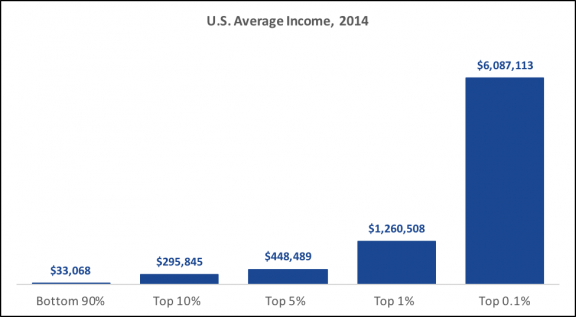
As a side note, McCloskey appears to grossly underestimating the share of wealth and income held by the wealthiest segment of U.S. society. Her calculation appears to assume that wealth is distributed evenly across all of the income quintiles (“If we took every dime from the top 20 percent of the income distribution and gave it to the bottom 80 percent, the bottom folk would be only 25 percent better off.”) In fact, a recent estimate by the Federal Reserve Board shows that the top 0.1% of U.S. households hold over 40% of the wealth. That means that redistributing the wealth of just 0.1% will lead to a 40% increase in the wealth of everyone else. I’m not advocating such a radical solution, but it does demonstrate the potential scale of redistributive policies. For example, redistributing just 25% of the wealth of the richest 1% could lead to a 10% increase in the wealth of the remaining 99.9%.


When is $100 billion not that big?

bg-red-tape-rising-2016-chart-1-825

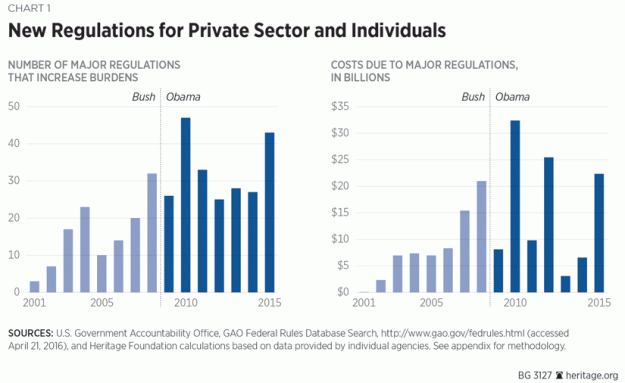
When it’s measured against $18,675 billion ($18.7 trillion) produced by the U.S. economy. The Heritage Foundation issued a report claiming the Obama Administration imposed $107 billion in new burdens over seven years. That sounds like a huge amount, but that’s only 0.6% (six-tenths of a percent) of the economy. And that’s spread over seven years which means that this the reduction in the GDP growth rate was only 0.08% (eight hundredths of a percent) per year. Against an annual average growth rate of over 2%, that’s a trivial amount. Another way to think of it is this way: if you had a dinner bill from Applebee’s for $19, would you not by dinner it if cost a dime more? Probably not–you wouldn’t even notice.

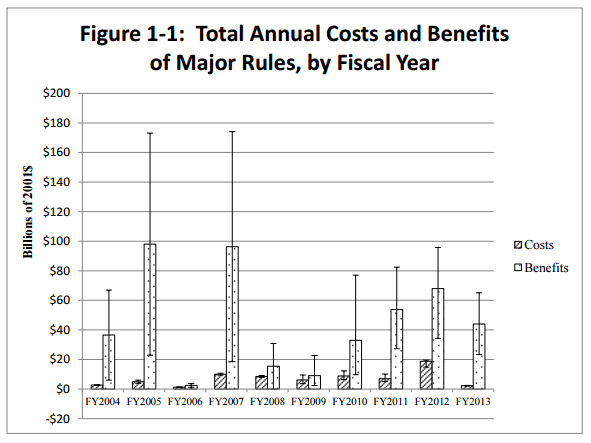
Plus, the HF’s estimate ignores the benefits of those regulations. This graphic from the OMB that shows the estimated relative benefits to costs of regulation.

omb

I won’t dig too deeply into the Heritage Foundation’s analysis other than to make a couple of notes about about alternative perspectives that I am familiar with:

  • Heritage Foundation claims that the Clean Power Plan has cost $7.2 billion as the single largest increment. Yet Lawrence Berkeley National Laboratory (which is much better qualified on this issue than the HF) just released a study showing the net financial “costs” of the various renewable portfolio standard (RPS) requirements is actually a benefit $47 to $109 billion. (And that ignores the environmental benefits identified in the report.)
  • After the 2008 financial debacle, the industry was going to face increased regulation to reign in its behavior during the previous decade. So increased regulation under Dodd-Frank is to be expected. And the better question might be what is the drag on the economy from high financial-related transaction costs? One study found that transaction costs may be as high at 45% in the U.S. economy. The financial and legal sectors likely are a bigger drag than government regulation.
  • On FCC net neutrality, see a previous post about how bigger corporations and economic concentration reduces innovation, which leads to reduced growth. Net neutrality is intended to fight that concentration.