Tag Archives: M.Cubed

Rethinking the rates that utilities offer to customers

I just got back from an annual conference put on by the Center for Research in Regulated Industries. It brings together many of the applied economists and policy analysts working in California’s electricity industry. I presented a paper on reconsidering rate design.

Customers are often left out of the conversation about how to move forward into the new energy future, as they were at the recent CAISO Symposium where not a single customer representative was included in the “Town Hall Meeting.” Current retail rate tariffs seem to be designed with little thought about how customers would prefer to pay for their energy, and what might best encourage consumer energy management. And when customers are asked to take on more risk or cost to address energy needs, their revenue responsibility is often unchanged.

How should utilities align their rates and tariffs to fit customers’ preferences? Utilities both face a rapidly evolving energy marketplace and have available to them a larger portfolio of technologies to provide more services and to measure usage across different dimensions. One important step that utilities could take is to offer customers the same variety of contracts as the utilities make with their suppliers, so that rates mirror the power market.

Customers have a range of preferences, and some prefer to be more innovative or risk takers than others. To better match the market, should utilities offer a range of tariffs, and even allow customers to construct a portfolio of rates that allow a mix of hedging strategies? How should the costs be allocated equitably to customers to reflect the varying risks in those portfolios? How should the benefits of lower costs be allocated between the active and passive customers? The new metering infrastructure also provides opportunities for different billing strategies.

How should time varying rate (TVR) periods be structured to adapt to the potential shift over time when peak meter loads occur? Should the periods be defined by utility-side resources or the combination with customer-side resources? Is the meter an arbitrary division for setting the price? What is the balance between rate stability to encourage customer investment versus matching changing system costs? Should the utilities offer different TVR periods depending on the desired incentives for customer response?
In developing costs, how should utilities and commissions consider how resources are added, and in what capacity? Renewables are now part of the incremental resources for “new” load, and we can no longer rely on the assumption that fossil fuels are the marginal resource 100% of the time.

The “super off-peak” rate offered by Southern California Edison (SCE) to agricultural customers is one example of how a rate can be constructed to encourage customer participation in autonomous ongoing energy management. Are the incentives appropriate for that rate? Over what term should these rates be set given customer investment?

If you’re interested in this paper, drop me a line and I’ll send it along.

Not talking past each other on California’s transportation fuels cap & trade implementation

Last week, 16 Democratic legislators sent a letter to ARB Chair Mary Nichols asking for a delay in adding transportation fuels to the AB 32 cap and trade program starting January 1, 2015. The legislators raise concerns about how a 15 cent per gallon increase could impact the state’s poor.

I was asked by EDF to sign on to a letter in response. That letter focuses on how much of the anticipated innovation arising from AB 32 is dependent on implementing this phase of cap and trade. However, I think the proposed letter misses an important point by the legislators.

Our state legislators are rightfully concerned about the impacts on those among us who have the least.  Nevertheless, that problem is easily addressed with the tools and resources that are already available to the state. Those families and households who now qualify for the CARE and FERA electric and natural gas utilities rate discounts can be made eligible for an annual rebate equal to the average annual gasoline consumption multiplied by the amount of the GHG allowance cost embedded in the gasoline price.  This rebate could be funded out of the state’s allowance revenue fund. For example, if the price is increased by 15 cents per gallon and the average automobile uses 650 gallons per year, an eligible household could receive $97.50 for each car.

About 30% of households are currently eligible for CARE or FERA. On a statewide basis, the program would cost about $650 million, which is comparable to the cost for CARE for a single utility like PG&E or Southern California Edison. Those legislators who are most concerned can coauthor legislation to put this program in place.


Think Globally, Act Beyond Locally

Two blog posts of interest on how climate change policy needs to focus on the much bigger picture and not just on local, or even statewide, strategies. If local and state policies are not attractive and readily transferable to other jurisdictions then we’re wasting our time (, California…)  Getting the last ton can be counterproductive if it creates too much complexity or becomes politically unpalatable.
Severin Borenstein from UC Berkeley on California’s policies.

And Jeffrey Rissman from Energy Innovation on three policy approaches.

The URAC could not agree on a recommendation to the Davis City Council on a preferred rate option. We probably had too many options with too many proposals for most members to sort through. In retrospect, we probably should have used pairwise comparisons to narrow down the choices for a final vote.

URAC members now have the option to submit a statement in support of a rate proposal. Frank Loge and I previously composed a statement on why summer water costs are higher, a portion of which I posted here. We will submit another statement in support of seasonal rates.

The proponents of Measure P have argued that voters the completely supported all of their reasons for rejecting the original rates, but the reality is quite varied, ranging from concerns about rate increases to rejecting the original water to concerns about the complexity of the new rate structure to resentment over the “look back” provision in the new rates to objections over summer prices. Given the razor thin margin and the low turnout, addressing anyone of these issues would have lead to rejection of Measure P. And now even Measure P proponent Bob Dunning has said that he will accept higher summer rates.  With that in mind, here’s our comments to be sent to the new City Council:

Fellow URAC Member Frank Loge and I wrote about why Davis water supplies cost more in the summer and why simple economic principles lead to those costs being allocated to the highest period of use—the summer in this case.  We want to expand on that statement of economic principles to suggest that the Council adopt seasonal rates with a summer premium.

Davis has extolled itself as being environmentally progressive. We have adopted an aggressive plan to reduce our greenhouse gas emissions and we have required proposed housing developments to adopt stringent standards that minimize environmental impacts. We should extend that commitment to how we use our water.

Moving to a surface water supply is an environmentally responsible way to reduce the impact of our wastewater discharges and the GHG emissions created by pumping water with electricity. However, we don’t get a free pass on using this new water source. The greatest environmental stress on the Sacramento-San Joaquin Rivers Delta occurs in the summer months when river flows ebb. The SWRCB already has ordered curtailments for junior water rights holders (which includes Conaway Ranch) and may order further summer cutbacks. We need to set water rates that reflect our commitment to reducing our footprint on the environment. That means charging a premium on summer water use when environmental costs are higher.

These higher environmental costs are consistent with other system costs including infrastructure and water rights, so the Council can rely on the draft rates constructed with to reflect those underlying seasonal cost patterns. According to analysis prepared by Bartle Wells and presented to the URAC, 55% of total system costs are higher during the summer than the winter period. In addition, current water pumping costs also are higher during the summer as that PG&E commercial time-of-use rates go up during the summer. Under the draft seasonal rates, summer volumetric charges would be 46% higher than winter.

These rates should not be tiered for two reasons. First, examining single family residential (SFR) use by decile shows that all but the lowest rank uses about twice as much water in the summer as in the winter. That means all customers are creating higher summer costs, both financial and environmental, and all should be signaled to conserve. Second, recent studies have shown that tiered rates have not delivered on promised conservation. While the highest users who see a high price may conserve, the lowest users see a below-average price that causes them to overuse water. The two effects offset each other. Using tiers to address concerns about low-income and senior customers causes such benefits to leak to wealthier customers who don’t need the assistance—this issue is best addressed through other rate assistance programs outside of setting the standard rate.

Finally, the Council should look closely at the amount of fixed charges included in the rates. While a large portion of the costs may appear fixed in the short run from an accounting standpoint, from an economic standpoint (which the appropriate stance for setting rates) the City has invested in much of the infrastructure and water rights to meet long-term variations in demand. This means that the water supply and even some of the local distribution system costs are actually variable costs. The Water Advisory Committee (WAC) found that 87% of system costs fall into this variable category and we haven’t seen information to cause us to revise this estimate.

Of concern though is that the City can’t ignore the financial accounting of costs, most importantly debt service.  Debt rating agencies that drive bond interest rates want a higher fixed revenue component. For investor-owned water utilities in California, particularly smaller ones, which rely on higher variable revenues than most municipal utilities, the swings in revenues have caused financial distress of late.

The City must balance the desire to match rates to costs with the need to meet financial commitments. This can be done in one of two ways. The first is to establish a hydrologic conditions or “drought” balancing account that accrues revenues in low-cost “wet” years and is drawn down in high-cost “dry” years. Establishing such an account, however, means that rates are likely to be higher in most years than if the rates had a higher fixed cost component due to higher financing costs. The City essentially has to carry two components of debt, the first to pay for the new water supply system and the second to fund the balancing account. The second method is to increase the amount collected in fixed charges each year so that the variation in revenues doesn’t cut into debt service. Bartle Wells has recommended a minimum of 40% in fixed charges that is consistent with practices with other municipalities. We don’t have a strong preference for either approach, but the Council should be aware of its choices.

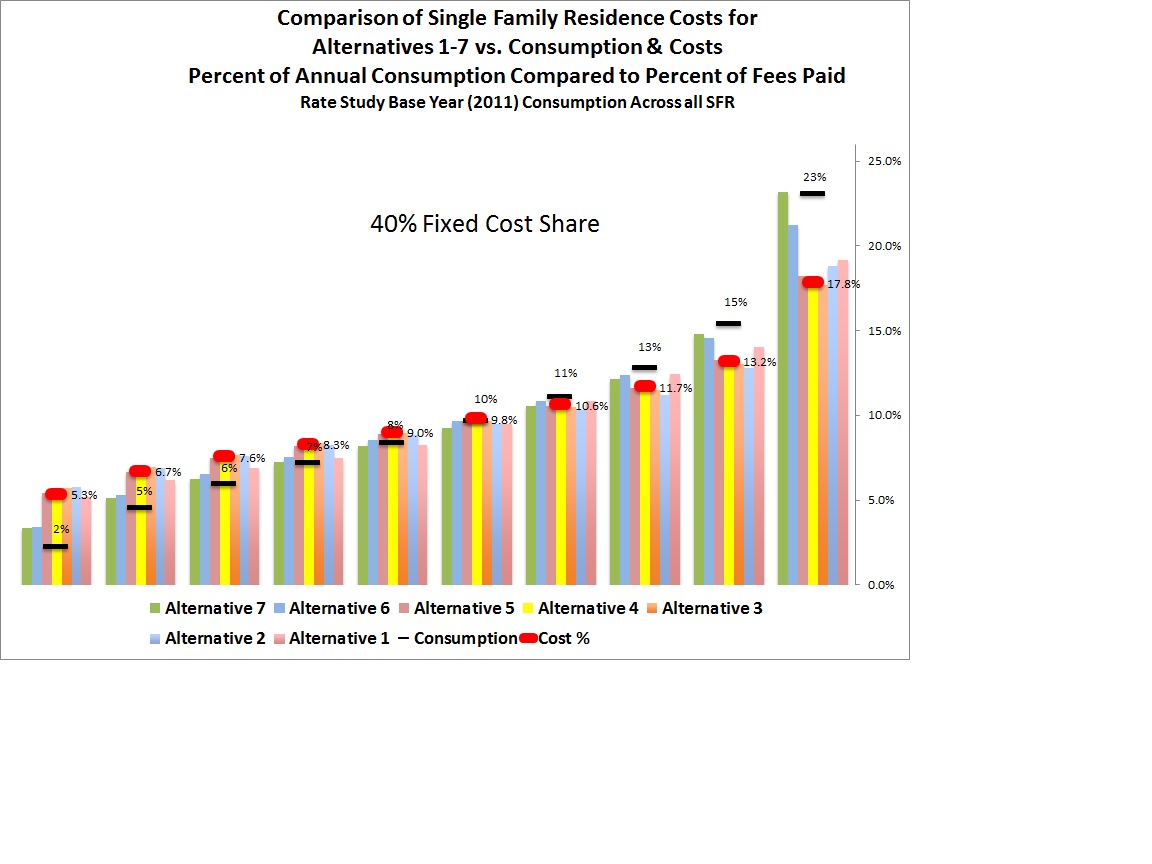
Below are two charts I prepared during the URAC meeting (and shared) that compare bill shares across usage deciles for SFR customers. The first chart shows allocations with 40% fixed costs, the second with 13% fixed costs. Note that the consumption shares are steeper than the cost shares due to the fixed costs. At 0% fixed costs, cost and consumption allocations would be identical. It’s important to note that consideration of fairness must not be a simplistic analysis of average water consumption, but also must consider the other investments and costs incurred to deliver that water.

CostAllocation-40P Cost allocation by Decile with 13% Fixed Costs

One final note: the City may not have been in this position if it had more clearly communicated the CBFR rate structure to the community. Measure P passed by only 2%–a swing of 144 votes would have defeated it. I think that most people will understand that water costs are higher in the summer; the City just says, “we live in California where it doesn’t rain during the summer and everyone starts watering their lawn.” The CBFR component could have been more clearly labeled as the “Summer Demand Charge.” Most people would have made the connection and there would have been much less outcry over “complexity.”

The Elusive Potential of California’s Water Supply

NRDC and the Pacific Institute just released a report purporting to show the potential for large water savings in California in the face of our severe drought. While laying out the technical potential in a static setting is a useful exercise, this report can be misleading about the true potential for water savings without significant institutional and political change. The report doesn’t account for how farmers actually respond to improved irrigation efficiencies, and how residential customers resist changing their landscapes and using recycled water.

Starting with farmers, we found in a study on the benefits of aggregating PG&E’s agricultural accounts that growers were using subsurface drip systems increase tomato yields by as much as 50%. In Fresno County, processed tomato yields have risen 26% in 5 years as flood irrigation has been replaced by drip. In addition, the amount of runoff has been reduced, so on net the new efficient irrigation technologies have lead to increased productivity with no reduction in water use.

Residential customers are resistant to the idea that they should give up their lush landscaping. As I posted previously, even in environmentally-friendly Davis, voters rejected a new rate structure that would have encouraged summer water conservation. And they are just as thrilled with using recycled water. A 2004 SDCWA survey found that 63% of residents didn’t want recycled water introduced into their drinking water. All of this adds up to political resistance to change that water professionals see as a “no-brainer.”

Another question is what happens to the downstream and groundwater basin users who now depend on runoff for their water supplies? Particularly in agriculture, water is often reused several times as it drains or percolates to the next user. Calculating the true potential savings requires a full water-budget analysis of a basin, not just adding up all of the individual savings without considering the synergism among them.

And finally, what happens to the ability to respond to variations in water conditions? Urban water agencies are already concerned about “demand hardening.” Farmers have moved to higher yield, more profitable orchard crops, but as a result they can’t easily accommodate large swings in water availability. Managing our water supply isn’t just about reducing the average consumption–it’s about creating a less vulnerable system.

Setting Davis water rates in the most fair manner

The City of Davis adopted an innovative rate structure in 2012 to fund a new surface water supply project. The new framework, called “consumption-based fixed rate” or CBFR, originally was structured to provide a stable revenue source for recovering debt costs while allowing customers to reduce their bills when conserving. Instead of having a fixed, constant readiness to serve or demand charge, the summer demand charge would be recomputed each year by dividing the fixed debt service (about $10M per year) by the total summer usage of all customers. When a customer reduced their share of overall summer usage, their bill would go down. However, the total revenue would remain stable year to year because the summer demand charge would be recomputed to ensure meeting the overall revenue target. The CBFR mutated to a more standard fixed demand charge for various political and legal reasons and it lost some of its revenue stability features.

The City has faced several challenges to the water project and the rates. All had lost up until June 3 when Measure P passed by a small margin and rolled rates back to 2011. The Utility Rates Advisory Committee (URAC), of which I am a member, is redesigning rates on an accelerated schedule to ensure viability of the water project. The Measure P proponents missed several key facts in their arguments, so the URAC will need to ignore some of those errors. However, the most important factor in the defeat of the proposed water rates was in the lack of simple communication and understanding by the public. “CBFR” just doesn’t cut it as a simple saleable concept.

I believe that Davis needs to move toward a more efficient water pricing scheme that signals consumers when they should be using water given costs and environmental impacts. The first fairness criterion is that people should pay prices that best reflect the cost to serve them so there are no unjustified subsidies flowing among customers.  The second fairness criterion is that those with less means can receive a subsidy from those with more if the subsidy can be structured to minimize misallocations of resources.

What doesn’t meet a fairness criterion is having everyone pay a single average annual price that doesn’t reflect how the cost of water varies over the year.  Someone who uses the same amount of water year round should not pay the same average annual rate as someone who uses much more water during the summer, even if they use the same total amount for the year. There are several reasons for this.

The most important centerpiece of the Woodland-Davis water project is the 10,000 acre-foot a year (or 3.25 billion gallons) water right acquired from Conaway Ranch. Based on terms of that agreement and depending on the period used to recover the investment, this water supply costs at least $0.50 per CCF.  But the most important fact is that this cost is only for water delivered in the summer. The purchased water right only runs from April 1 to October 31. Water used in the winter is free. That means that customers using water in the summer should pay at least $0.50 per CCF more just to cover the ongoing costs of the water supply.

Further we need to consider how to allocate the costs of delivering that water to Davis. The reason why Sacramento River water is expensive in the summer and free in the winter is that water is scare and in high demand during the summer. How best to allocate costs when most of the demand happens over a short period can be best illustrated by looking at parking in downtown San Francisco. Parking structures are built with capacity to meet demand during work hours on weekdays. Work hour parking can cost upwards of $30 per day, but on a weekend night when the area is empty, parking typically costs $5. These rates are set by private operators who are recovering their investments as efficiently as they can.

For the same reason, Davis must recover most of its investment in the water conveyance facilities from summer users—the plant capacity was built to meet their demand.  A plant built to an annual average capacity won’t be sufficient in August. The current rate structure properly recovers those costs from those individuals who create the need for such a large investment.

Fortunately, the second fairness criterion of reducing costs for those of lesser means can be met through higher summer pricing because they tend to live in multi-family dwellings or have lower irrigation needs.

Summer water bills could increase dramatically, but a solution is to create an Easy Pay plan where a large portion of the summer water bills are spread over a 12-month period. PG&E offers its Balanced Pay Plan to achieve the same ends. Customers should be placed in this bill payment plan on an opt-out basis, as that opt-in options are usually undersubscribed even when the opt-in benefits are large.