Portugal just ran its entire grid for 107 straight hours on 100% renewables. That’s four and a half days. The country now gets about 48% of its energy from green power.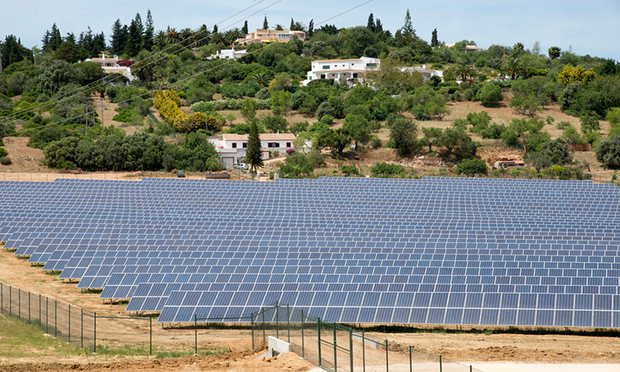
Portugal shows 100% renewables is feasible
1 Reply

Portugal just ran its entire grid for 107 straight hours on 100% renewables. That’s four and a half days. The country now gets about 48% of its energy from green power.
Severin Borenstein at the Energy Institute @ Haas wrote a good summary of the issues around community choice aggregation.
Source: Is “Community Choice” Electric Supply a Solution or a Problem?
I am on the City of Davis’ Community Choice Energy Advisory Committee and have been looking at these issues closely for a year. I had my own reactions to this post:
First, in California the existing and proposed CCEs (there are probably a dozen in process at the moment to add to the 3 existing ones) universally offer a higher “green” % product than the incumbent IOU, most often a 50% RPS product. And although MCE and SCP started out relying on RECs of various types to start out, they all are phasing out most of those by 2017. I think most will offer a 100% product as well.
The reason that these CCE’s are able to offer lower rates than the IOUs at a lower RPS is that the IOUs prematurely contracted long for renewables in anticipation of the 2020 goal. In fact, the penalty for failing to meet the RPS in any given year is so low, that the prudent strategy by an IOU would have been to risk being short in each year and contract for the year ahead instead of locking in too many 20+ year PPAs. At least one reason why this happened is that the IOUs require confidentiality by any reviewers and no connections to any competing procurement decisions. As a result the outside reviewers couldn’t be up to speed on the rapidly falling PPA prices. The CPUC has made a huge mistake on this point (and the CEC has rightfully harassed the CPUC over this policy.)
CCE’s also offer the ability to craft a broader range of rate offerings to customers–even flat 20 year rates that can compete with solar roofs on the main issue that customers really care about: price guarantees. In addition, CCE’s are more likely to be to nimbly adjust a rapidly changing utility landscape. CCE’s are much less likely to care about falling loads because their earnings aren’t dependent on continued service.
It’s also to recognize the difference between local government general services (e.g., safety and public protection, social services, regulation, etc.) and enterprise services (e.g., utilities of all sorts). In general, the latter are as efficient as IOUs (except LADWP which illustrates the INefficiency created by overlarge organizations). So one can’t make a broad generalization about local government problems and how they might apply in this situation. The fact is that almost all of the existing and new CCEs are or will be JPAs, which are often even leaner. (Lancaster is the exception.)
Finally, Severin made this statement:
“Whatever regulatory mandates, managerial mistakes, or incompetence occurred in the past, customers switching to a CCA should not be allowed to shift their share of costs from past decisions onto other ratepayers.”
I have to disagree to a certain exent with this statement. Am I forced to pay for the past incompetencies of GM or GE or any other corporation? Yes, utilities have a higher assurance of return on their investments, but no where is it written that it is “ironclad.” Those utilities had an assurance first as the sole legal provider and then as the provider of last resort, but that’s eroding. In California, the CTC was a political deal to get the IOUs out of the way. The fact is in California that the CPUC abrogated its responsibility to oversee these decisions on behalf of ratepayers with the encouragement of the IOUs. If the IOUs want to retain their customers, then they should be forced to compete with the CCEs (and DA LSEs.) It’s time to reopen this matter.
And to add a bit more:
The logic of this statement is that ANY customer who leaves the system, including moving to another area, state or nation, should have to continue to pay these stranded costs. Why should we draw the line arbitrarily at whether they happen to still get distribution services even though the generation services have been completely severed? Particularly if someone moves from say, San Francisco to Palo Alto, that customer still relies on PG&E’s transmission system and its hydro system for ancillary services. Why not charge that Palo Alto customer a non-by-passable charge? And why shouldn’t it be reciprocal? Relying on “political practicality” is not an answer. Either ALL customers are tethered forever, or no customers are required to meet this obligation.
Lawrence Berkeley Lab released a report estimating the economic benefits from the renewable portfolio standards (RPS) around the U.S. Two surprising findings were:
Both of these claims require a deeper review because they run contrary to previous analyses.
Based on PG&E’s Power Charge Indifference Adjustment (PCIA), the renewables contracts that it holds are increasing its rates by almost 2 cents per kilowatt-hour. It is only recently that renewable contract prices have started approaching conventional resource costs, so it’s hard to understand how an RPS could have already reduced electricity rates. (I do see that this will eventually be the case.)
Typically the emission reduction benefits from GHG reductions are several multiples of those from criteria air pollutants (e.g., NOx and volatile organic compounds (VOC or ROG) that produce ozone; particulate matter (PM 2.5)). For example, ClimateCost has issued studies estimating reduced energy impacts and health benefits compared to air quality benefits that show much larger GHG benefits.
Just hooking up EV owners and not compensating them for the storage services they can provide won’t be a successful or popular idea. Rather the first step is to figure out what is the value of that storage? A new NREL study estimates that value to be about $59 per kW-year with a 33% RPS portfolio in California, increasing to $109/kW-year at a 40% RPS. For a typical EV, that could translate into $300 to $550 per year or $2,000 to $5,000 over 10 years.
Then you assess what are the incremental costs to the EV owner in reduced battery life. Note that batteries depleted 30% can’t be used for EVs any more but are still valuable for grid storage. Vendors probably can build in-home racks that store and connect the depleted batteries. Those become factors in determining the payments to the EV owners and their agents.
As for enrolling EV owners in a storage management program, it need not be cumbersome if enrollment is the default (opt-out) when buying a car or installing a charging station. (See all of the literature on the importance of opt-out vs. opt-in and status quo bias.) The auto dealer or charging administrator becomes the agent. An EV buyer might sign up for the program and not even know it. The charging process could work much like the massive distributed computing projects that harness small parts of the idle processors across millions of personal computers. All of this becomes part of the peer-to-peer transactive energy (TE) grid.
PG&E has been running a series of “advertorials” on clean energy in the Sacramento Bee and other papers. Today’s on the need for electricity storage caught my eye. I’m not sure that we need new storage in California, at least not large-scale, in the immediate future.
The PG&E article describes an event in February 2014 when California generated more energy, much of it from solar and wind, than consumers were using. PG&E raises this as a concern that should be addressed so as not to lose that energy. But PG&E’s premise ignores one critical point–California is not isolated–it’s connected to many other states.
California is the largest electricity consumer in the Western Interconnection (with 10 other states and parts of Canada and Mexico). However the state only represents 30% of Western load. All of those states have weaker directives on renewables and greenhouse gas emissions, and most have much larger portions coming from high-emitting coal-fired plants.
When California overgenerates from renewables, it exports that power to those other states. This leads to a reduction in natural gas and coal use. When California needs power, it imports power as it has been doing for decades. In other words, the rest of the Western Interconnect is already acting like a storage device. The Southwest utilities have long exported excess coal-fired power overnight to California at low prices. Now California can turn the tables. PG&E may not be getting renewable portfolio standard (RPS) or greenhouse gas reduction credits for those exports, but they reduce GHG emissions in other states.
This situation is similar to the recent rise in petroleum production in the U.S. The country now exports refined products thanks to advances in extraction technologies. Congress is considering whether to allow the export of crude oil. For both California and the U.S., the concept of exporting energy has been inconceivable up to now. Time to rethink our paradigms?
Stephen Cohen posted on the Energy Collective about whether a carbon tax is political feasible in the current environment. He argues that Republicans are likely to block any such attempt, and instead proponents should focus on efforts to reduce the costs of renewables and non-fossil alternatives. He’s particularly interested in the problem of making the purchase of renewable energy in all forms accessible to lower income groups. He proposes that R&D efforts be increased to achieve that goal.
I see two problems with this approach. First is that it’s not clear the achieving increased R&D investment is any more feasible given likely GOP resistance. Even if the solar R&D investment program was successful on net, the prominence of the Solyndra failure stands in the way.
The second is that failing to internalize the social cost of carbon emissions can lead to future distortions. The biggest problem is not so much the subsidies themselves, which may be justified on a short run basis to spark a market, but rather the difficulty of ending them when they are no longer needed. In one example, California’s Central Valley Project provided subsidized water to farmers with contracts with 40 year terms. The original subsidies were supposed to expire at the point, but the 1992 Central Valley Project Improvement Act provided for renewal of those contracts on similar terms, which was actually expected by farmers for many years prior. Those subsidies were capitalized into land prices and eventually captured by the landowners resulting in a large wealth transfer from tax payers. While the “average” price of water now likely reflects the opportunity cost of water, the marginal price of that water is still below the actual true cost, and farmers still don’t have as strong of an efficiency signal as they should. (In contrast, State Water Project and groundwater pumping costs have little or no real subsidies.) This illustrates how a subsidy has long outlived it’s usefulness and the extreme difficultly in ending them when a political constituency is created.
As a counter point, Martin Weitzman proposes that a carbon tax be created essentially through the backdoor of tariff negotiations. Weitzman points out the difficulty of negotiating quantity targets through such instruments such as the Kyoto Protocol. In contrast, successful tariff negotiations are the norm in the World Trade Organization. The President conducts those negotiations with relatively more independence, even as the current controversy over the Trans-Pacific Partnership has highlighted the exceptions to the rule. That implies that a carbon tariff probably can make it deeper into the federal legislative process than a straight up carbon tax, and the probability of a successful outcome increases significantly.
The renewable energy market has been in upheaval since the collapse of the financing sector in 2008. The withdrawal of easy money and uncertainty over federal tax policy has increased perceived risk. Large firms have been shedding renewables subsidiaries and promising newcomers have dropped high-profile projects. Waste Management just sold Wheelabrator, exiting the waste-to-energy market. Brightsource suspended its Hidden HIlls solar thermal project. Much of this activity is driven by the perception that wholesale electricity market prices are falling and the underlying fundamentals will lead to further declines.
This perception is misplaced, however. Short run electricity market prices are falling as natural gas becomes cheaper, and more importantly, fossil fuel generation is squeezed out by increasing renewables and falling demand. However, the electricity marketplace hasn’t yet adjusted to the fact that natural gas generation is no longer the only marginal generation resource. In California, the renewables portfolio standard (RPS) makes at least 33% of the marginal generation from renewable resources. When capital costs are correctly figured in, and more long-term contracts are offered to match those deferred resources, power purchase agreement (PPA) prices for the right types of resources should increase, not decrease.
The problem is that the industry hasn’t been able to adjust its procurement model to reflect this new reality. I think this is coming from a combination of utilities continuing to maintain their monopsony (single buyer) position, risk averse regulatory agencies still relying on an obsolete procurement regulatory process, and those agencies enforcing the monopsony power of the utilities in the name of protecting ratepayers. This may not change until there is public acknowledgement that this situation exists. The difficulty is finding the right stakeholders with enough sway to raise the issue.
All Things Solar and Electric
Musings from M.Cubed on the environment, energy and water
This blog is not necessarily about biking. It's about life that is lived locally, at a human pace.
Energy, Environment and Policy
Musings from M.Cubed on the environment, energy and water
Examining State Authority in Interstate Electricity Markets
Musings from M.Cubed on the environment, energy and water
Musings from M.Cubed on the environment, energy and water
Economic insight and analysis from The Wall Street Journal.
Musings from M.Cubed on the environment, energy and water
Musings from M.Cubed on the environment, energy and water
A few thoughts from John Fleck, a writer of journalism and other things, living in New Mexico
Musings from M.Cubed on the environment, energy and water
Musings from M.Cubed on the environment, energy and water
Musings from M.Cubed on the environment, energy and water
Tips and tricks on programming, evolutionary algorithms, and doing research
Musings from M.Cubed on the environment, energy and water
A blog about water resources and law
Musings from M.Cubed on the environment, energy and water
 Economics Outside the Cube