Monthly Archives: November 2021

Why are we punishing customers for doing the right thing?

The saying goes “No good deed goes unpunished.” The California Public Utilities Commission seems to have taken that motto to heart recently, and stands ready to penalize yet another group of customers who answered the clarion call to help solve the state’s problems by radically altering the rules for solar rooftops. Here’s three case studies of recent CPUC actions that undermine incentives for customers to act in the future in response to state initiatives: (1) farmers who invested in response to price incentives, (2) communities that pursued renewables more assertively, and (3) customers who installed solar panels.

Agriculture: Farmers have responded to past time of use (TOU) rate incentives more consistently and enthusiastically than any other customer class. Instead of being rewarded for their consistency, their peak price periods shifted from the afternoon to the early evening. Growers face much more difficulty in avoiding pumping during that latter period.

Since TOU rates were introduced to agricultural customers in the late 1970s, growers have made significant operational changes in response to TOU differentials between peak and off-peak energy prices to minimize their on-peak consumption. These include significant investments in irrigation equipment, storage and conveyance infrastructure and labor deployment rescheduling. The results of these expenditures are illustrated in the figure below, which shows how agricultural loads compare with system-wide load on a peak summer weekday in 2015, contrasting hourly loads to the load at the coincident peak hour. Both the smaller and larger agricultural accounts perform better than a range of representative rate schedules. Most notably agriculture’s aggregate load shape on a summer weekday is inverted relative to system peak, i.e., the highest agricultural loads occur during the lowest system load periods, in contrast with other rate classes.
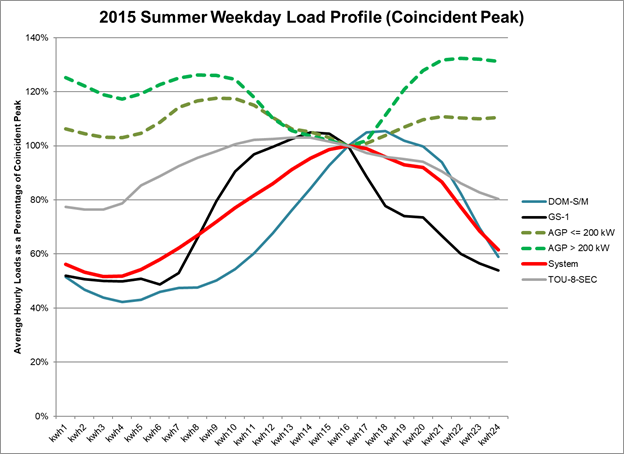
All other rate schedules shown in the graphic hit their annual peak on the same peak day within the then-applicable peak hours of noon to 6 p.m. In contrast, agriculture electricity demand is less than 80% of its annual peak during those high-load hours, with its daily peak falling outside the peak period. Agriculture’s avoidance of peak hours occurred during the summer agricultural growing season, which coincided with peak system demand—just as the Commission asked customers to do. The Commission could not ask for a better aggregate response to system needs; in contrast to the profiles for all of the other customer groups, agriculture has significantly contributed to shifting the peak to a lower cost evening period.

The significant changes in the peak period price timing and differential that the CPUC adopted increases uncertainty over whether large investments in high water-use efficiency microdrip systems – which typically cost $2,000 per acre–will be financially viable. Microdrip systems have been adopted widely by growers over the last several years—one recent study of tomato irrigation rates in Fresno County could not find any significant quantity of other types of irrigation systems. Such systems can be subject to blockages and leaks that are only detectable at start up in daylight. Growers were able to start overnight irrigation at 6 p.m. under the legacy TOU periods and avoid peak energy use. In addition, workers are able to end their day shortly after 6 p.m. and avoid nighttime accidents. Shifting that load out of the peak period will be much more difficult to do with the peak period ending after sunset.

Contrary to strong Commission direction to incent customers to avoid peak power usage, the shift in TOU periods has served to penalize, and reverse, the great strides the agricultural class has made benefiting the utility system over the last four decades.

Community choice aggregators: CCAs were created, among other reasons, to develop more renewable or “green” power. The state achieved its 2020 target of 33% in large part because of the efforts of CCAs fostered through offerings of 50% and 100% green power to retail customers. CCAs also have offered a range of innovative programs that go beyond the offerings of PG&E, SCE and SDG&E.

Nevertheless, the difficulty of reaching clean energy goals is created by the current structure of the PCIA. The PCIA varies inversely with the market prices in the market–as market prices rise, the PCIA charged to CCAs and direct access (DA) customers decreases. For these customers, their overall retail rate is largely hedged against variation and risk through this inverse relationship.

The portfolios of the incumbent utilities are dominated by long-term contracts with renewables and capital-intensive utility-owned generation. For example, PG&E is paying a risk premium of nearly 2 cents per kilowatt-hour for its investment in these resources. These portfolios are largely impervious to market price swings now, but at a significant cost. The PCIA passes along this hedge through the PCIA to CCAs and DA customers which discourages those latter customers from making their own long term investments. (I wrote earlier about how this mechanism discouraged investment in new capacity for reliability purposes to provide resource adequacy.)

The legacy utilities are not in a position to acquire new renewables–they are forecasting falling loads and decreasing customers as CCAs grow. So the state cannot look to those utilities to meet California’s ambitious goals–it must incentivize CCAs with that task. The CCAs are already game, with many of them offering much more aggressive “green power” options to their customers than PG&E, SCE or SDG&E.

But CCAs place themselves at greater financial risk under the current rules if they sign more long-term contracts. If market prices fall, they must bear the risk of overpaying for both the legacy utility’s portfolio and their own.

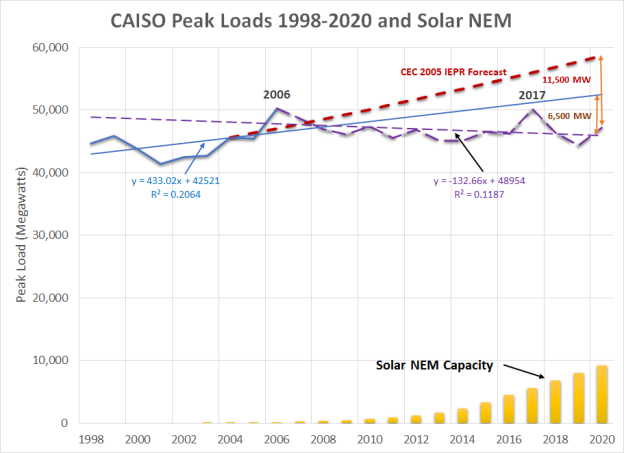
Solar net energy metered customers: Distributed solar generation installed under California’s net energy metering (NEM/NEMA) programs has mitigated and even eliminated load and demand growth in areas with established customers. This benefit supports protecting the investments that have been made by existing NEM/NEMA customers. Similarly, NEM/NEMA customers can displace investment in distribution assets. That distribution planners are not considering this impact appropriately is not an excuse for failing to value this benefit. For example, PG&E’s sales fell by 5% from 2010 to 2018 and other utilities had similar declines. Peak loads in the CAISO balancing authority reach their highest point in 2006 and the peak in August 2020 was 6% below that level.
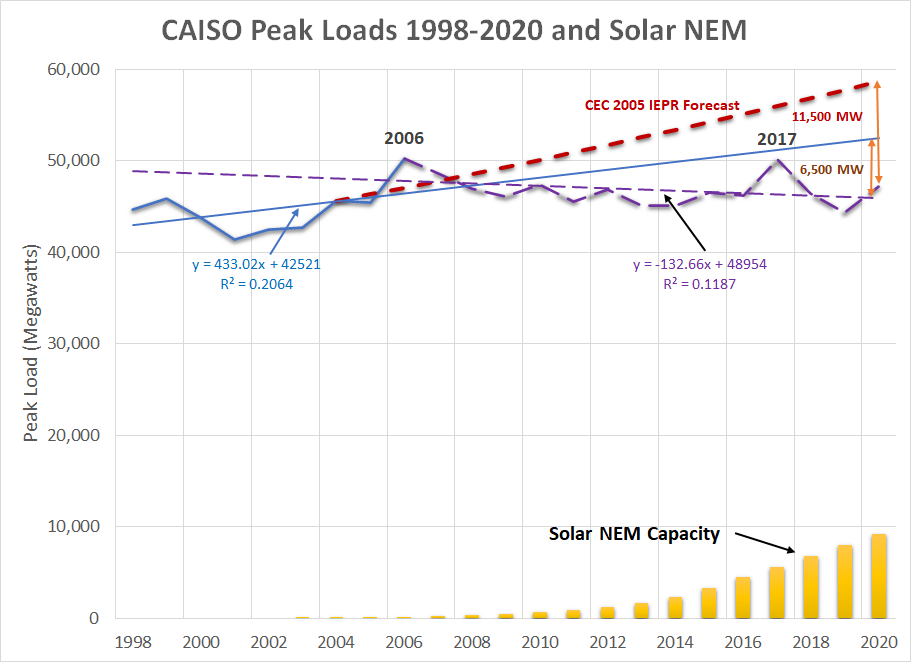
Much of that decrease appears to have been driven by the installation of rooftop solar. The figure above illustrates the trends in CAISO peak loads in the set of top lines and the relationship to added NEM/NEMA installations in the lower corner. It also shows the CEC’s forecast from its 2005 Integrated Energy Policy Report as the top line. Prior to 2006, the CAISO peak was growing at annual rate of 0.97%; after 2006, peak loads have declined at a 0.28% trend. Over the same period, solar NEM capacity grew by over 9,200 megawatts. The correlation factor or “R-squared” between the decline in peak load after 2006 and the incremental NEM additions is 0.93, with 1.0 being perfect correlation. Based on these calculations, NEM capacity has deferred 6,500 megawatts of capacity additions over this period. Comparing the “extreme” 2020 peak to the average conditions load forecast from 2005, the load reduction is over 11,500 megawatts. The obvious conclusion is that these investments by NEM customers have saved all ratepayers both reliability and energy costs while delivering zero-carbon energy.

The CPUC now has before it a rulemaking in which the utilities and some ratepayer advocates are proposing to not only radically reduce the compensation to new NEM/NEMA customers but also to change the terms of the agreements for existing ones.

One of the key principles of providing financial stability is setting prices and rates for long-lived assets such as solar panels and generation plants at the economic value when the investment decision was made to reflect the full value of the assets that would have been acquired otherwise.  If that new resource had not been built, either a ratebased generation asset would have been constructed by the utility at a cost that would have been recovered over a standard 30-year period or more likely, additional PPAs would have been signed. Additionally, the utilities’ investments and procurement costs are not subject to retroactive ratemaking under the rule prohibiting such ratemaking and Public Utilities Code Section 728, thus protecting shareholders from any risk of future changes in state or Commission policies.

Utility customers who similarly invest in generation should be afforded at least the same assurances as the utilities with respect to protection from future Commission decisions that may diminish the value of those investments. Moreover, customers do not have the additional assurances of achieving a certain net income so they already face higher risks than utility shareholders for their investments.

Generators are almost universally afforded the ability to recover capital investments based on prices set for multiple years, and often the economic life of their assets. Utilities are able to put investments in ratebase to be recovered at a fixed rate of return plus depreciation over several decades. Third-party generators are able to sign fixed price contracts for 10, 20, and even 40 years. Some merchant generators may choose to sell only into the short-term “hourly” market, but those plants are not committed to selling whenever the CAISO demands so. Generators are only required to do so when they sign a PPA with an assured payment toward investment recovery.

Ratepayers who make investments that benefit all ratepayers over the long term should be offered tariffs that provide a reasonable assurance of recovery of those investments, similar to the PPAs offered to generators. Ratepayers should be able to gain the same assurances as generators who sign long-term PPAs, or even utilities that ratebase their generation assets, that they will not be forced to bear all of the risk of investing of clean self-generation. These ratepayers should have some assurance over the 20-plus year expected life of their generation investment.

What to do about Diablo Canyon?

The debate over whether to close Diablo Canyon has resurfaced. The California Public Utilities Commission, which support from the Legislature, decided in 2018 to close Diablo by 2025 rather than proceed to relicensing. PG&E applied in 2016 to retire the plant rather than relicense due to the high costs that would make the energy uneconomic. (I advised the Joint CCAs in this proceeding.)

Now a new study from MIT and Stanford finds potential savings and emission reductions from continuing operation. (MIT in particular has been an advocate for greater use of nuclear power.) Others have written opinion articles on either side of the issue. I wrote the article below in the Davis Enterprise addressing this issue. (It was limited to 900 words so I couldn’t cover everything.)

IT’S OK TO CLOSE DIABLO CANYON NUCLEAR PLANT
A previous column (by John Mott-Smith) asked whether shutting down the Diablo Canyon nuclear plant is risky business if we don’t know what will replace the electricity it produces. John’s friend Richard McCann offered to answer his question. This is a guest column, written by Richard, a universally respected expert on energy, water and environmental economics.

John Mott-Smith asked several questions about the future of nuclear power and the upcoming closure of PG&E’s Diablo Canyon Power Plant in 2025. His main question is how are we going to produce enough reliable power for our economy’s shift to electricity for cars and heating. The answers are apparent, but they have been hidden for a variety of reasons.
I’ve worked on electricity and transportation issues for more than three decades. I began my career evaluating whether to close Sacramento Municipal Utility District’s Rancho Seco Nuclear Generating Station and recently assessed the cost to relicense and continue operations of Diablo after 2025.
Looking first at Diablo Canyon, the question turns almost entirely on economics and cost. When the San Onofre Nuclear Generating Station closed suddenly in 2012, greenhouse gas emissions rose statewide the next year, but then continued a steady downward trend. We will again have time to replace Diablo with renewables.
Some groups focus on the risk of radiation contamination, but that was not a consideration for Diablo’s closure. Instead, it was the cost of compliance with water quality regulations. The power plant currently uses ocean water for cooling. State regulations required changing to a less impactful method that would have cost several billion dollars to install and would have increased operating costs. PG&E’s application to retire the plant showed the costs going forward would be at least 10 to 12 cents per kilowatt-hour.
In contrast, solar and wind power can be purchased for 2 to 10 cents per kilowatt-hour depending on configuration and power transmission. Even if new power transmission costs 4 cents per kilowatt-hour and energy storage adds another 3 cents, solar and wind units cost about 3 cents, which totals at the low end of the cost for Diablo Canyon.
What’s even more exciting is the potential for “distributed” energy resources, where generation and power management occurs locally, even right on the customers’ premises rather than centrally at a power plant. Rooftop solar panels are just one example—we may be able to store renewable power practically for free in our cars and trucks.
Automobiles are parked 95% of the time, which means that an electric vehicle (EV) could store solar power at home or work during the day and for use at night. When we get to a vehicle fleet that is 100% EVs, we will have more than 30 times the power capacity that we need today. This means that any individual car likely will only have to use 10% of its battery capacity to power a house, leaving plenty for driving the next day.
With these opportunities, rooftop and community power projects cost 6 to 10 cents per kilowatt-hour compared with Diablo’s future costs of 10 to 12 cents.
Distributed resources add an important local protection as well. These resources can improve reliability and resilience in the face of increasing hazards created by climate change. Disruptions in the distribution wires are the cause of more than 95% of customer outages. With local generation, storage, and demand management, many of those outages can be avoided, and electricity generated in our own neighborhoods can power our houses during extreme events. The ad that ran during the Olympics for Ford’s F-150 Lightning pick-up illustrates this potential.
Opposition to this new paradigm comes mainly from those with strong economic interests in maintaining the status quo reliance on large centrally located generation. Those interests are the existing utilities, owners, and builders of those large plants plus the utility labor unions. Unfortunately, their policy choices to-date have led to extremely high rates and necessitate even higher rates in the future. PG&E is proposing to increase its rates by another third by 2024 and plans more down the line. PG&E’s past mistakes, including Diablo Canyon, are shown in the “PCIA” exit fee that [CCA] customers pay—it is currently 20% of the rate. Yolo County created VCEA to think and manage differently than PG&E.
There may be room for nuclear generation in the future, but the industry has a poor record. While the cost per kilowatt-hour has gone down for almost all technologies, even fossil-fueled combustion turbines, that is not true for nuclear energy. Several large engineering firms have gone bankrupt due to cost overruns. The global average cost has risen to over 10 cents per kilowatt-hour. Small modular reactors (SMR) may solve this problem, but we have been promised these are just around the corner for two decades now. No SMR is in operation yet.
Another problem is management of radioactive waste disposal and storage over the course of decades, or even millennia. Further, reactors fail on a periodic basis and the cleanup costs are enormous. The Fukuyama accident cost Japan $300 to $750 billion. No other energy technology presents such a degree of catastrophic failure. This liability needs to be addressed head on and not ignored or dismissed if the technology is to be pursued.

Considerations for designing groundwater markets

The California Water Commission staff asked a group of informed stakeholders and experts about “how to shape well-managed groundwater trading programs with appropriate safeguards for communities, ecosystems, and farms.” I submitted the following essay in response to a set of questions.

In general, setting up functioning and fair markets is a more complex process than many proponents envision. Due to the special characteristics of water that make location particularly important, water markets are likely to be even more complex, and this will require more thinking to address in a way that doesn’t stifle the power of markets.

Anticipation of Performance

  1. Market power is a concern in many markets. What opportunities or problems could market power create for overall market performance or for safeguarding? How is it likely to manifest in groundwater trading programs in California?

I was an expert witness on behalf of the California Parties in the FERC Energy Crisis proceeding in 2003 after the collapse of California’s electricity market in 2000-2001. That initial market arrangement failed for several reasons that included both exploitations of traits of internal market functions and limitations on outside transactions that enhanced market power. An important requirement that can mitigate market power is the ability to sign long-term agreements that then reduces the amount of resources that are open to market manipulation. Clear definitions of resource accounting used in transactions is a second important element. And lowering transaction costs and increasing liquidity are a third element. Note that confidentiality has not prevented market gaming in electricity markets.

Groundwater provides a fairly frequent opportunity for exploitation of market power with recurrence of dry and drought conditions. The analogy for electricity is during peak load conditions. Prices in the Texas ERCOT market went up 30,000 fold last February during such a shortage. Droughts in California happen more frequently than freezes in Texas.

The other dimension is that often a GSA has a concentration of a small number of property owners. This small concentration eases the ability to manipulate prices even if buyers and sellers are anonymous. This situation is what led to the crisis in the CAISO market. (I was able beforehand to calculate the minimum generation capacity ownership required to profitably manipulate prices, and it was an amount held by many of the merchant generators in the market.) Those larger owners are also the ones most likely to have the resources to participate in certain types of market designs due to higher transaction costs that act as barriers.

2. Given a configuration of market rules, how well can impacts to communities, the environment, and small farmers be predicted?

The impacts can be fairly well assessed with sufficient modeling with inclusion of three important pieces of information. The first is a completely structured market design that can be tested and modeled. The second is a relatively accurate assessment of the costs of individuals entities to participate in such a market. And the third is modelling the variation in groundwater depth to assess the likelihood of those swings exceeding current well depths for these groups.

Safeguards

3. What rules are needed to safeguard these water users? If not through market mechanisms directly, how could or should these users be protected?

These groups should not participate in shorter term groundwater trading markets such as for annual allocations unless they proactively elect to do so. They are unlikely to have the resources to participate in an usefully informed way. Instead, the GSAs should carve allocations out of the sustainable yields that are then distributed in any number of methods that include bidding for long run allocations as well as direct allowances.

For tenant farmers, restrictions on landlords’ participation in short-term markets should be implemented. This can be specified either through quantity limits, long term contracting requirements or time windows for guaranteed supplies to tenants that match with lease terms.

4. What other kinds of oversight, monitoring, and evaluation of markets are needed to safeguard? Who should perform these functions?

These markets will likely require oversight to prevent market manipulation. Instituting market monitors akin to those who now oversee the CAISO electricity and the CARB GHG Allowance auctions is potential approach. The state would most likely be the appropriate institution to provide this service. The functions for those monitors are well delineated by those other agencies. The single most important requirement for this function is a clear authority and willingness to enforce meaningful actions as a consequence of violations.

5. Groundwater trading programs could impact markets for agricultural commodities, land, labor, or more. To what degree could the safeguards offered by groundwater trading programs be undermined through the programs’ interactions with other markets? How should other markets be considered?

These interactions among different markets are called pecuniary externalities, and economists consider these as intended consequences of using market mechanisms to change behavior and investments across markets. For example, establishing prices for groundwater most likely will change both cropping decisions and irrigation practices, which in turn will impact both equipment and service dealers and labor. Safeguards must be established in ways that do not directly affect these impacts—to do otherwise defeats the very purpose of setting up markets in the first place. People will be required to change from their current practices and choices as a result of instituting these markets.

Mitigation of adverse consequences should account for catastrophic social outcomes to individuals and businesses that are truly outside of their control. SGMA, and associated groundwater markets, are intended to create economic benefits for the larger community. A piece often missing from the social benefit-cost assessment that leads to the adoption of these programs is compensation to those who lose economically from the change. For example, conversion from a labor intensive crop to a less water intensive one could reduce farm labor demand. Those workers should be paid compensation from a public pool of beneficiaries.

6. Should safeguarding take common forms across all of the groundwater trading programs that may form in California? To the degree you think it would help, what level of detail should a common framework specify?

Localities generally do not have either the resources, expertise or sufficient incentives to manage these types of safeguards. Further the safeguards should be relatively uniform across the region to avoid creating inadvertent market manipulation opportunities among different groundwater markets. (That was one of the means of exploiting CAISO market in 2000-01.) The level of detail will depend on other factors that can be identified after potential market structures are developed and a deeper understanding is prepared.

7. Could transactions occurring outside of a basin or sub-basin’s groundwater trading program make it harder to safeguard? If so, what should be done to address this?

The most important consideration is the interconnection with surface water supplies and markets. Varying access to surface water will affect the relative ability to manipulate market supplies and prices. The emergence of the NASDAQ Veles water futures market presents another opportunity to game these markets.

Among the most notorious market manipulation techniques used by Enron during the Energy Crisis was one called “Ricochet” that involved sending a trade out of state and then returning down a different transmission line to create increased “congestion.” Natural gas market prices were also manipulated to impact electricity prices during the period. (Even the SCAQMD RECLAIM market may have been manipulated.) It is possible to imagine a similar series of trades among groundwater and surface water markets. It is not always possible to identify these types of opportunities and prepare mitigation until a full market design is prepared—they are particular to situations and general rules are not easily specified.

Performance Indicators and Adaptive Management

8. Some argue that market rules can be adjusted in response to evidence a market design did not safeguard. What should the rules for changing the rules be?

In general, changing the rules for short term markets, e.g., trading annual allocations, should be relatively easy. Investors should not be allowed to profit from market design flaws no matter how much they have spent. Changes must be carefully considered but they also should not be easily impeded by those who are exploiting those flaws, as was the case in fall of 2000 for California’s electricity market.