Monthly Archives: February 2022

Has rooftop solar cost California ratepayers more than the alternatives?

The Energy Institute’s blog has an important premise–that solar rooftop customers have imposed costs on other ratepayers with few benefits. This premise runs counter to the empirical evidence.

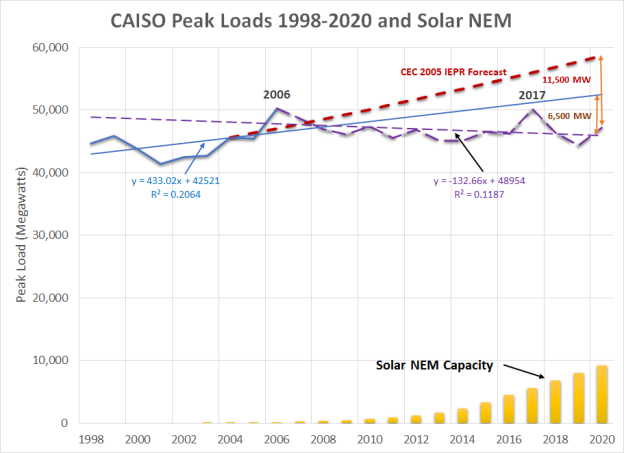
First, these customers have deferred an enormous amount of utility-scale generation. In 2005 the CEC forecasted the 2020 CAISO peak load would 58,662 MW. The highest peak after 2006 has been 50,116 MW (in 2017–3,000 MW higher than in August 2020). That’s a savings of 8,546 MW. (Note that residential installations are two-thirds of the distributed solar installations.) The correlation of added distributed solar capacity with that peak reduction is 0.938. Even in 2020, the incremental solar DER was 72% of the peak reduction trend. We can calculate the avoided peak capacity investment from 2006 to today using the CEC’s 2011 Cost of Generation model inputs. Combustion turbines cost $1,366/kW (based on a survey of the 20 installed plants–I managed that survey) and the annual fixed charge rate was 15.3% for a cost of $209/kW-year. The total annual savings is $1.8 billion. The total revenue requirements for the three IOUs plus implied generation costs for DA and CCA LSEs in 2021 was $37 billion. So the annual savings that have accrued to ALL customers is 4.9%. Given that NEM customers are about 4% of the customer base, if those customers paid nothing, everyone else’s bill would only go up by 4% or less than what rooftop solar has saved so far.

In addition, the California Independent System Operator (CAISO) calculated in 2018 that at least $2.6 billion in transmission projects had been deferred through installed distributed solar. Using the amount installed in 2017 of 6,785 MW, the avoided costs are $383/kW or $59/kW-year. This translates to an additional $400 million per year or about 1.1% of utility revenues.

The total savings to customers is over $2.2 billion or about 6% of revenue requirements.

Second, rooftop solar isn’t the most expensive power source. My rooftop system installed in 2017 costs 12.6 cents/kWh (financed separately from our mortgage). In comparison, PG&E’s RPS portfolio cost over 12 cents/kWh in 2019 according to the CPUC’s 2020 Padilla Report, plus there’s an increments transmission cost approaching 4 cents/kWh, so we’re looking at a total delivered cost of 16 cents/kwh for existing renewables. (Note that the system costs to integrate solar are largely the same whether they are utility scale or distributed).

Comparing to the average IOU RPS portfolio cost to that of rooftop solar is appropriate from the perspective of a customer. Utility customers see average, not marginal, costs and average cost pricing is widely prevalent in our economy. To achieve 100% renewable power a reasonable customer will look at average utility costs for the same type of power. We use the same principle by posting on energy efficient appliances the expect bill savings based on utility rates–-not on the marginal resource acquisition costs for the utilities.

And customers who would choose to respond to the marginal cost of new utility power instead will never really see those economic savings because the supposed savings created by that decision will be diffused across all customers. In other words, other customers will extract all of the positive rents created by that choice. We could allow for bypass pricing (which industrial customers get if they threaten to leave the service area) but currently we force other customers to bear the costs of this type of pricing, not shareholders as would occur in other industries. Individual customers are currently the decision making point of view for most energy use purposes and they base those on average cost pricing, so why should we have a single carve out for a special case that is quite similar to energy efficiency?

I wrote more about whether a fixed connection cost is appropriate for NEM customers and the complexity of calculating that charge earlier this week.

Are fixed charges the solution to the solar rooftop dilemma?

A recent post at the Energy Institute at Haas proposed that all residential ratepayers should pay the “solar tax” in the recently withdrawn proposed decision from the California Public Utilities Commission through a connection fee. I agree that charging residential a connection charge is a reasonable solution. (All commercial and agricultural customers in California already pay such a charge.) The more important question though is what that connection fee should be?

Much less of the distribution costs are “fixed” than many proponents understand–we can see an example of the ability to avoid large undergrounding costs by installing microgrids as an example. Southern California Edison has repeatedly asked for a largely fixed “grid charge” for the last dozen years and the intervening ratepayer groups have shown that SCE’s estimate is much too high. A service connection costs about $10-$15/month, not more than $50 per month. So what might be the other elements of a fixed monthly charge rather than collecting these revenues through a volumetric rate as is done today?

A strong economic argument can be made that if the utility is collecting a fixed charge for upstream T&D capacity, then a customer should be able to trade that capacity that they have paid for with other customers. In the face of transaction costs, that market would devolve down to the per kWh price managed by the utility acting as a dealer–just what we have today.

Other candidates abound. How to recover stranded costs really requires a conversation about how much of those costs shareholders should shoulder. Income distributional public purpose costs should be collected from taxes, not rates. Energy efficiency is a resource that should be charged in the generation component, not distribution, and should be treated like other generation resources in cost recovery. The problem is that decoupling which was used to encourage energy efficiency investment has become a backdoor way to recover stranded costs without any conversation about whether that is appropriate–rates go up as demand decreases with little reduction in revenue requirements. So what the connection charge should be becomes quite complex.

Understanding core facts before moving forward with NEM reform

There is a general understanding among the most informed participants and observers that California’ net energy metering (NEM) tariff as originally conceived was not intended to be a permanent fixture. The objective of the NEM rate was to get a nascent renewable energy industry off the ground and now California has more than 11,000 megawatts of distributed solar generation. Now that the distributed energy resources industry is in much less of a need for subsidies, but its full value also must be recognized. To this end it is important to understand some key facts that are sometimes overlooked in the debate.

The true underlying reason for high rates–rising utility revenue requirements

In California, retail electricity rates are so high for two reasons, the first being stranded generation costs and the second being a bunch of “public goods charges” that constitute close to half of the distribution cost. PG&E’s rates have risen 57% since 2009. Many, if not most, NEM customers have installed solar panels as one way to avoid these rising rates. The thing is when NEM 1.0 and 2.0 were adopted, the cost of the renewable power purchase agreements (PPA) portfolios were well over $100/MWH—even $120MWH through 2019, and adding in the other T&D costs, this approached the average system rate as late as 2019 for SCE and PG&E before their downward trends reversed course. That the retail rate skyrocketed while renewable PPAs fell dramatically is a subsequent development that too many people have forgotten.

California uses Ramsey pricing principles to allocate these (the CPUC applies “equal percent marginal costs” or EPMC as a derivative measure), but Ramsey pricing was conceived for one-way pricing. I don’t know what Harold Hotelling would think of using his late student’s work for two way transactions. This is probably the fundamental problem in NEM rates—the stranded and public goods costs are incurred by one party on one side of the ledger (the utility) but the other party (the NEM customer) doesn’t have these same cost categories on the other side of the ledger; they might have their own set of costs but they don’t fall into the same categories. So the issue is how to set two way rates given the odd relationships of these costs and between utilities and ratepayers.

This situation argues for setting aside the stranded costs and public goods to be paid for in some manner other than electric rates. The answer can’t be in a form of a shift of consumption charges to a large access charge (e.g., customer charge) because customers will just leave entirely when half of their current bill is rolled into the new access charge.

The largest nonbypassable charge (NBC), now delineated for all customers, is the power cost indifference adjustment (PCIA). The PCIA is the stranded generation asset charge for the portfolio composed of utility-scale generation. Most of this is power purchase agreements (PPAs) signed within the last decade. For PG&E in 2021 according to its 2020 General Rate Case workpapers, this exceeded 4 cents per kilowatt-hour.

Basic facts about the grid

  • The grid is not a static entity in which there are no changes going forward. Yet the cost of service analysis used in the CPUC’s recent NEM proposed decision assumes that posture. Acknowledging that the system will change going forward depending on our configuration decisions is an important key principle that is continually overlooked in these discussions.
  • In California, a customer is about 15 times more likely to experience an outage due to distribution system problems than from generation/transmission issues. That means that a customer who decides to rely on self-provided resources can have a set up that is 15 times less reliable than the system grid and still have better reliability than conventional service. This is even more true for customers who reside in rural areas.
  • Upstream of the individual service connection (which costs about $10 per month for residential customers based on testimony I have submitted in all three utilities’ rate cases), customers share distribution grid capacity with other customers. They are not given shares of the grid to buy and sell with other customers—we leave that task to the utilities who act as dealers in that market place, owning the capacity and selling it to customers. If we are going to have fixed charges for customers which essentially allocated a capacity share to each of them, those customers also should be entitled to buy and sell capacity as they need it. The end result will be a marketplace which will price distribution capacity on either a daily $ per kilowatt or cents per kilowatt-hour basis. That system will look just like our current distribution pricing system but with a bunch of unnecessary complexity.
  • This situation is even more true for transmission. There most certainly is not a fixed share of the transmission grid to be allocated to each customer. Those shares are highly fungible.

What is the objective of utility regulation: just and reasonable rates or revenue assurance?

At the core of this issue is the question of whether utility shareholders are entitled to largely guaranteed revenues to recover their investments. In a market with some level of competitiveness, the producers face a degree of risk under normal functional conditions (more mundane than wildfire risk)—that is not the case with electric utilities, at least in California. (We cataloged the amount of disallowances for California IOUs in the 2020 cost of capital applications and it was less than one one-hundredth of a percent (0.01%) of revenues over the last decade.) When customers reduce or change their consumption patterns in a manner that reduces sales in a normal market, other customers are not required to pick up the slack—shareholders are. This risk is one of the core benefits of a competitive market, no matter what the degree of imperfection. Neither the utilities or the generators who sell to them under contract face these risks.

Why should we bother with “efficient” pricing if we are pushing the entire burden of achieving that efficiency on customers who have little ability to alter utilities’ investment decisions? Bottom line: if economists argue for “efficient” pricing, they need to also include in that how utility shareholders will participate directly in the outcomes of that efficient pricing without simply shifting revenue requirements to other customers.

As to the intent of the utilities, in my 30 year on the ground experience, the management does not make decisions that are based on “doing good” that go against their profit objective. There are examples of each utility choosing to gain profits that they were not entitled to. We entered into testimony in PG&E’s 1999 GRC a speech by a PG&E CEO talking about how PG&E would exploit the transition period during restructuring to maintain market share. That came back to haunt the state as it set up the conditions for ensuing market manipulation.

Each of these issues have been largely ignored in the debate over what to do about solar rooftop policy and investment going forward. It is time to push these to fore.