
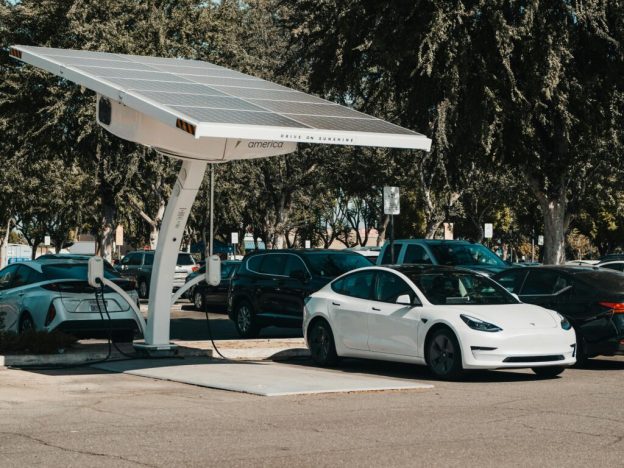
James Bushnell with the Energy Institute at Haas wrote about a study he co authored looking at whether electric vehicle owners are willing to accept a monthly payment to participate in managed charging. The study offered payments ranging from $0 to $40 per month to give the utility access to controlling when the EV charges. Less than 5% signed up even at the highest payment.
While this study was useful in revealing that flat payments will not induced much customer participation. But that does not mean that pricing cannot be used to enhance participation.
To start, here’s two important observations:
- Clearly TOU pricing is working for EV owners because they start charging at midnight. It is the observation of this incremental response that triggered this study. We can use that knowledge to construct more effective incentives to manage EV charging.
- Customers do not trust their utility and in many places, the utility is doing its best to undermine that trust even further. Of course no one want to let the utility control their EV in some nefarious way. Customers either want to maintain control, or turn that control over to an agent who they trust more or they can switch from.
The solution is to have different sets of TOU periods with staggered starting and ending times. The utility is easily able to have set different starting and ending times so as to smooth the load curve. (Agricultural customers already have a range of tariff options, including picking different peak pricing days.) The first TOU offering could run from 8 pm to 1 am, and the next could run from 8:30 to 1:30, etc. The utility could set the least desirable (e.g., 10 am-3pm) as the default and then offer a limited set of specific start time periods within each circuit as alternative options. Customers could even bid for specific slots. In this way customers maintain control over when they get the lowest prices for charging.
Another option is to have the EV car companies manage the charging. Consumers who buy from that company buy choice (rather than through a mandate as it is with the electric utility) are more likely to trust that company, and may feel that they can switch to a different company if they are unsatisfied. (There might even be third party vendors who can step in.) They would partner with the utility on distributing charging across a neighborhood circuit, maybe even using versions of the shifting TOU period schedules described above. The response would be coarser than direct utility control but it likely would achieve the majority of the load shifting benefits that are needed.


Perhaps the preferential EV rates should require a sub-metered L2 charger?
We drove our family EV last year about 1,000 miles a month. Mostly city driving. So that’s roughly 4 miles per kW. 250 kw/month.
With DC fast charging during the day I normally pay around 40 cents per kw That’s roughly the same as PG&E’s E-1 and TOU-C rates. E-ELEC would get you down to roughly 30 cents (assuming you can avoid peek evening hours). EV2-A gets you 23 cents except that your evening hour rate peaks in a nasty way.
Sub-metering was designed allow EV charging to bypass normal household consumption rates.
250 kw/month x 12 months = 3,000 kw /year
3,000 x 0.40 = $1,200 (off peak fast charging, E-1, TOU-C off peak over baseline)
3,000 x 0.35 = $1,050 (TOU-D off peak)
3,000 x 0.30 = $900 (E-ELEC off peak)
3,000 x 0.23 = $690 (EV2-A assuming submetering)
Getting access to the “best” rate for an EV should be around 23 cents. But that leaves us with a paltry $210/year to incentivize an E-ELEC customer. The quoted price for an install at my house exceeds $2,000 and that ignores risks with my obsolete and dangerous electrical panel.
We need something simple and deployable.
I’ll just say that a PG&E owned, meter collar attached L2 EVSE (charger) would do it. Free install. $20/month. $15/month (or more) credit towards EV charging. That way there is an incentive to actually use the charger. PG&E could also pay out a bonus for achieving a year long charge streak or something similar. We don’t want this stuff to get installed and go unused.
Call the rate EV3-ManagedEVSE-A (since we won’t get it right the first time). One rate for managed off-peak charging, a normal EV2-A type rate curve for unmanaged charging, and there could be room in the app for some dynamic pricing tests.
The tricky part would be software and control. Features need to be developed that allow switching between the managed and unmanaged rates. Solar users might want to do free daylight charging too. That requires more software integration. Tesla owners might prefer a Tesla charger for better integration. So there needs to be some flexibility to make the enthusiasts happy while not forcing an overly complicated charger on my parents.
Not everyone could get this right away. If your meter is too far away from the EV there would be some extra install charges that would cost a bit extra per month.
Ideally the “value” of the managed EV charging would help keep the rate low. It Extra power at noon and car is plugged in, go for it. Car is at work and needs to be at 80% before 6am on Tuesday then that needs to be auto-scheduled too.
Other thoughts would be a cheap PG&E installed meter collar or that baby SPAN panel. I’d really like to see something plug and playish that’s safe and does not need permits and $1,000+ in electrical labor.
LikeLike
A pilot with 120 EVs now underway in California to test bidirectional charging:
https://www.canarymedia.com/articles/ev-charging/ev-helps-power-appliances-grid?
As the CEO of Bidirectional Energy, Bell is outfitting homes across California with the same Wallbox Quasar 2 bidirectional direct-current charger that’s mounted to her house. This year, Bidirectional Energy and Wallbox are installing the equipment at about 120 homes as part of a state-funded pilot program that offers participants rebates for two-way chargers.
LikeLike
BEV’s are generally smart enough to interact over 4g/5g networks to talk to apps on users phones. PHEV’s perhaps a bit less. The app’s provided by the car manufactures are pretty terrible and rarely improve. Improvements to the app might well requires car software updates that the manufacturer is desperate to avoid. So that makes it tough for traditional car companies to respond to regulatory requests for features (lack of motivation and technical competence).
One could jump in with a third party app that talked to the car over an API (over 4g/5g). There is some real technical risk that the app will aggressively poll the car’s charge status (to be helpful) and then run down the car’s battery.
Oh. Many EV’s require a data subscription of $10-$15/month to use the 4g/5g radio that allows the app to control the car.
It’s also not helpful that the standard L2 charging connecter (J1772) is “dumb” and can’t get any data from the car.
The next place to add some smarts is the L2 charger. Plenty of these are technically obsolete. These L2 chargers would be easy to upgrade if connecting them with an outlet was easy and sensible. But the correct (safest) way to connect a L2 charger is by having it hardwired into a dedicated circuit. This means the average man now needs an electrician to pull off a charger upgrade. Then you need the average homeowner to get their L2 charger connected to the Internet and the app on their phone. For some this is easy, for others this is a huge task.
Once the L2 charger is connected then you need to configure it in some meaningful way that deals with energy policy and user wants vs. needs for charging to be completed by a certain time.
I had been waiting for the last few years for PG&E and the other IOU’s to deliver at home EV sub-metering. But this has pretty much been a bust. Very few chargers support the protocol (vague) and the market design made it the customers problem to find a vendor who is willing to connect their fancy L2 charger to a sub-meter data provider (and pay that vendor too).
I’d like to see more attention to “smart” submetering where preferential energy rates can be offered to customers who can comply with the program needs. The “new” PG&E EV2-A rate of $0.23/kw for off-peak charging from midnight to 3pm is pretty good. Perhaps raise the rate to 0.25 for dumb charging and lower the rate to $0.20 for smart submetered app charging.
I’d also like to see some effort to court Tesla to build the submetering features into their next gen L2 home charger. They should also be allowed to run a private data broker service to allow their charger customers easy access to these preferential rates. That should provide enough competitive anxiety to get the other charger vendors to figure out the data broker situation too.
The current CPUC design for the sub-metering does not really address the value in giving the utility control over the start time/stop time/rate of charge. I’d like to see this in the hands of the utility, except that they are terrible at customer facing software and web-sites. And the sub-metering effort is almost 10 years old with rather pathetic progress.
LikeLike
Karl, A rather bleak portrayal of the current EV managing charging environment. The question then who is best positioned to solve this since isn’t optional when we reach a high penetration of EVs. History tells us that the utilities are not well motivated and are trailers, not leaders. We wouldn’t have had widespread use of either natural gas combined cycle plants or solar PV if we hadn’t had deregulation. Allowing other providers spurred the needed technology development and adoption. Solving this also likely will require regulatory agencies outside of the CPUC to accept more responsibility for addressing this–“breaking silos.”
Ford and GM have run pilots with PG&E and I have not seen assessments and lessons learned. Those types of experiences will help move forward.
LikeLike
Once you look at EV charging, V2X, solar (including PCS – Power Control System), home batteries, VPP and all their interfaces you realize what a giant mess of software and protocols this whole thing is.
And that’s before you even try to get these components to talk to each other between brands. Ideally air-conditioning (heat pump), traditional furnaces (or thermostats) and water heaters would be able to share usage and control mechanisms within the home (without a cloud dependency).
If these components don’t talk together to share real-time usage data then everyone will need larger electrical panels that have wastefully low utilization. Smarter devices are more long term flexible than “smart” panels (SPAN).
There are incentives from many of the actors to keep the software system closed for the sake of engineering simplicity and improved margins. Every vendor wants their system to be the smart leader in the home so they have control. But this probably means that hardly anyone will get it done.
Perhaps Apple, Google or Tesla could figure this out by selling a home controller? There is a newish feature in the Apple Home App that downloads your PG&E usage. Check that out if you have not seen it. I was able to start the PG&E data feed with only a few clicks. Most impressive.
Smarter EV chargers are the work around for dumb cars. We could add rate incentives for smart enough L2 home chargers. But signing up for this needs to be stupid simple (like the Apple Home example). It can’t be e-mailing a spreadsheet to a IOU approved sub-metering MDMA and going through a terrible signup process. One or two minutes with no human interaction for the simple use cases. The normal EV sub-metered usage rate probably needs to cover the MDMA cost instead of breaking that out. Frankly, getting EV’s charged optimally is a grid health positive thing. Having small bits of incentive cash to promote grid health might be sensible if you can keep it from being a feeding trough for the entitled.
Ideally improved submetering, coordinated charging and related work would not be California specific so that no one regulatory body can ruin the whole thing.
Getting the plumbing going is one thing. You still need to have rate designs and a reasonable user experience for getting your car charged by the user set deadline at an agreed upon price.
Ideally I could tell PG&E that I want to keep my car charged up to 80% on certain mornings, agree on a price and let PG&E (or a broker) figure out when to push the start and stop buttons and how to set the flow rate.
LikeLike
I don’t think car owners are willing to trust PG&E enough to turn over control of their charging to the utility. There needs to be other alternatives–“escapes” from the omnipresent/omniscient utility that no one likes. PG&E can set up the layered rate schedules that I suggested but that’s as far as we can expect customers to go.
ComEd is having a very difficult time getting customers to sign up for its real time pricing rate despite trying for almost 20 years. Again the utility is not well liked and its communication is counterproductive. Customers want some degree of control which scares utilities.
LikeLike