Category Archives: Energy innovation

Emerging technologies and institutional change to meet new challenges while satisfying consumer tastes

Proposed TOU rate revisions are “fighting the last war” in California

p58cht

California’s investor-owned utilities (IOUs) have asserted that the underlying costs molding time variant or time of use (TOU) rate structures should be largely, or even exclusively, derived based on conventional fossil generation costs. The IOUs rely on “net load” to determine TOU prices, calculated by subtracting all load met by renewables, nuclear and hydropower generation—the majority of the utilities’ generation fleets.

In theory, net load is the portion of the load served by fossil-fueled generation that has the highest short-run operating costs, and therefore is “marginal.” The infamous “duck curve” shown above depicts the net load (not the metered load.) Yet, the marginal energy generation for most load is no longer served by natural gas; it is now met by renewable energy contracts. The utilities’ net load approach ignores the bulk of their true marginal costs to serve added load, which arise from procuring renewables.[1] The IOUs’ resource procurement has been dominated by adding solar, wind, biofuels, and other renewables since at least 2006 to meet the state’s renewable portfolio standard (RPS), first at 20 percent, then 33 percent, and soon 50 percent.

The tunnel-vision focus on net, rather than the entire, load is especially problematic in the context of State policy to phase-down fossil fuel generation. Eventually, natural gas production will even more significantly diminish, and could disappear from the grid entirely, leaving no price-setting metric under this paradigm. Insistence on the net load approach in the face of this transformation is akin to evaluating the economics of ridesharing based on the exclusive cost of taxis, without consideration of Uber® and Lyft®.

Once fossil-fuel resources are used minimally – an explicit state goal reflected in SB 350 – and potentially no longer on the margin, it is unclear what price benchmark the utilities will propose to set time-variant rates.  Continuing the trend toward fewer fossil-fuel resources is already reflected in pending legislation in Sacramento that proposes a clean-peak standard – AB 1405[2] – and a 100 percent Renewable Portfolio Standard—SB 584.[3] Relying solely on the cost of generation resources that State policy plans to phaseout to define TOU periods is inconsistent with good, long-term, ratemaking principles.  Instead, marginal energy generation costs should be calculated, at least in part, from a set of recent RPS-eligible PPAs, weighted by time of delivery.

Likewise, the marginal energy costs derived using the net load method, which drive the proposed shifts in TOU periods, reflect less than one-third of total average utility rates. The IOUs do not explain why cost differences within a modest component of overall rates should steer determination of TOU periods.

Further, it is not clear why the California Public Utilities Commission (CPUC) should rely on a speculative forecast about load shapes in 2024—seven years from now—to set today’s TOU periods. As the CPUC is well aware, the electricity system is changing rapidly along many dimensions. Infusion of utility-scale renewables, which is driving the IOUs’ rate analyses, is but one factor. Increasing amounts of storage and electric vehicles, shifting work patterns, and other social and economic factors will substantially influence load profiles over the next decade. In 2006, few energy experts foresaw stagnant, or even falling, electricity demand; there is even greater uncertainty today.

[1]This perspective excludes contributions made by utility-scale renewables that meet most of the remaining load, and by customer-side resources.

[2] See http://leginfo.legislature.ca.gov/faces/billTextClient.xhtml?bill_id=201720180AB1405

[3] See https://leginfo.legislature.ca.gov/faces/billNavClient.xhtml?bill_id=201720180SB584
Germany’s clean energy holiday weekend

Germany reached 85% renewable of total energy production on April 30.

Source: Germany’s clean energy holiday weekend

Repost: Why utilities are more confident than ever about renewable energy growth | Utility Dive

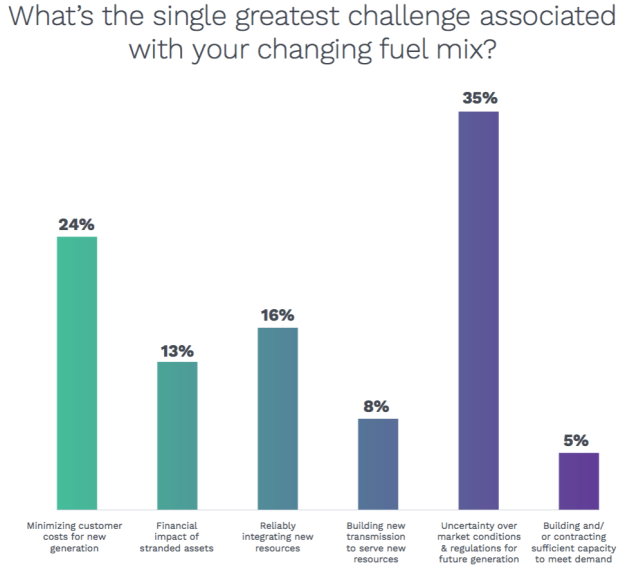
“(O)nly 16% of respondents indicating integration is the most pressing problem. Instead, the election of Donald Trump appeared to have an impact on their fuel mix outlooks, with 35% of respondents indicating regulatory and market uncertainty are now the most pressing concern.”

Source: Why utilities are more confident than ever about renewable energy growth | Utility Dive

Repost: CAISO notches record, serving 56.7% of demand with renewable energy in one day | Utility Dive

Solar and wind power combined also hit a peak on the same day by serving 49.2% of demand.

Source: CAISO notches record, serving 56.7% of demand with renewable energy in one day | Utility Dive

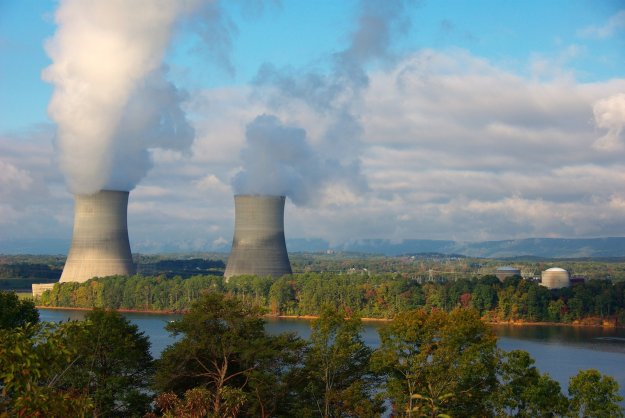
The end of nuclear in the U.S. for now?

Westinghouse has a long history, rivaling General Electric for decades. The two nuclear plants its constructing are overbudget and behind schedule (which was already nearly a decade to completion.) Hard to believe any firm will want to take on these risks in the future.

Reports: Nuclear firm Westinghouse Electric to file for bankruptcy next week | Utility Dive

Utilities are already preparing for potential fallout if the engineering firm overseeing construction of the Vogtle and VC Summer nuclear units goes under.  

Source: Reports: Nuclear firm Westinghouse Electric to file for bankruptcy next week | Utility Dive

Why coal isn’t coming back–cheap renewables

It’s not environmental regulation now that is leading to the demise of the coal industry–it’s the cheaper cost of alternatives. Rather than “bring back coal mining jobs,” we should focus on how we retrain and relocate those displaced workers. And we need to look for new industries that may thrive in “coal country.”

Moody’s: Falling wind energy costs threaten Midwestern coal plants | Utility Dive

In the Midwest, the investor services firm sees 56 GW of regulated coal-fired capacity at risk.

Source: Moody’s: Falling wind energy costs threaten Midwestern coal plants | Utility Dive

Push comes to shove on whether electricity markets are functioning

Over the last year, various states have introduced subsidies and preferences for different electricity resources that have circumvented the independent system operator (ISO) markets that the Federal Energy Regulatory Commission (FERC) approved in the 1990s. FERC’s intent was that hourly markets would provide all of the price signals needed to induce appropriate investment. As we’ve found out in California, that hasn’t worked out that way. These markets have difficulty conveying the full price information for all services (in part because many utility-owned generators are subsidized through state rate of return regulation) and the environmental and technological benefits that may be difficult to monetize in an hourly price.

FERC has challenged some of these new rules, and both won and lost in the courts.  Now the market monitor in the biggest market in the U.S. that covers the Northeast and Midwest is joining the fight. If the market monitor wins, this will raise the salient question of whether FERC needs to rethink its policy, or will states begin to withdraw from the ISOs to pursue their own policy goals?

PJM market monitor opposes Illinois nuclear subsidies | Utility Dive

The market monitor argues the state’s subsidies “unlawfully intruded” on FERC’s authority over wholesale interstate electricity sales. 

Source: PJM market monitor opposes Illinois nuclear subsidies | Utility Dive

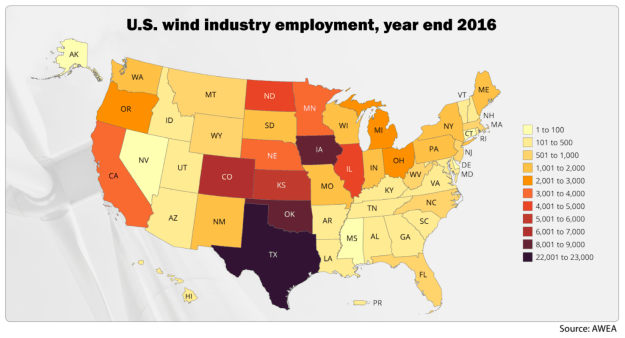
Repost: How the US Wind Sector Is Building Momentum, Driving Economic Benefits | Greentech Media

Five graphics that show strong growth in U.S. wind energy after a two-year slowdown

Source: How the US Wind Sector Is Building Momentum, Driving Economic Benefits | Greentech Media

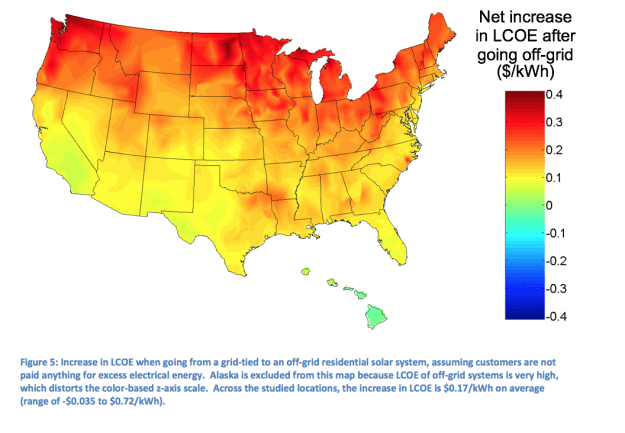
Fighting the last war: Study finds solar + storage uneconomic now  | from Utility Dive

“A Rochester Institute of Technology study says a customer must face high electricity bills and unfavorable net metering or feed-in policies for grid defection to work.”

Yet…this study used current battery costs (at $350/KW-Hr), ignoring probably cost decreases, and then made more restrictive assumptions about how such a system might work. It’s not clear if “defection” meant complete self sufficiency, or reducing the generation portion (which in California about half of electricity bill.) Regardless, the study shows that grid defection is cost-effective in Hawaii, confirm the RMI findings. Even so, RMI said it would take at least 10 years before such defection was cost-effective in even the high-cost states like New York and California.

A more interesting study would be to look at the “break-even” cost thresholds for solar panels and batteries to make these competitive with utility service. Then planners and decision makers could assess the likelihood of reaching those levels within a range of time periods.

Source: A study throws cold water on residential solar-plus-storage economics | Utility Dive