Category Archives: Energy innovation

Emerging technologies and institutional change to meet new challenges while satisfying consumer tastes

PG&E has cost California over $3 billion by mismanaging its RPS portfolio

CCA Savings

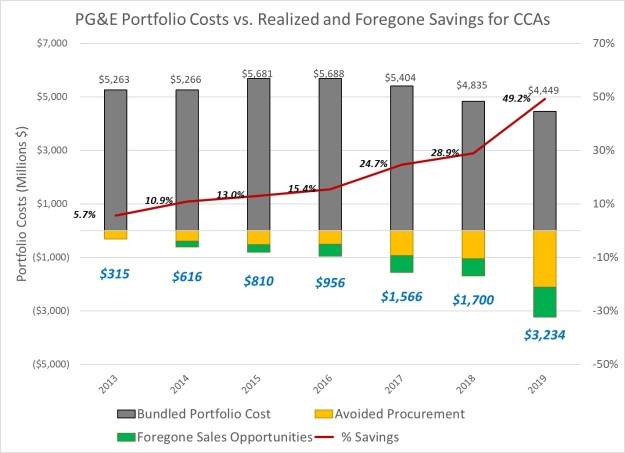
When community choice aggregators take up serving PG&E customers, PG&E saves the cost of having to procure power for the departed load. Instead the CCAs bear that cost for that power. The savings to PG&E’s bundled customers are not fully reflected when calculating the exit fee (known as the power charge indifference adjustment or PCIA) for those CCAs. As a result, the exit fee does not reflect the true value that CCAs provide to PG&E and its bundled customers.

The chart above shows the realized and potential savings to PG&E from the departure of CCA customers. The realized part is the avoided costs of procuring resources to meet that load, shown in yellow. The second part is the foregone sales opportunity if PG&E had sold a portion of its portfolio to the CCAs at the going price when they departed. In 2019, these combined savings could have reached $3.2 billion if PG&E had acted prudently.

Many local governments launched CCAs to address their climate goals, and CCAs issued multiple requests for offers of RPS energy.  However, PG&E failed to respond to this opportunity to sell excess renewable energy no longer needed to serve their customers.  By deciding to hold these unneeded resources in a declining market, PG&E accumulated additional losses every year.  Indeed, the assigned Judge on the exit-fee proceeding at the CPUC concluded that PG&E must benefit from “holding back the RECs [renewable energy credits] for some reason.”

This willingness to hold onto an unneeded resource that loses value every year is contrary to prudent management.  However, shareholders, are shielded entirely from contract that are too costly, and only pay penalties for failing to meet RPS targets.  Instead, ratepayers—both bundled and CCA—pay all of the excessive costs, and shareholders only have a strong incentive to over-procure using those ratepayer dollars to avoid any possibility of reduced shareholder profits.  Holding these contracts also inflates the exit-fee departed customers must pay, making it harder for alternatives like public power and distributed generation to PG&E to thrive.

When Sonoma Clean Power launched in 2014, the average price of RPS energy was $128/MWh.  It has declined every year, and now sits at $57/MWh.  PG&E’s decision to not sell excess energy at 2014 prices, and to protect shareholders at the expense of ratepayers has cost customers over $3 billion dollars in the last 6 years as shown in the green columns below.  As RPS prices continue to decline, and the amount of customer departing increases, this figure will continue to increase every year.  Indeed, it surpassed $1.1 billion for 2019 alone.
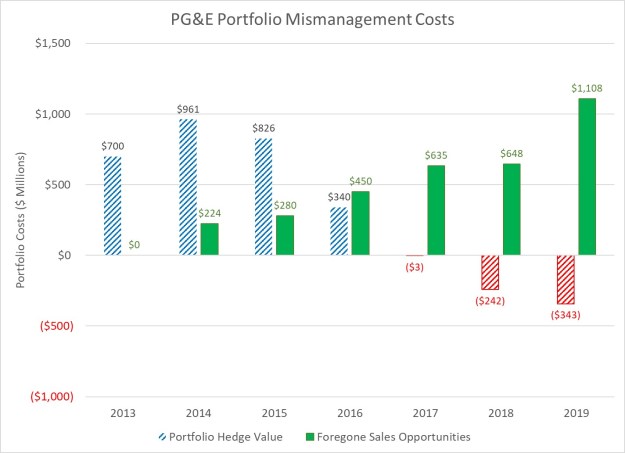
PGAE Mismanagement Costs

Further, the hedging value of the RPS resources that PG&E listed as key attribute of holding these PPAs instead of disposing of them has diminished dramatically since PG&E pushed that as its strategy in its 2014 Bundled Procurement Plan. As shown in the chart above, the hedge value fell $1.3 billion from 2014 to 2019, from a high of $961 million to a burden of $343 million. PG&E’s hedge now adds $33/MWH to the cost of its renewables portfolio.

In comparison, Southern California Edison’s renewables portfolio costs just under $20/MWH less than PG&E’s. SCE did not rush into signing PPAs like PG&E and did not sign them for as long of terms as PG&E.


VCEA offers PG&E $300 million for Yolo County

vce_logo_color_white-border

Valley Clean Energy Alliance made its official offer to PG&E to acquire the Yolo County distribution system for $300 million. The offer is being submitted in PG&E’s bankruptcy proceeding. This offer is substantially higher than the $108 million that Sacramento Municipal Utility District (SMUD) offered in 2005, and not far below the $400 million that PG&E countered with.

San Francisco offered $2.5 billion for PG&E’s system, and San Jose announced that it also will make a bid. Municipalities believe that the bankruptcy court will be more receptive to accepting the offers as a means of raising cash for the bankrupt utility.

PG&E hijacks its own website

PG&E PSPS website clip

I was looking for PG&E’s 2019 Catastrophic Events Memo Account (CEMA) on its website at https://www.pge.com/en_US/about-pge/company-information/regulation/regulation.page, and instead I was redirected to PG&E’s PSPS website at https://www.pgealerts.com/. It does not appear possible to get around this website to the regulatory filings that PG&E maintains on its website.

I guess that’s one way to get enough bandwidth after crashing its website during the PSPS blackouts.

PG&E apologizes, yet again

5610400_101019-kgo-pge-ceo-bill-johnson-img_image_23-04-2516

(Image: ABC 7 News)

I listened to PG&E’s CEO Bill Johnson and his staff apologize for its mishandling of the public safety power shutoffs (PSPS) that affected over 700,000 “customers” (what other industry calls meters “customers”?) yesterday. And as I listened, I thought of the many times that PG&E has fumbled (or even acted maliciously) over the years. Here’s my partial list (and I’m leaving out the faux pas that I’ve experienced in regulatory proceedings):

  • Failing to turn off power locally in 2017 and 2018 under hazardous weather conditions, which led to the Wine Country and Camp fires.
  • Failing to install distribution shut off equipment that was installed by San Diego Gas & Electric and Southern California Edison after the 2007 wildfires in Southern  California.
  • Signing too many power purchase agreements with renewables in the 2009 to 2014 period that were for too long of terms (e.g., 20 years instead of 10 years). PG&E is unable to take advantage of the dramatic cost decreases created by California’s bold investments. For a comparison, PG&E’s renewable portfolio costs about 20% more than SCE’s. (I am one of a few that has access to the confidential portfolio data for both utilities.)
  • Failing to act on the opportunity to sell part of its overstuffed renewable portfolio to the CCAs that emerged from 2010 to 2016. Those sales could have benefited everyone by decreasing PG&E’s obligations and providing the CCAs with existing firm resources. That opportunity has now largely passed.
  • The gas pipeline explosion in San Bruno in 2010 caused by PG&E’s failure to keep proper records for decades. PG&E was convicted of a felony for its negligence.
  • Overinvesting in obsolete distribution infrastructure after 2009 by failing to recognize that electricity demand had flattened and that customers were switching en masse to solar rooftops. (I repeatedly filed testimony starting in 2010 pointing out this error.)
  • Deploying an Advanced Meter Infrastructure (AMI) system starting in 2004 using SmartMeters that claimed that it would provide much more control of PG&E’s distribution system, and deliver positive benefits to ratepayers. Savings have largely failed to materialize, and PG&E’s inability to use its AMI to more narrowly target its PSPS illustrates how AMI has failed to deliver.
  • Acquiring and building three unneeded natural gas plants starting in 2006. Several merchant-owned plants constructed in the early 2000s are already on the verge of retiring because of the flattening in demand.
  • Failing to act in May 2000 to end the “competitive transition” period of California’s restructuring by agreeing to the market valuation of its hydropower system.
  • If PG&E had ended the transition period, it would have been immediately free to sign longer term contracts with merchant generators, thereby taking away the incentive for those generators to manipulate the market. The subsequent energy crisis most likely would have not occurred, or been much more isolated to Southern California.
  • PG&E’s CEO in 1998 made a speech to the shareholders stating that it was PG&E’s intent to extend the transition period as far as possible, to March 2001 at least. (We cited this speech from a transcript in the 1999 GRC case.)
  • Offering rebuttal in the 1999 GRC that instead confirmed the ORA’s analysis that the optimal size of a utility is closer to 500,000 customers rather than 4 million plus. Commissioner Bilas wrote a draft decision confirming this finding, but restructuring derailed the vote on the case.
  • Being caught by the CPUC in diverting $495 million from maintenance spending to shareholders from 1992 to 1997. PG&E was fined $29 million.
  • Forcing the CPUC in 1996 to adopt the “competitive transition charge” which was tied to the fluctuating CAISO day-ahead market price instead of using Commissioner Knight’s up front pay out for stranded assets. The CTC led to the “transition period” which facilitated the ability of merchant generators to manipulate the market price.
  • Two settlement agreements allow PG&E to fully recover its costs in Diablo Canyon by January 1, 1998 based on its authorized rate of return from 1986 to 1998, but also allows it to put into ratebase about half of its “remaining” construction costs as a prelude to restructuring.
  • Getting caught in 1990 telling FERC that PG&E was short resources and needed to build more, while telling the CPUC that it had a long term surplus and that it needed to curtail its payments to third-party qualifying facilities (QF) generators.
  • In the early 1980s, failing to set up a rationale process for signing QF contracts that limited the addition of these resources. In addition, PG&E missed an important pricing calculation mistake in the capacity payment term that led to a double payment to QFs.
  • In the 1970s, making many construction management mistakes when building the Diablo Canyon nuclear power plant, including reversing the blueprints, that led to the costs rising from $315 million to over $5 billion. (And Diablo Canyon in 3 of the last 5 years has operated at a loss and should not have been generating for several months each of those years.)
  • In the 1960s, signing an agreement with Sacramento Municipal Utility District (SMUD) to finance the construction of the Rancho Seco nuclear plant that essentially gave SMUD free energy when Rancho Seco wasn’t generating. The result was the mismanagement of the plant, which was so damaged that it was closed in 1989 (in part as a result of analysis conducted by the consulting team that I was on.)

The other two California IOUs are guilty of some of these same errors, and SMUD and Los Angeles Department of Water and Power (LADWP) also do not have a clean bill of health, but the quantities and magnitudes to don’t match those of PG&E.

CPUC proposes radical restructuring of PG&E

104778251-gettyimages-861000956In PG&E’s safety order institution investigation (OII), outgoing CPUC President Michael Picker (along with senior administrative law judge Peter Allen) has put on the table four dramatic proposals to address governance and incentive issues at the utility. These proposals are:

  1. Separating PG&E into separate gas and electric utilities or selling the gas assets;
  2. Establishing periodic review of PG&E’s Certificate of Convenience and Necessity (CPCN);
  3. Modification or elimination of PG&E Corp.’s holding company structure; and
  4. Linking PG&E’s rate of return or return on equity to safety performance metrics.

The OII originally was opened to investigate PG&E’s management of its natural gas infrastructure, but the series of electricity-sparked wildfires reinfused the OII with a new direction. The proceeding has been a forum for various dramatic proposals on how to handle wildfire-related issues and PG&E’s subsequent bankruptcy filing.


Not grasping the concept: PG&E misses the peak load shift

Utility peak shifted by solar graph

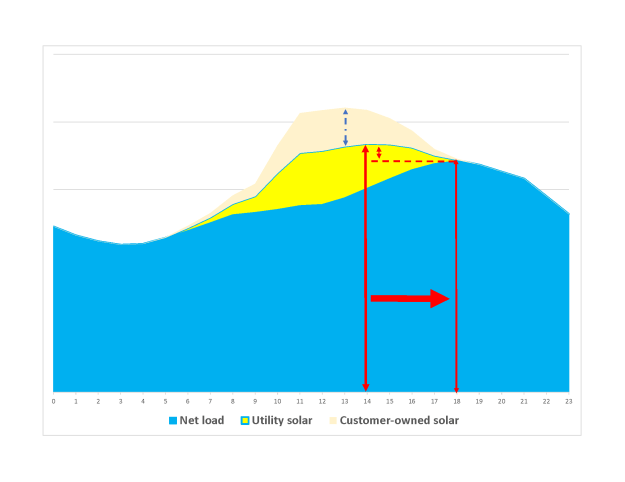
PG&E in its 2020 ERRA Forecast Proceeding testimony wrote “however, BTM DG [behind the meter distributed generation] has a limited impact to the annual system peak as customer-owned solar photovoltaic (PV) generation is minimal during the peak hour of 7 p.m.” Uh, how does PG&E know that customer-owned solar doesn’t contribute to reducing the system peak if PG&E does not meter that generation?

PG&E actually has it wrong. Customer-owned solar has in fact reduced the former pre-solar peak that used to occur between 2 and 4 p.m. The metered load that PG&E can see, which is customer usage minus solar output (BTM DG), has shifted its apparent peak from 4 p.m. to 7 p.m.–3 hours. The graphic above illustrates how this shift has occurred. (PG&E produced a similar chart of its 2016 loads in its TOU rate rulemaking.) So BTM DG has had a profound impact on the annual system peak.

PG&E fails to provide safety support in Davis

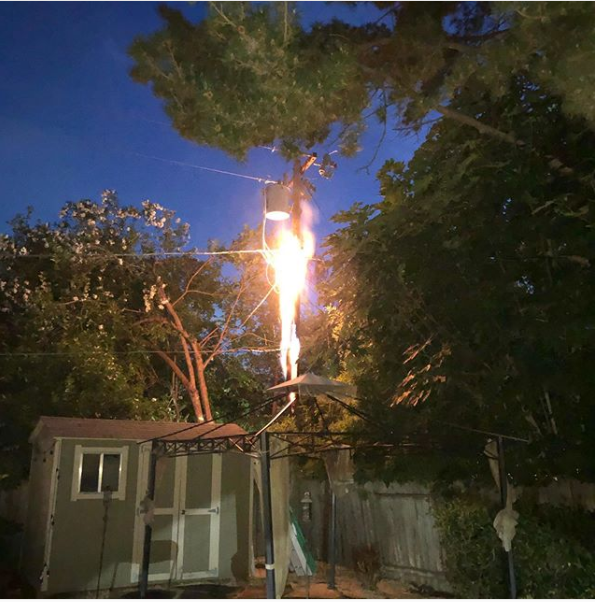
This article on a local webnews site, the Davis Vanguard, describes how PG&E was slow to respond and has since failed to communicate with homeowners about subsequent measures to be taken. Note that in this case, the power lines run down an easement through the backyards of these houses. 

What should strict liability look like for wildfire costs?

104815131-gettyimages-861017202-california-fire-power-530x298

Governor Newsom, the Assembly Speaker and Senate Pro Tem have publicly opposed eliminating the strict liability doctrine applicable to utilities for allocating responsibility for wildfire costs.

Maintaining inverse condemnation better assures wildfire victims that they will receive at least some compensation for their damages. However, there needs to be a limit on the types of damages that can be collected if the utilities are allowed to pass through those costs to ratepayers will little review.

Punitive damages are intended to incent the bad actor to fix the problem. But if that bad actor–the electric utility in this case–is shielded from most or all of the punitive damages, then they will have no incentive to change their behavior. Why should they if what they are doing now is costless?

Only if utility shareholders must bear 100% of all punitive damages and the proportion of damages attributable to negligence should the remaining costs be passed through to ratepayers in this situation. Only in this way can California derive the benefits of privately-owned utilities. If these conditions are unacceptable to shareholders, then the only alternative is public ownership so that ratepayers can reap both the benefits and risks of asset ownership.


Upfront solar subsidy more cost effective than per kilowatt-hour

Solar_panels_on_house_roof_winter_view

This paper from the American Economic Review found that consumers use a discount rate in excess of 15% in valuing residential solar power credits, compared to a social-wide discount rate of 3%.  The implication is that a government can incent the same amount of solar investment through an upfront credit for as little as half the cost of a per kilowatt-hour ongoing subsidy.

The California Solar Initiative had two different incentive methods, the Performance Based Incentive (PBI) which was paid out over 5 years and the Expected Performance-Based Buydowns (EPBB) paid out upfront. The former was preferred by policy makers but the latter was more popular with homeowners. Now we know the degree of difference in the preference.

Chasing gold at the end of the rainbow: how reliance on hourly markets doesn’t spur generation investment

dec2018cdrgraphic_550x624

Commentators have touted the Texas ERCOT market as the epitome of how a fully functioning hourly electricity market can deliver the economic signals needed to spur investment in new capacity. They further assert that this type of market can be technology neutral in what type of investment is made. The Federal Energy Regulatory Commission (FERC) largely adopted this position more than two decades ago when it initiated restructuring that led to the creation of these hourly markets, including the California Independent System Operator (CAISO). And FERC continues to take that stance, although it has allowed for short term capacity markets to backfill for reliability needs.

But now we hear that the Texas market is falling short in incenting new capacity investment. ERCOT which manages the Texas grid projects near term risks and a growing shortfall at least to 2024. At issue is the fact that waiting around for the gambler’s chance at price spike revenues doesn’t make a strong case for financing capital intensive generation, particularly if one’s own investment is likely to make those price spikes disappear. It’s like chasing the gold at the end of the rainbow!

This is another sign that hourly markets are not reliable indicators of market value, contrary to the view of proponents of those markets. The combination of the lumpiness of generation investment and the duration of that generation capital, how that new generation undermines the apparent value in the market, and the lack of political tolerance for failures in reliability or meeting environmental targets require that a much more holistic view of market value for these investments. The value of hedging risk, providing cost stability, improving reliability and resilience and reducing overall portfolio costs all need to be incorporated into a full valuation process.