Category Archives: Risks of climate change

Even if we don’t know if the magnitude is large, can we afford to be wrong?

Modern climate change is now 27 times faster than historic global warming mass extinction events

Steve Hampton has updated his original analysis from 2019 when he worked at the California Department of Fish and Wildlife as an economist. The warming rate has now increased to 27 times any previous event. This chart is sobering for anyone who believes that the current warming is part of a natural cycle. This points to a potentially catastrophic result. Steve wrote recently “it’s now about 18x, not 10x, faster than the other fastest warming.”

The Jolt: California’s solar blame-game (a podcast interview)

In Wednesday’s episode of The Jolt, Sam looks into why California’s rooftop solar rollout is at risk of stalling.

  • Richard McCann, an expert on California’s energy system and founding partner of the M.Cubed consultancy, joins The Jolt to explain where the state’s officials are making mistakes and what needs to be done to fix them.
  • To reach its 2045 carbon neutrality goal, California needs to build a lot of renewable energy. Rooftop solar has reached about 16 gigawatts of capacity in the state and is a major part of the power mix.
  • But new policy changes, designed to bring down power prices, could derail the rooftop sector’s impressive progress and stunt future growth.

How to properly calculate the marginal GHG emissions from electric vehicles and electrification

Recently the questions about whether electric vehicles increase greenhouse gas (GHG) emissions and tracking emissions directly to generation on a 24/7 basis have gained saliency. This focus on immediate grid-created emissions illustrates an important concept that is overlooked when looking at marginal emissions from electricity. The decision to consume electricity is more often created by a single large purchase or action, such as buying a refrigerator or a new electric vehicle, than by small decisions such as opening the refrigerator door or driving to the grocery store. Yet, the conventional analysis of marginal electricity costs and emissions assumes that we can arrive at a full accounting of those costs and emissions by summing up the momentary changes in electricity generation measured at the bulk power markets created by opening that door or driving to the store.

But that’s obviously misleading. The real consumption decision that created the marginal costs and emissions is when that item is purchased and connected to the grid. And on the other side, the comparative marginal decision is the addition of a new resource such as a power plant or an energy efficiency investment to serve that new increment of load.

So in that way, your flight to Boston is not whether you actually get on the plane, which is like opening the refrigerator door, but rather your purchase of the ticket which led to the incremental decision by the airline to add another scheduled flight. It’s the share of the fuel use for that added flight which is marginal, just as buying a refrigerator is responsible for the share of the energy from the generator added to serve the incremental long-term load.

There are growing questions about the use of short run market prices as indicators of market value of generation assets for a number of reasons. This paper critiquing “surge” pricing on the grid has one set of aspects that undermine that principle.

Meredith Fowley at the Energy Institute at Haas compared two approaches to measuring the additional GHG emissions from a new electric vehicle. The NREL paper uses the correct approach of looking at longer term incremental resource additions rather than short run operating emissions. The hourly marginal energy use modeled by Holland et al (2022) is not particularly relevant to the question of GHG emissions from added load for several reasons and for that reason any study that doesn’t use a capacity expansion model will deliver erroneous results. In fact, you will get more accurate results from relying on a simple spreadsheet model using capacity expansion than a complex production cost hourly model.

In the electricity grid, added load generally doesn’t just require increased generation from existing plants, but rather it induces investment in new generation (or energy savings elsewhere, which have zero emissions) to meet capacity demands. This is where economists make a mistake thinking that the “marginal” unit is additional generation from existing plants–in a capacity limited system such as the electricity grid, its investment in new capacity.

That average emissions are falling as shown in Holland et al while hourly “marginal” emissions are rising illustrates this error in construction. Mathematically that cannot be happening if the marginal emission metric is correct. The problem is that Holland et al have misinterpreted the value they have calculated. It is in fact not the first derivative of the average emission function, but rather the second partial derivative. That measures the change in marginal emissions, not marginal emissions themselves. (And this is why long-run marginal costs are the relevant costing and pricing metric for electricity, not hourly prices.) Given that 75% of new generation assets in the U.S. were renewables, it’s difficult to see how “marginal” emissions are rising when the majority of new generation is GHG-free.

The second issue is that the “marginal” generation cannot be identified in ceteris paribus (i.e., all else held constant) isolation from all other policy choices. California has a high RPS and 100% clean generation target in the context of beneficial electrification of buildings and transportation. Without the latter, the former wouldn’t be pushed to those levels. The same thing is happening at the federal level. This means that the marginal emissions from building decarbonization and EVs are even lower than for more conventional emission changes.

Further, those consumers who choose beneficial electrification are much more likely to install distributed energy resources that are 100% emission free. Several studies show that 40% of EV owners install rooftop solar as well, far in excess of the state average, (In Australia its 60% of EV owners.) and they most likely install sufficient capacity to meet the full charging load of their EVs. So the system marginal emissions apply only to 60% of EV owners.

There may be a transition from hourly (or operational) to capacity expansion (or building) marginal or incremental emissions, but the transition should be fairly short so long as the system is operating near its reserve margin. (What to do about overbuilt systems is a different conversation.)

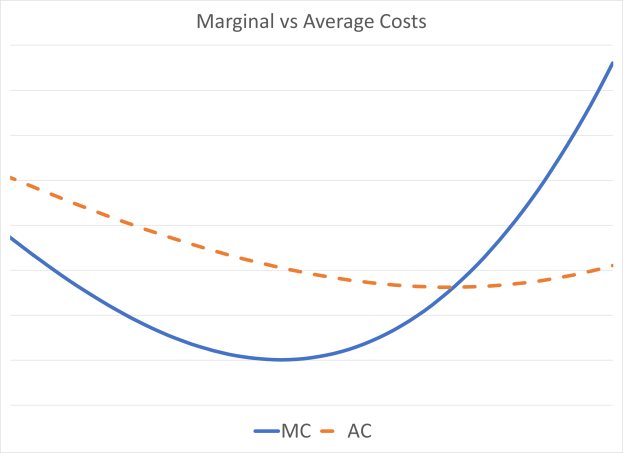
There’s deeper problem with the Holland et al papers. The chart that Fowlie pulls from the article showing that marginal emissions are rising above average emissions while average emissions are falling is not mathematically possible. (See for example, https://www.thoughtco.com/relationship-between-average-and-marginal-cost-1147863) For average emissions to be falling, marginal emissions must be falling and below average emissions. The hourly emissions are not “marginal” but more likely are the first derivative of the marginal emissions (i.e., the marginal emissions are falling at a decreasing rate.) If this relationship holds true for emissions, that also means that the same relationship holds for hourly market prices based on power plant hourly costs.

All of that said, it is important to incentivize charging during high renewable hours, but so long as we are adding renewables in a manner that quantitatively matches the added EV load, regardless of timing, we will still see falling average GHG emissions.

It is mathematically impossible for average emissions to fall while marginal emissions are rising if the marginal emission values are ABOVE the average emissions, as is the case in the Holland et al study. What analysts have heuristically called “marginal” emissions, i.e., hourly incremental fuel changes, are in fact, not “marginal”, but rather the first derivative of the marginal emissions. And as you point out the marginal change includes the addition of renewables as well as the change in conventional generation output. Marginal must include the entire mix of incremental resources. How marginal is measured, whether via change in output or over time doesn’t matter. The bottom line is that the term “marginal” must be used in a rigorous economic context, not in a casual manner as has become common.

Often the marginal costs do not fit the theoretical mathematical construct based on the first derivative in a calculus equation that economists point to. In many cases it is a very large discreet increment, and each consumer must be assigned a share of that large increment in a marginal cost analysis. The single most important fact is that for average costs to be rising, marginal costs must be above average costs. Right now in California, average costs for electricity are rising (rapidly) so marginal costs must be above those average costs. The only possible way of getting to those marginal costs is by going beyond just the hourly CAISO price to the incremental capital additions that consumption choices induce. It’s a crazy idea to claim that the first 99 consumers have a tiny marginal cost and then the 100th is assigned the responsibility for an entire new addition such as another flight scheduled or a new distribution upgrade.

We can consider the analogy to unit commitment, and even further to the continuous operation of nuclear power plants. The airline scheduled that flight in part based on the purchase of the plane ticket, not on the final decision just before the gate was closed. Not flying saved a miniscule amount of fuel, but the initial scheduling decision created the bulk of the fuel use for the flight. In a similar manner a power plant that is committed several days before an expected peak load burns fuels while idling in anticipation of that load. If that load doesn’t arrive, that plant avoids a small amount of fuel use, but focusing only on the hourly price or marginal fuel use ignores the fuel burned at a significant cost up to that point. Similarly, Diablo Canyon is run at a constant load year-round, yet there are significant periods–weeks and even months–where Diablo Canyon’s full operational costs are above the CAISO market clearing price average. The nuclear plant is run at full load constantly because it’s dispatch decision was made at the moment of interconnection, not each hour, or even each week or month, which would make economic sense. Renewables have a similar characteristic where they are “scheduled and dispatched” effectively at the time of interconnection. That’s when the marginal cost is incurred, not as “zero-cost” resources each hour.

Focusing solely on the small increment of fuel used as a true measure of “marginal” reflects a larger problem that is distorting economic analysis. No one looks at the marginal cost of petroleum production as the energy cost of pumping one more barrel from an existing well. It’s viewed as the cost of sinking another well in a high cost region, e.g., Kern County or the North Sea. The same needs to be true of air travel and of electricity generation. Adding one more unit isn’t just another inframarginal energy cost–it’s an implied aggregation of many incremental decisions that lead to addition of another unit of capacity. Too often economics is caught up in belief that its like classical physics and the rules of calculus prevail.

A Residential Energy Retrofit Greenhouse Gas Emission Offset Reverse Auction Program

In most local California jurisdictions, the largest share of stationary emissions will continue to come from the existing buildings. On the other hand, achieving zero net energy (ZNE) or zero net carbon (ZNC) for new developments can be cost prohibitive, particularly if incremental transportation emissions are included. A Residential Retrofit Offset Reverse Auction Program (Retrofit Program) aims to balance emission reductions from both new and existing buildings s to lower overall costs, encourage new construction that is more energy efficient, and incentivize a broader energy efficiency marketplace for retrofitting existing buildings.

The program would collect carbon offset mitigation fees from project developers who are unable to achieve a ZNE or ZNC standard with available technologies and measures. The County would then identify eligible low-income residential buildings to be targeted for energy efficiency and electrification retrofits. Contractors then would be invited to bid on how many buildings they could do for a set amount of money.

The approach proposed here is modeled on the Audubon Society’s and The Nature Conservacy’s BirdReturns Program.[1] That program contracts with rice growers in the Sacramento Valley to provide wetlands in the Pacific Flyway. It asks growers to offer a specified amount of acreage with given characteristics for a set price–that’s the “reverse” part of the auction.

A key impediment to further adoption of energy efficiency measures and appliances is that contractors do not have a strong incentive to “upsell” these measures and products to consumers. In general, contractors pass through most of the hardware costs with little markup; their profits are made on the installation and service labor. In addition, contractors are often asked by homeowners and landlords to provide the “cheapest” alternative measured in initial purchase costs without regard to energy savings or long-term expenditures.

The Retrofit Program is intended to change the decision point for contractors to encourage homeowners and landlords to implement upgrades that would create homes and buildings that are more energy efficient. Contractors would bid to install a certain number of measures and appliances that exceed State and local efficiency standards in exchange for payments from the Retrofit Program. The amount of GHG reductions associated with each type of measure and appliance would be predetermined based on a range of building types (e.g., single-family residential by floor-size category, number of floors, and year built). The contractors can use the funds to either provide incentives to consumers or retain those funds for their own internal use, including increased profits. Contractors may choose to provide more information to consumers on the benefits of improved energy efficiency as a means of increasing sales. Contractors would then be compensated from the Offset Program fund upon showing proof that the measures and appliances were installed. The jurisdiction’s building department would confirm the installation of these measures in the normal course of its permit review work.

Funds for the Retrofit Program would be collected as part of an ordinance for new building standards to achieve the no-net increase in GHG emissions. It also could be included as a mitigation measure for projects falling under the purview of the California Environmental Quality Act (CEQA.)

The Retrofit Program would be financed by mitigation payments made by building developers to achieve a no-net increase in GHG emissions. Buildings would be required to meet the lowest achievable GHG emission levels, but then would pay to mitigate any remainders, including for transportation, charged at the current State Cap and Trade Program auction price for an extended collection of annual allowances[2] that cover emissions for the expected life of the building (e.g., 40 years) (CARB 2024).

M.Cubed proposed this financing mechanism for Sonoma County in its climate action plan.


[1] See https://birdreturns.org/

[2] Referred to as a “strip” in the finance industry.

A Working Lands Carbon Mitigation Bank Program

A number of counties in California are largely agricultural, with a few small communities. Most of that agricultural land is intensively farmed, much of it irrigated. This situation presents the opportunity to sequester large amounts of carbon relative to the total greenhouse gas emissions from all county activities. In other words, the county can approach a level of net-zero emissions with a surplus available to share with other jurisdictions, particularly with those in within a county.

Since many of these counties are already planning to use this sequestration strategy to meet its own emission reduction goals, these reductions will be real, additional, and verifiable, meeting the gold standard for use as credits by other jurisdictions. The county has a strong incentive to ensure that these reductions are of sufficient quality to meet its own targets, which should make these attractive to other jurisdictions, unlike other credits offered in the marketplace.

A county would establish a Carbon Mitigation Bank using a similar framework to habitat conservation mitigation banks.[1] The county would establish the parameters that achieve the requisite carbon sequestration and then collect in-lieu fees to cover the costs of the bank’s expenses. By expanding the number of jurisdictions contributing and receiving coverage, overall carbon emissions can be reduced more cost-effectively.

Sequestration from working lands can be achieved at a lower cost than most alternatives. For this reason, a county can use its surplus to finance much of its share of the sequestration program by offering it to cities in the county at a margin above the implementation cost sufficient to cover the county’s share of the costs as well. For example, it may cost $50 per CO2e ton sequestered, and the County may use only half of the potential sequestration to meet its own target. The County could then offer its surplus credits to the other jurisdictions at $100 per ton, which is likely less than the cost of additional reductions elsewhere, to cover the full program costs.

M.Cubed proposed this financing mechanism for both Yolo and Sonoma in their climate action plans. Both counties could potentially sequesters hundreds of thousands of tons annually, implying this could be a major revenue source for meeting broader targets.

Per Capita: Climate needs more than just good will

I wrote this guest column in the Davis Enterprise about the City’s Climate Action and Adaptation Plan. (Thank you John Mott-Smith for extending the privilege.)

Dear Readers, the guest column below was written by Richard McCann, a Davis resident and expert on energy and climate action plans.

————

The city of Davis is considering its first update of its Climate Action and Adaptation Plan since 2010 with a 2020-2040 Plan. The city plans to update the CAAP every couple of years to reflect changing conditions, technologies, financing options, laws and regulations.

The plan does not and cannot achieve a total reduction in greenhouse gas emissions simply because we do not control all of the emission sources — almost three-quarters of our emissions are from vehicles that are largely regulated by state and federal laws. But it does lay out a means to putting a serious dent in the overall amount. 

The CAAP offers a promising future and accepts that we have to protect ourselves as the climate worsens. Among the many benefits we can look forward to are avoiding volatile gas prices while driving cleaner, quieter cars; faster and more controllable cooking while eliminating toxic indoor air; and air conditioning and heating without having to make two investments while paying less.

To better adapt, we’ll have a greener landscape, filtered air for rental homes, and community shelter hubs powered by microgrids to ride out more frequent extreme weather.

We have already seen that adding solar panels raises the value of a house by as much as $4,000 per installed kilowatt (so a 5 kilowatt system adds $20,000). We can expect similar increases in home values with these new technologies due to the future savings, safety and convenience. 

Several state and federal laws and rules foretell what is coming. By 2045 California aims to be at zero net GHG emissions. That will require retiring all of the residential and commercial gas distribution lines. PG&E has already started a program to phase out its lines. A change in state rules will remove from the market several large natural gas appliances such as furnaces by 2030.

In addition, PG&E will no longer offer subsidies to developers to install gas lines to new homes starting next year. The U.S. Environmental Protection Agency appears poised to push further the use of electric appliances in areas with poor air quality such the Sacramento Valley. (Renewable gas and hydrogen will be too expensive and there won’t be enough to go around.)

Without sales to new customers or for replaced furnaces, the cost of maintaining the gas system will rise substantially so switching to electricity for cooking and water heating will save even more money. The CAAP anticipates this transition by having residents begin switching earlier. 

In addition, the recently enacted federal Inflation Reduction Act offers between $400 and $800 billion into funding these types of changes. The California Energy Commission’s budget for this year went from $1 billion to $10 billion to finance these transitions. The CAAP lays out a process for acquiring these financial sources for Davis and its residents. 

That said, some have objected to the CAAP as being too draconian and infringing on personal choices. The fact is that we are now in the midst of a climate emergency — the City Council endorsed this concern with a declaration in 2019. We’re already behind schedule to head off the worst of the threatening impacts. 

We won’t be able to rely solely on voluntary actions to achieve the reductions we need. That the CAAP has to include these actions proves that people have not been acting on their own despite a decade of cajoling since the last CAAP. While we’ve been successful at encouraging voluntary compliance with easy tasks like recycling, we’ve used mandatory permitting requirements to gain compliance with various building standards including energy efficiency measures. (These are usually enforced at point-of-sale of a house.)

We have a choice of mandatory ordinances, incentives through taxes or fees, and subsidies from grants and funds — voluntary just won’t deliver what’s needed. We might be able to financially help those least able to afford changing stoves, heaters or cars, but those funds will be limited. The ability to raise taxes or fees is restricted due to various provisions in the state’s constitution. So we are left with mandatory measures, applied at the most opportune moments. 

Switching to electricity for cooking and water heating may involve some costs, some or most of which will be offset by lower energy costs (especially as gas rates go up.) If you have an air conditioner, you’re likely already set up for a heat pump to replace your furnace — it’s a simple swap. Even so, you can avoid some costs by using a 120-volt induction cooktop instead of 240 volts, and installing a circuit-sharing plug or breaker for large loads to avoid panel upgrades. 

The CAAP will be fleshed out and evolve for at least the next decade. Change is coming and will be inevitable given the dire situation. But this change gives us opportunities to clean our environment and make our city more livable.  

Don’t get too excited about the fusion breakthrough yet

The U.S. Department of Energy announced on December 13 that a net positive fusion reaction achieved at the Lawrence Livermore National Laboratory. While impressive, this one last aside raises another substantial barrier:

“(T)he fusion reaction creates neutrons that significantly stress equipment, and could potentially destroy that equipment.”

While the momentary burst produced about 150% more energy than the input from the lasers, the lasers required about 150 times more energy than their output.

The technology won’t be ready for use until at least 2060, which is a decade after the goal of achieving net zero carbon emissions. That means that we need to plan and progress without relying on this energy source.

Getting EVs where we need them in multi family and low-income communities

They seem to be everywhere. A pickup rolls up to a dark house in a storm during the Olympics and the house lights come on. (And even powers a product launch event when the power goes out!) The Governator throws lightning bolts like Zeus in a Super Bowl ad touting them. The top manufacturer is among the most valuable companies in the world and the CEO is a cultural icon. Electric vehicles (EVs) or cars are making a splash in the state.

The Ford F-150 Lightning pick up generated so much excitement last summer that it had to increase its initial roll out from 40,000 to 80,000 to 200,000 due to demand. General Motors answered with electric versions of the Silverado and Hummer. (Dodge is bringing up the rear with its Ram and Dakota pickups.)

Much of this has been spurred by California’s EV sales mandates that date back to 1990. The state now plans to phase out the sale of new cars and passenger trucks entirely by 2035, with 35% of sales by 2026. In the first quarter of 2022, EVs were 16% of new car sales.

While EVs look they will be here to stay, the question is where will drivers be able to charge up? That means recharging at home, at work, and on the road when needed. The majority of charging—70% to 80%–occurs at home or at work. Thanks to the abundance of California’s renewable energy, largely from solar power including from rooftops, the most advantageous time is in the middle of the day. The next big hurdle will be putting charging stations where they are needed, most valuable and accessible to those who don’t live in conventional single-family housing.

The state has about 80,000 public and shared private chargers, of which about 10% are DC “fast chargers” that can deliver 80% capacity in about 30 minutes. Yet we likely need 20 times more chargers that what we have today.

Multi-family housing is considered a prime target for additional chargers because of various constraints on tenants such as limitations on installing and owning a charging station and sharing of parking spaces. Community solar panels can be outfitted with charging stations that rely on the output of the panels.

California has a range of programs to provide incentives and subsidies for installing chargers. Funding for another 5,000 chargers was recently authorized. The state funds the California Electric Vehicle Infrastructure Project (CALeVIP) that provides direct incentives and works with local partners plan and install Level 2 and DC fast charging infrastructure. This program has about $200 million available. The program has 13 county and regional projects that contribute $6,000 and more for Level 2 chargers and often $80,000 for a DC fast charger. A minimum of 25% of funds are reserved for disadvantaged and low-income communities. In many cases, the programs are significantly oversubscribed with waiting lists, but the state plans to add enough funding for an additional 100,000 charging stations in the 2022-23 fiscal year, with $900 million over the next four years.

California’s electric utilities also fund charging projects, although those programs open and are quickly oversubscribed.

  • Southern California Edison manages the Charge Ready program with a focus on multi-family properties including mobilehome parks. The program offers both turn-key installation and rebates. SCE’s website provides tools for configuring a parking lot for charging.
  • San Diego Gas & Electric offered Power Your Drive to multi-family developments, with 255 locations currently. SDG&E has added the Power Your Drive Extension to add another 2,000 charging stations over the next two years. SDG&E will provide up to $12,000 for Level 2 chargers and additional maintenance funding.
  • Pacific Gas & Electric offered the EV Charge program in which PG&E will pay for, own, maintain and coordinate construction of infrastructure from the transformer to the parking space, as well as support independent ownership and operation. The program is not currently taking applications however. PG&E’s website offers other tools for assessing the costs and identifying vendors for installing chargers.
  • PG&E is launching a “bidirectional” EV charging pilot program with General Motors that will test whether EVs can be used to improve electric system reliability and resilience by using EVs as back up energy storage. The goal is to extend the program by the end of 2022. This new approach may provide EV owners with additional value beyond simply driving around town. PG&E also is setting up a similar pilot with Ford.
  • Most municipally-owned electric utilities offer rebates and incentives as well..

Community residents have a range of incentives available to them to purchase an EV.

  • The state offers $750 through the Clean Fuel Reward on the purchase of a new EV. .
  • California also offers the Clean Vehicle Rebate Project that offers $1,000 to $7,000 for buying or leasing a (non-Tesla) to households making less than $200,000 or individuals making less than $135,000. Savings depend on location and vehicle acquired.
  • Low-income households can apply for a state grant to purchase a new or used electric or hybrid vehicle, plus $2,000 for a home charging station, through the Clean Vehicle Assistance Program. The income standards are about 50% higher than those establishing eligibility for the CARE utility rate discount. The average grant is about $5,000.
  • The federal government offers a tax credit of up to $7,500 depending on the make and model of vehicle.
  • Car owners also can scrap their gasoline-fueled cars for $1,000 to $1,500, depending on household income.
  • Several counties, including San Diego and Sonoma, have offered EV purchase incentives to county residents. Those programs open and fill fairly quickly.

The difference between these EVs coming down the road (yes, that’s a pun) and the current models is akin to the difference between flip phones and smart phones. One is a single function communication device, and we use the latter to manage our lives. The marketing of EVs could shift course to emphasize these added benefits that are not possible with a conventional vehicle. We can expect a similar transformation in how we view energy and transportation as the communication and information revolution.

What “Electrify Everything” has wrong about “reduce, reuse, recycle”

Saul Griffith has written a book that highlights the role of electrification in achieving greenhouse gas emission reductions, and I agree with his basic premise. But he misses important aspects about two points. First, the need to reduce, reuse and recycle goes well beyond just energy consumption. And second, we have the ability to meet most if not all of our energy needs with the lowest impact renewable sources.

Reduce, reuse and recycle is not just about energy–it’s also about reducing consumption of natural resources such as minerals and biomass, as well as petroleum and methane used for plastics, and pollution caused by that consumption. In many situations, energy savings are only a byproduct. Even so, almost always the cheapest way to meet an energy need is to first reduce its use. That’s what energy efficiency is about. So we don’t want to just tell consumers to continue along their merry way, just switch it up with electricity. A quarter to a third our global GHG emissions are from resource consumption, not energy use.

In meeting our energy needs, we can largely rely on solar and wind supplemented with biofuels. Griffith asserts that the U.S. would need 2% of its land mass to supply the needed electricity, but his accounting makes three important errors. First, placing renewables doesn’t eliminate other uses of that land, particularly for wind. Acreage devoted to wind in particular can be used also for different types of farming and even open space. In comparison, fossil-fuel and nuclear plants completely displace any other land use. Turbine technology is evolving to limit avian mortality (and even then its tall buildings and household cats that cause most bird deaths). Second most of the solar supply can be met on rooftops and covering parking lots. These locations are cost effective compared to grid scale sources once we account for transmission costs. And third, our energy storage is literally driving down the road–in our new electric vehicles. A 100% EV fleet in California will have enough storage to meet 30 times the current peak load. A car owner will be able to devote less than 5% of their battery capacity to meet their home energy needs. All of this means that the real footprint can be much less than 1%.

Nuclear power has never lived up to its promise and is expensive compared to other low-emission options. While the direct costs of current-technology nuclear power is more than 12 cents a kilowatt-hour when adding transmission, grid-scale renewables are less than half of that, and distributed energy resources are at least comparable with almost no land-use footprint and able to provide better reliability and resilience. In addition, the potential of catastrophic events at nuclear plants adds another 1 to 3 cents per kilowatt-hour. Small modular reactors (SMR) have been promoted as a game changer, but we have been waiting for two decades. Nuclear or green hydrogen may emerge as economically-viable options, but we shouldn’t base our plans on that.

California could buy back GHG allowances cost-effectively

California is concerned that entities that emit greenhouse gases (GHG) have accrued a too-large bank of allowances through the Air Resources Board (CARB) cap-and-trade program (CATP.) The excess is estimated at 321 million allowances (one allowance equals one metric tonne of carbon dioxide equivalent (CO2e) emissions). This is more an a year’s worth of allowances. About half of these were issued for free to eligible energy utilities and energy-intensive trade-exposed (EITE) companies.

The state could consider purchasing back a certain portion to reduce the backlog and increase the market price so as to further encourage reductions in GHG emissions by retiring those allowances. Prices in the last allowance auction ranged from $28 to $34 per allowance/tonne. If California bought back half or 160 million allowances at those prices, it would cost $4.5 to $5.5 billion. That would create effectively a reduction of 160 million tonnes in future GHG emissions.

That should be compared to the various benchmarks for the benefits and costs of reducing GHG emissions. The currently accepted social cost of GHG emissions developed by the U.S. Environmental Protection Agency (US EPA) is ranges from $50 to $150 per tonne in 2030 (and recent studies have estimated that this is too low.) That would create a net social benefit from $2.5 to $19.6 billion.

CARB’s AB 32 Scoping Plan update estimates the average cost of reductions without the CATP to be $70 per tonne in 2030. The incremental avoided costs of the CATP are estimated at $220 per tonne. The net avoided costs on this basis would range from $5.7 to $30.4 billion.