Category Archives: Risks of climate change

Even if we don’t know if the magnitude is large, can we afford to be wrong?

When is $100 billion not that big?

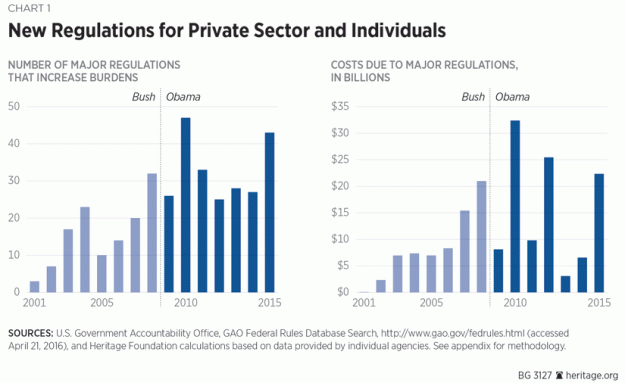
bg-red-tape-rising-2016-chart-1-825

When it’s measured against $18,675 billion ($18.7 trillion) produced by the U.S. economy. The Heritage Foundation issued a report claiming the Obama Administration imposed $107 billion in new burdens over seven years. That sounds like a huge amount, but that’s only 0.6% (six-tenths of a percent) of the economy. And that’s spread over seven years which means that this the reduction in the GDP growth rate was only 0.08% (eight hundredths of a percent) per year. Against an annual average growth rate of over 2%, that’s a trivial amount. Another way to think of it is this way: if you had a dinner bill from Applebee’s for $19, would you not by dinner it if cost a dime more? Probably not–you wouldn’t even notice.

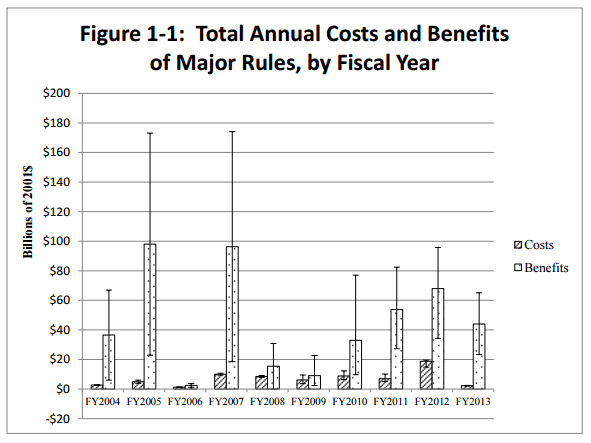
Plus, the HF’s estimate ignores the benefits of those regulations. This graphic from the OMB that shows the estimated relative benefits to costs of regulation.

omb

I won’t dig too deeply into the Heritage Foundation’s analysis other than to make a couple of notes about about alternative perspectives that I am familiar with:

  • Heritage Foundation claims that the Clean Power Plan has cost $7.2 billion as the single largest increment. Yet Lawrence Berkeley National Laboratory (which is much better qualified on this issue than the HF) just released a study showing the net financial “costs” of the various renewable portfolio standard (RPS) requirements is actually a benefit $47 to $109 billion. (And that ignores the environmental benefits identified in the report.)
  • After the 2008 financial debacle, the industry was going to face increased regulation to reign in its behavior during the previous decade. So increased regulation under Dodd-Frank is to be expected. And the better question might be what is the drag on the economy from high financial-related transaction costs? One study found that transaction costs may be as high at 45% in the U.S. economy. The financial and legal sectors likely are a bigger drag than government regulation.
  • On FCC net neutrality, see a previous post about how bigger corporations and economic concentration reduces innovation, which leads to reduced growth. Net neutrality is intended to fight that concentration.

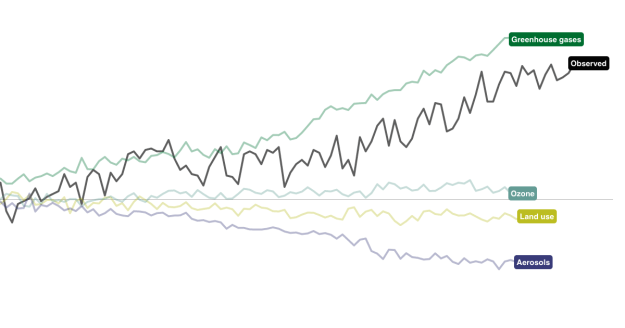
Reblog: What’s Really Warming the World? from Bloomberg News

An interesting presentation separating about a dozen factors, natural and human.

Source: What’s Really Warming the World? Climate deniers blame natural factors; NASA data proves otherwise

Could Trumps win lead to global carbon tariffs?

000_g34cy_0

Former French President Sarkozy suggested that if the U.S. pulled out of the Paris Climate Accord, that the EU impose carbon tariffs on U.S. goods. Many economists have suggested that this may be the best solution to gaining collected global action. So perhaps Trump’s win will actually further action on climate change rather than delay it.

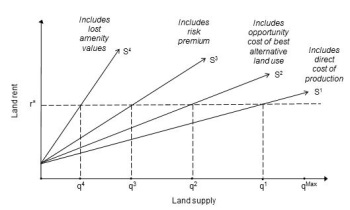
Reblog: Inconvenient Truths about Landowner (Un)Willingness to Grow Dedicated Bioenergy Crops: Choices Magazine

Dedicated production of biofuels has been a Holy Grail for the sector, but this study finds that this is unlikely.

Source: 4th Quarter 2016 | Choices Magazine Online

Four articles on uncertainty and unconventional economics

From the current issue of American Economics Review:

Robust Social Decisions: We propose and operationalize normative principles to guide social decisions when individuals potentially have imprecise and heterogeneous beliefs, in addition to conflicting tastes or interests. To do so, we adapt the standard Pareto principle to those preference comparisons that are robust to belief imprecision and characterize social preferences that respect this robust principle. [This paper focused on decisions related to climate change.]

Beyond GDP? Welfare across Countries and Time: We propose a summary statistic for the economic well-being of people in a country. Our measure incorporates consumption, leisure, mortality, and inequality, first for a narrow set of countries using detailed micro data, and then more broadly using multi-country datasets. While welfare is highly correlated with GDP per capita, deviations are often large. Western Europe looks considerably closer to the United States, emerging Asia has not caught up as much, and many developing countries are further behind. Each component we introduce plays a significant role in accounting for these differences, with mortality being most important.

(W)hat proportion of consumption in the United States, given the US values of leisure, mortality, and inequality, would deliver the same expected utility as the values in France? In our results, lower mortality, lower inequality, and higher leisure each add roughly 10 percentage points to French welfare in terms of equivalent consumption. Rather than looking like 60 percent of the US value, as it does based solely in consumption, France ends up with consumption-equivalent welfare equal to 92 percent of that in the United States.

A summary:

(i) GDP per person is an informative indicator of welfare across a broad range of countries: the two measures have a correlation of 0.98. Nevertheless, there are economically important differences between GDP per person and consumption-equivalent welfare. Across our 13 countries, the median deviation is around 35 percent—so disparities like we see in France are quite common.

(ii) Average Western European living standards appear much closer to those in the United States (around 85 percent for welfare versus 67 percent for income) when we take into account Europe’s longer life expectancy, additional leisure time, and lower inequality.

(iii) Most developing countries—including much of sub-Saharan Africa, Latin America, southern Asia, and China—are substantially poorer than incomes suggest because of a combination of shorter lives and extreme inequality. Lower life expectancy reduces welfare by 15 to 50 percent in the developing countries we examine. Combined with the previous finding, the upshot is that, across countries, welfare inequality appears even greater than income inequality.

(iv) Growth rates are typically revised upward, with welfare growth averaging 3.1 percent between the 1980s and the mid-2000s versus income growth of 2.1 percent. A boost from rising life expectancy of more than a percentage point shows up throughout the world, with the notable exception of sub-Saharan Africa. When welfare grows 3 percent instead of 2 percent per year, living standards double in 24 years instead of 36 years; over a century, this leads to a 20-fold increase rather than a 7-fold increase.

Bailouts, Time Inconsistency, and Optimal Regulation: A Macroeconomic View:  A common view is that bailouts of firms by governments are needed to cure inefficiencies in private markets. We propose an alternative view: even when private markets are efficient, costly bankruptcies will occur and benevolent governments without commitment will
bail out firms to avoid bankruptcy costs. Bailouts then introduce inefficiencies where none had existed. Although granting the government orderly resolution powers which allow it to rewrite private contracts improves on bailout outcomes, regulating leverage and taxing size is needed to achieve the relevant constrained efficient outcome, the sustainably efficient outcome.

Long-Run Risk Is the Worst-Case Scenario: We study an investor who is unsure of the dynamics of the economy. Not only are parameters unknown, but the investor does not even know what order model to estimate. She estimates her consumption process nonparametrically…and prices assets using a pessimistic model that minimizes lifetime utility subject to a constraint on statistical plausibility…[A] way of interpreting our results is that they say that what people fear most, and what makes them averse to investing in equities, is that growth rates or asset returns are going to be persistently lower over the rest of their lives than they have been on average in the past.


How to misconstrue statistics in your favor: an example arguing against SB 32


statebystatechangeinco2emissionrateThis blog post on Fox & Hounds is an example of how to take statistics of one cause-and-effect relationship and misapply them to another situation. In this case, this graphic above shows how GHG emissions have dropped dramatically in states that used to burn coal to generate electricity, but now rely much more on natural gas. The decline in coal emissions has occurred over the last half-decade due to the fall in gas prices and the increased stringency in air quality regulations. But more importantly, those states had higher emissions that California to start with because they have been laggards in protecting their environments. The chart shows that these states are finally starting to catch up! If anything, this supports adopting SB 32 as a follow on to AB 32!

Yet the blog post misconstrues this situation to argue that it’s the “free market” that somehow is generating these greater reductions, implying that California and Mississippi had started from the same place–which of course if far from the truth. Yes, the market push from natural gas fracking explains some of this, but California was already so far ahead due to its own efforts that it has less room to improve.

Watch for these types of misrepresentations. Understand the initial premises by the authors. Ask hard questions before you accept their conclusions.

Source: There’s a Better Way :: Fox&Hounds

CEQA has no effect on California growth

Bay Area Economics conducted a study for the Rose Foundation that found that CEQA regulations have had no appreciable effect on economic growth in California.ceqaprocesssoil_procflow_web_01top-02-02

Here’s a summary of the findings:

The report includes a number of significant findings, including:

  • There is no quantitative evidence that CEQA has a retarding effect on the state’s economic prosperity.
  • Legislative changes to CEQA aimed at streamlining the CEQA process to encourage infill development are working. In San Francisco, only 14 environmental impact reports were prepared in the last three years. In that time, 100 projects proceeded with CEQA exemptions or expedited review.
  • Despite rapid population growth and development, the number of CEQA lawsuits statewide has remained constant over the past 14 years. Between 2013 and 2015, legal challenges were filed in 0.7 percent of projects subject to CEQA review.
  • Less than one percent of projects subject to CEQA review face litigation.
  • Direct costs for complete environmental reviews under CEQA typically range from 0.025% to 0.5% of total development costs.
  • California is the 11th most densely populated state in the nation. Its urban areas compare favorably to cities around the country with regard to the rate of infill vs. greenfield development.
  • The state’s largest cities show ongoing improvement in walkability. California is home to 12 of the nation’s 50 most walkable cities.
  • CEQA does not hamper the development of affordable housing in urban areas. Although the need to provide more affordable housing in California is undisputed, when compared to other states, California produces the second highest number of affordable housing units per 100,000 residents in the nation.

American Economics Association: Agricultural adaptation to climate change

From the AMERICAN ECONOMIC JOURNAL: ECONOMIC POLICY
VOL. 8, NO. 3, AUGUST 2016

Understanding the potential impacts of climate change on economic outcomes requires knowing how agents might adapt to a changing climate. We exploit large variation in recent temperature and precipitation trends to identify adaptation to climate change in US agriculture, and use this information to generate new estimates of the potential impact of future climate change on agricultural outcomes. Longer run adaptations appear to have mitigated less than half–and more likely none–of the large negative short-run impacts of extreme heat on productivity. Limited recent adaptation implies substantial losses under future climate change in the absence of countervailing investments.

Source: American Economic Association

Maven’s Notebook: “Normative science has a corrosive effect on the entire scientific enterprise”

‘Normative science’ has a corrosive effect on the entire scientific enterprise, says Dr. Robert Lackey These days, scientists in environmental science, natural resources, ecology, conse…

Source: MAVEN’S NOTEBOOK – Water news

Maybe time to look for High Speed Rail alternatives?

High speed rail (HSR) may not be the best means to moving people quickly from San Francisco to Los Angeles–it looks like a 20th century solution to a 21st century problem. I’ve written written about how electric vehicles will diminish the projected GHG emission reductions, and may be an effective alternative. Now comes a Chinese-designed super bus27chinabus01-master768 that can use the same I-5 lanes simultaneously with cars. (See the video in the link above.) The Dutch have developed a high-speed electric bus that also can use I-5 at little added cost.

And now comes word that the auction of greenhouse gas (GHG) allowances by the State fell well below forecasts. Due to how HSR is funded out of that allowance fund, HSR’s share will fall by 98% to $2.5 million. Given that the state still has not attracted any private investment, which is a necessity to make this go, it may be time to rethink solutions.