California’s investor-owned utilities (IOUs) have asserted that the underlying costs molding time variant or time of use (TOU) rate structures should be largely, or even exclusively, derived based on conventional fossil generation costs. The IOUs rely on “net load” to determine TOU prices, calculated by subtracting all load met by renewables, nuclear and hydropower generation—the majority of the utilities’ generation fleets.
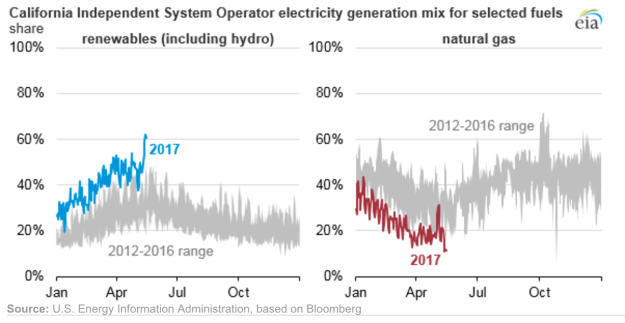
In theory, net load is the portion of the load served by fossil-fueled generation that has the highest short-run operating costs, and therefore is “marginal.” The infamous “duck curve” shown above depicts the net load (not the metered load.) Yet, the marginal energy generation for most load is no longer served by natural gas; it is now met by renewable energy contracts. The utilities’ net load approach ignores the bulk of their true marginal costs to serve added load, which arise from procuring renewables.[1] The IOUs’ resource procurement has been dominated by adding solar, wind, biofuels, and other renewables since at least 2006 to meet the state’s renewable portfolio standard (RPS), first at 20 percent, then 33 percent, and soon 50 percent.
The tunnel-vision focus on net, rather than the entire, load is especially problematic in the context of State policy to phase-down fossil fuel generation. Eventually, natural gas production will even more significantly diminish, and could disappear from the grid entirely, leaving no price-setting metric under this paradigm. Insistence on the net load approach in the face of this transformation is akin to evaluating the economics of ridesharing based on the exclusive cost of taxis, without consideration of Uber® and Lyft®.
Once fossil-fuel resources are used minimally – an explicit state goal reflected in SB 350 – and potentially no longer on the margin, it is unclear what price benchmark the utilities will propose to set time-variant rates. Continuing the trend toward fewer fossil-fuel resources is already reflected in pending legislation in Sacramento that proposes a clean-peak standard – AB 1405[2] – and a 100 percent Renewable Portfolio Standard—SB 584.[3] Relying solely on the cost of generation resources that State policy plans to phaseout to define TOU periods is inconsistent with good, long-term, ratemaking principles. Instead, marginal energy generation costs should be calculated, at least in part, from a set of recent RPS-eligible PPAs, weighted by time of delivery.
Likewise, the marginal energy costs derived using the net load method, which drive the proposed shifts in TOU periods, reflect less than one-third of total average utility rates. The IOUs do not explain why cost differences within a modest component of overall rates should steer determination of TOU periods.
Further, it is not clear why the California Public Utilities Commission (CPUC) should rely on a speculative forecast about load shapes in 2024—seven years from now—to set today’s TOU periods. As the CPUC is well aware, the electricity system is changing rapidly along many dimensions. Infusion of utility-scale renewables, which is driving the IOUs’ rate analyses, is but one factor. Increasing amounts of storage and electric vehicles, shifting work patterns, and other social and economic factors will substantially influence load profiles over the next decade. In 2006, few energy experts foresaw stagnant, or even falling, electricity demand; there is even greater uncertainty today.
[1]This perspective excludes contributions made by utility-scale renewables that meet most of the remaining load, and by customer-side resources.
[2] See http://leginfo.legislature.ca.gov/faces/billTextClient.xhtml?bill_id=201720180AB1405
[3] See https://leginfo.legislature.ca.gov/faces/billNavClient.xhtml?bill_id=201720180SB584

 Meredith Fowlie at the Energy Institute at Haas (California’s Carbon Border Wall ) and Dallas Burtraw at RFF have taken on the specific issues in the proposal to replace California’s cap & trade program (CATP).