Tag Archives: climate change

Modern climate change is now 27 times faster than historic global warming mass extinction events

Steve Hampton has updated his original analysis from 2019 when he worked at the California Department of Fish and Wildlife as an economist. The warming rate has now increased to 27 times any previous event. This chart is sobering for anyone who believes that the current warming is part of a natural cycle. This points to a potentially catastrophic result. Steve wrote recently “it’s now about 18x, not 10x, faster than the other fastest warming.”

The Jolt: California’s solar blame-game (a podcast interview)

In Wednesday’s episode of The Jolt, Sam looks into why California’s rooftop solar rollout is at risk of stalling.

  • Richard McCann, an expert on California’s energy system and founding partner of the M.Cubed consultancy, joins The Jolt to explain where the state’s officials are making mistakes and what needs to be done to fix them.
  • To reach its 2045 carbon neutrality goal, California needs to build a lot of renewable energy. Rooftop solar has reached about 16 gigawatts of capacity in the state and is a major part of the power mix.
  • But new policy changes, designed to bring down power prices, could derail the rooftop sector’s impressive progress and stunt future growth.

White paper on how rooftop solar is really a benefit to all ratepayers

In cooperation with the California Solar & Storage Association, M.Cubed is releasing a white paper Rooftop Solar Reduces Costs for All Ratepayers.

As California policy makers seek to address energy affordability in 2025, this report shows why rooftop solar can and has helped control rate escalation. This research stands in direct contrast to claims that rooftop solar is to blame for rising rates. The report shows that the real reason electricity rates have increased dramatically in recent years is out-of-control utility spending and utility profit making, enabled by a lack of proper oversight by regulators.

This work builds on the original short report issued in November 2024, and subsequent replies to critiques by the Public Advocates Office and Professor Severin Borenstein. The supporting workpapers can be found here.

Policy makers wanting to address California’s affordability crisis should reject the utility’s so-called “solar cost shift” and instead partner with consumers who have helped save all ratepayers $1.5 billion in 2024 alone by investing in rooftop solar. The state should prioritize these resources that simultaneously reduce carbon, increase resiliency, and minimize grid spending. This realignment of energy priorities away from what works for investor-owned utilities – spending more on the grid – and toward what works for consumers – spending less – is particularly important in the face of increased electricity consumption due to electrification. More rooftop solar is needed, not less, to control costs for all ratepayers and meet the state’s clean energy goals.

Utilities have peddled a false “cost shift” theory that is based on the concept of “departing load.” Utilities claim that the majority of their costs are fixed. When a customer generates their own power from onsite solar panels, the utilities claim this forces all other ratepayers to pick up a larger share of their “fixed” costs. A close look at hard data behind this theory, however, shows a different picture.

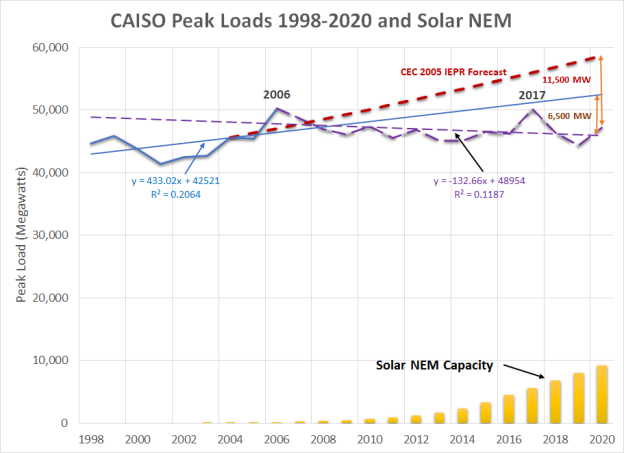
While California’s gross consumption – the “plug load” that is actual electricity consumption – has grown, that growth has been offset by customer-sited rooftop solar. This has kept the state’s peak consumption from the grid remarkably flat over the past twenty years, despite population growth, temperature increases, increased economic activity, and the rise in computers and other electronics in homes and businesses. Rooftop solar has not caused departing load in California. It has avoided load growth. By keeping our electric load on the grid flat, rooftop solar has avoided expensive grid expansion projects, in addition to reducing generation expenses, lowering costs for everyone.

Contrary to messaging from utilities and their regulators, California electricity consumption still peaks in mid-afternoon on hot summer days. There has been so much focus on the evening “net peak,” depicted by the “duck curve,” that many people have lost sight of the true peak. The annual peak in plug load happens when the sun is shining brightest. Clear, hot days lead to both high electricity usage from air conditioning and peak solar output.

The “net peak” is grid-based consumption minus generation from utility-scale solar and wind farms. It is an important dynamic to look at as we seek to reduce non-renewable sources of energy, and it shows us that energy storage will be essential going forward. However, an exclusive focus on net peak misses a bigger picture, particularly when looking at previously installed resources, and hides the value of solar energy.
California’s two million rooftop solar systems installed under net metering, including those that do not have batteries, continue to reduce statewide costs year after year by reducing the true peak. While most new solar systems now have batteries to address the evening net peak, historic solar continues to play a critical role in addressing the mid-day true peak.

Utilities and their regulators ignore these facts and focus the blame of rising rates on consumers seeking relief via rooftop solar. Politicians looking to address a growing crisis of energy affordability in California should reject the scapegoating of working- and middle-class families who have invested their own money in rooftop solar, and should instead promote the continued growth of this important distributed resource to meet growing needs for electricity.

The state is at a crossroads. As we power more of our cars, appliances, and heating with electricity, usage will increase dramatically. Relying entirely on utilities to deliver that energy from faraway power plants on long-distance power lines would involve massive delays and cause costs to rise even higher. Aggressive rooftop solar deployment could offset significant portions of the projected demand increase from electrification, helping control costs in the future.

The real reason for rate increases is runaway utility spending, driven by the utilities’ interest in increasing profits. Utility spending on grid infrastructure at the transmission and distribution levels has increased 130%-260% for each of the utilities over the past 8-12 years. These increases in spending track at a nearly 1:1 ratio with rate increases. This demonstrates that rates have gone up because utility spending has gone up. If utility costs were anything close to fixed and rates kept going up, there could be room for a cost shift argument. Or, if utility spending increased and rates increased significantly more, there could be a cost shift. The data shows neither of these trends. Rates have been increasing commensurate with spending, demonstrating that it is utility spending increases that have caused rates to increase, not consumers investing in clean energy.

Inspired by this faulty approach to measuring solar costs and benefits, the CPUC rolled out a transition from net metering to net billing that was abrupt and extreme. It has caused massive layoffs of skilled solar professionals and bankruptcies or closures of long-standing solar businesses. The poorly managed policy change set the market back ten years. A year and a half after the transition, the market still has not recovered.
California needs more rooftop solar and customer-sited batteries to contain costs and thereby rein in rate increases for all California ratepayers. To get the state back on track, policy makers need to stop attacking solar and adopt smart policies without delay.

• Respect the investments of customers who installed solar under NEM-1 and NEM-2. Do not change the terms of those contracts.
• Reject solar-specific taxes or fees in all forms, via the CPUC, the state budget, or local property taxes.
• Cut red tape in permitting and interconnection, and restore the right of solar contractors to install batteries. Do not use contractor licensing rules at the CSLB to restrict solar contractors from installing batteries.
• Establish a Million Solar Batteries initiative that includes virtual power plants and targeted incentives.
• Fix perverse utility profit motives that drive utilities to spend ratepayer money inefficiently, and even unnecessarily, and that motivate them to fight rooftop solar and other alternative ways to power California families and businesses.
• Launch a new investigation into utility oversight and overhaul the regulatory structure such that government regulators have the ability to properly scrutinize and contain utility spending.

California should be proud of its globally significant rooftop solar market. This solar development has diversified resources, served as a check on runaway utility spending, and helped clean the air all while tapping into private investments in clean energy. As the state looks to decarbonize its economy, the need to generate energy while minimizing capital intensive investments in grid infrastructure makes distributed solar and storage an even higher priority. State regulators need to stop being weak in utility oversight and exercise bold leadership for affordable clean energy that will benefit all ratepayers. California can start by getting back to promoting, not attacking, rooftop solar and batteries for all consumers.

Response to Borenstein’s critique of our assessment of the benefits of rooftop solar

Severin Borenstein at the Energy Institute at the Haas Business School posted a reply[1] to our analysis[2] of the Public Advocates Office’s claim[3] of a large “cost shift” created by rooftop solar customers to other customers. Here is my extended reply to Borenstein’s critique.

  • Issues of agreement: Borenstein acknowledges that the PAO used an incorrect capacity factor to calculate the total amount of rooftop solar generation. He also acknowledged that the monthly bill payments from rooftop solar customers should be included in the calculation, an error that both PAO and he has previously committed. Further, he agreed, with caveats, that the rate reductions and subsidy savings for low-income CARE customers should be included. Those elements alone add up to reducing PAO’s claimed cost shift approaching $2 billion or 25%
  • Self generation: Borenstein and the PAO ignore the fact that self generation is not included in any utility resource planning. Rooftop solar generation is counted in load forecasts as a load reduction just like energy efficiency. Grid investments, generation capacity and operational decisions such as reserve margins all focus solely on metered load that excludes all self generation.. Borenstein mistakenly asserts that grid and self-provided power mingles, obviating the right to self generation. If there is generation and consumption onsite at the same time, those electrons do not touch the grid. Along with the fact that the energy does not mix, legal precedents and analysis by leading regulators contradict Borenstein’s (and PAO’s) position. Further, the NEM tariffs explicitly recognize the right to self generate for the term of the tariff.
  • Historic utility savings: Borenstein, like PAO, creates a confusing “apples-to-oranges” comparison of historic costs vs. projected future savings. The Avoided Cost Calculator does not include information about historic costs and therefore cannot be used to calculate historic savings from previously installed rooftop solar systems. Using this tool to estimate how much utilities would have spent were it not for previous solar installations is highly inaccurate. The ACC does not have this data. Rates do not reflect future value. In addition, Borenstein ignores suppression of peak load growth since 2006 by the addition of rooftop solar. He confuses the total customer peak served by all resources including rooftop solar with the CAISO metered peak served only by utility resources, asserting that rooftop solar provides little value to meeting today’s metered peak. Only by recreating the costs that would have been borne by ratepayers over the last two decades can the actual savings and reduction in rates be calculated.
  • Customer Bill Payment: While he agrees bill payments should be included in the PAO’s analysis, but he focuses only on the cost-shift burden and fails to acknowledge the contribution to utility fixed costs made by these customers. The appropriate comparison is customer bill payments compared to utility fixed costs per customer. My analysis shows solar customers more than cover utility fixed costs.
  • Overall savings provided to all ratepayers from rooftop solar conservatively is $1.5 billion in 2024.

Further observations

To start, the focus of our analysis is on the Public Advocates Office (PAO) report issued in August 2024. We used PAO’s own spreadsheet as the base of the analysis and supplemented that with other sources. The critique of Borenstein’s analysis is collateral and, compared to that of the PAO analysis, is limited to the questions of self generation and how to calculate the cost savings created by rooftop solar. His capacity factor, inclusion of CARE customers and applicable retail rates are much closer to those that I used. I pointed out in my blog post that Borenstein had not made the mistakes that PAO had made on technical issues.

Yet on the other hand, Borenstein’s own spreadsheet was documented in a small, cryptic “Readme” file,[4] and the final calculation of the “cost shift” was a set of raw values with no internal calculations. When I recreated those calculations, I could not exactly duplicate what Borenstein presented. Similarly, the PAO’s spreadsheet was sparse on documentation. Most of what is shown in my workpapers are my own additions, not PAO’s.

Finally, many of the sources that Borenstein refers to are in fact himself. The NRDC citation relies on his own Next10 report. The LAO report cites back to his own blog post. He refers to his own critique of NEM from four years ago to criticize the NEM 3.0/NBT framework that was finalized two years later. That analysis is likely now obsolete.

As for being an “industry consultant,” a sample of our recent clients shows their diversity where we have worked for environmental organizations, water districts and utilities, agricultural and business associations intervening at the CPUC, CCAs, county governments, tribes, regional energy networks, state agencies, and lately solar advocates. We must present analyses that are sufficiently balanced so as to be credible with all of these different stakeholders. Further, our work is carefully documented and our data and assumptions completely transparent, unlike the work of Borenstein or the PAO.

(I will also note that Borenstein has apparently blocked me on LinkedIn so that he can exclude me from the discussion taking place on his post there.)


[1] See https://energyathaas.wordpress.com/2025/01/27/guess-what-didnt-kill-rooftop-solar/

[2] See https://mcubedecon.com/2024/11/14/how-californias-rooftop-solar-customers-benefit-other-ratepayers-financially-to-the-tune-of-1-5-billion/

[3] See https://www.publicadvocates.cpuc.ca.gov/-/media/cal-advocates-website/files/press-room/reports-and-analyses/240822-public-advocates-office-2024-nem-cost-shift-fact-sheet.pdf

[4] Published with his April 2024 blog post.

How California’s Rooftop Solar Customers Benefit Other Ratepayers Financially to the Tune of $1.5 Billion

The California Public Utilities Commission’s (CPUC) Public Advocates Office (PAO) issued in August 2024 an analysis that purported to show current rooftop solar customers are causing a “cost shift” onto non-solar customers amounting to $8.5 billion in 2024. Unfortunately, this rather simplistic analysis started from an incorrect base and left out significant contributions, many of which are unique to rooftop solar, made to the utilities’ systems and benefitting all ratepayers. After incorporating this more accurate accounting of benefits, the data (presented in the chart above) shows that rooftop solar customers will in fact save other ratepayers approximately $1.5 billion in 2024.

The following steps were made to adjust the original analysis presented by the PAO:

  1. Rates & Solar Output: The PAO miscalculates rates and overestimates solar output. Retail rates were calculated based on utilities’ advice letters and proceeding workpapers. They incorporate time-of-use rates according to the hours when an average solar customer is actually using and exporting electricity.  The averages are adjusted to include the share of net energy metering (NEM 1.0 and 2.0) and net billing tariff (NBT or “NEM 3.0”) customers (8% to 18% depending on the utility) who are receiving the California Alternate Rates for Energy program’s (CARE) low-income rate discount. (PAO assumed that all customers were non-CARE). In addition, the average solar panel capacity factor was reduced to 17.5% based on the state’s distributed solar database.[1] Accurately accounting for rates and solar outputs amounts to a $2.457 billion in benefits ignored by the PAO analysis.
  2. Self Generation: The PAO analysis included solar self-consumption as being obligated to pay full retail rates. Customers are not obligated to pay for energy to the utility for self generation. Solar output that is self-consumed by the solar customer was removed from the calculation. Inappropriately including self consumption as “lost” revenue in PAO analysis amounts to $3.989 billion in a phantom cost shift that should be set aside.
  3. Historic Utility Savings: The PAO fails to account for the full and accurate amount of savings and the shift in the system created by rooftop solar that has lowered costs and rates. The historic savings are based on distributed solar displacing 15,000 megawatts of peak load and 23,000 gigawatt-hours of energy since 2006 compared to the California Energy Commission’s (CEC) 2005 Integrated Energy Policy Report forecast.[2] Deferred generation capacity valuation starts with the CEC’s cost of a combustion turbine[3] and is trended to the marginal costs filed in the most recent decided general rate cases. Generation energy is the mix of average California Independent System Operator (CAISO) market prices in 2023,[4] and utilities’ average renewable energy contract prices.[5] Avoided transmission costs are conservatively set at the current unbundled retail transmission rate components. Distribution investment savings are the weighted average of the marginal costs included in the utilities’ general case filings from 2007 to 2021. Accounting for utility savings from distributed solar amounts to $2.165 billion ignored by the PAO’s calculation.
  4. Displaced CARE Subsidy: The PAO analysis does not account for savings from solar customers who would otherwise receive CARE subsidies. When CARE customers buy less energy from the utilities, it reduces the total cost of the CARE subsidy born by other ratepayers. This is equally true for energy efficiency. The savings to all non-CARE customers from displacing electricity consumption by CARE customers with self generation is calculated from the rate discount times that self generation. Accounting for reduced CARE subsidies amounts to $157 million in benefits ignored by the PAO analysis.
  5. Customer Bill Payments: The PAO analysis does not account for payments towards fixed costs made by solar customers. Most NEM customers do not offset all of their electricity usage with solar.[6] NEM customers pay an average of $80 to $160 per month, depending on the utility, after installing solar.[7] Their monthly bill payments more than cover what are purported fixed costs, such as the service transformer. A justification for the $24 per month customer charge was a purported under collection from rooftop solar customers.[8] Subtracting the variable costs represented by the Avoided Cost Calculator from these monthly payments, the remainder is the contribution to utility fixed costs, amounting to an average of $70 per month. (In comparison for example, PG&E proposed an average fixed charge of $51 per month in the income graduated fixed charge proceeding.[9]) There is no data available on average NBT bills, but NBT customers also pay at least $15 per month in a minimum fixed charge today.[10] Accounting for fixed cost payments adds $1.18 billion in benefits ignored by the PAO analysis.

The correct analytic steps are as follows:

NEM Net Benefits = [(kWh Generation [Corrected] – kWh Self Use) x Average Retail Rate Compensation [Corrected] )]
– [(kWh Generation [Corrected] – kWh Self Use) x Historic Utility Savings ($/kWh)]
– [CARE/FERA kWh Self Use x CARE/FERA Rate Discount ($/kWh)]
– [(kWh Delivered x (Average Retail Rate ($/kWh) – Historic Utility Savings $(kWh))]

NBT Net Benefits = [(kWh Generation [Corrected] – kWh Self Use) x Average Retail Rate Compensation [Corrected])]
– [(kWh Generation [Corrected] – kWh Self Use) x Avoided Cost (Corrected) ($/kWh)]
– [CARE/FERA kWh Self Use x CARE/FERA Rate Discount ($/kWh)]
– [(Net kWh Delivered x (Average Retail Rate ($/kWh) – Historic Utility Savings $(kWh))]

This analysis is not a value of solar nor a full benefit-cost analysis. It is only an adjusted ratepayer-impact test calculation that reflects the appropriate perspective given the PAO’s recent published analysis. A full benefit-cost analysis would include a broader assessment of impacts on the long-term resource plan, environmental impacts such as greenhouse gas and criteria air pollutant emissions, changes in reliability and resilience, distribution effects including from shifts in environmental impacts, changes in economic activity, and acceleration in technological innovation. Policy makers may also want to consider other non-energy benefits as well such local job creation and supporting minority owned businesses.

This analysis applies equally to one conducted by Severin Borenstein at the University of California’s Energy Institute at Haas. Borenstein arrived at an average retail rate similar to the one used in this analysis, but he also included an obligation for self generation to pay the retail rate, ignored historic utility cost savings and did not include existing bill contributions to fixed costs.

The supporting workpapers are posted here.

Thanks to Tom Beach at Crossborder Energy for a more rigorous calculation of average retail rates paid by rooftop solar customers.


[1] PAO assumed a solar panel capacity factor of 20%, which inflates the amount of electricity that comes from solar. For a more accurate calculation see California Distributed Generation Statistics, https://www.californiadgstats.ca.gov/charts/.

[2] This estimate is conservative because it does not include the accumulated time value of money created by investment begun 18 years ago. It also ignores the savings in reduced line losses (up to 20% during peak hours), avoided reserve margins of at least 15%, and suppressed CAISO market prices from a 13% reduction in energy sales.

[3] CEC, Comparative Costs of California Central Station Electricity Generation Technologies, CEC-200-2007-011-SF, December 2007.

[4] CAISO, 2023 Annual Report on Market Issues & Performance, Department of Market Monitoring, July 29, 2024.

[5] CPUC, “2023 Padilla Report: Costs and Cost Savings for the RPS Program,” May 2023.

[6] Those customers who offset all of their usage pay minimum bills of at least $12 per month.

[7] PG&E, SCE and SDG&E data responses to CALSSA in CPUC Proceeding R.20-08-020, escalated from 2020 to 2024 average rates.

[8] CPUC Decision 24-05-028.

[9] CPUC Proceeding Rulemaking 22-07-005.

[10] The average bill for NBT customer is not known at this time.

How to properly calculate the marginal GHG emissions from electric vehicles and electrification

Recently the questions about whether electric vehicles increase greenhouse gas (GHG) emissions and tracking emissions directly to generation on a 24/7 basis have gained saliency. This focus on immediate grid-created emissions illustrates an important concept that is overlooked when looking at marginal emissions from electricity. The decision to consume electricity is more often created by a single large purchase or action, such as buying a refrigerator or a new electric vehicle, than by small decisions such as opening the refrigerator door or driving to the grocery store. Yet, the conventional analysis of marginal electricity costs and emissions assumes that we can arrive at a full accounting of those costs and emissions by summing up the momentary changes in electricity generation measured at the bulk power markets created by opening that door or driving to the store.

But that’s obviously misleading. The real consumption decision that created the marginal costs and emissions is when that item is purchased and connected to the grid. And on the other side, the comparative marginal decision is the addition of a new resource such as a power plant or an energy efficiency investment to serve that new increment of load.

So in that way, your flight to Boston is not whether you actually get on the plane, which is like opening the refrigerator door, but rather your purchase of the ticket which led to the incremental decision by the airline to add another scheduled flight. It’s the share of the fuel use for that added flight which is marginal, just as buying a refrigerator is responsible for the share of the energy from the generator added to serve the incremental long-term load.

There are growing questions about the use of short run market prices as indicators of market value of generation assets for a number of reasons. This paper critiquing “surge” pricing on the grid has one set of aspects that undermine that principle.

Meredith Fowley at the Energy Institute at Haas compared two approaches to measuring the additional GHG emissions from a new electric vehicle. The NREL paper uses the correct approach of looking at longer term incremental resource additions rather than short run operating emissions. The hourly marginal energy use modeled by Holland et al (2022) is not particularly relevant to the question of GHG emissions from added load for several reasons and for that reason any study that doesn’t use a capacity expansion model will deliver erroneous results. In fact, you will get more accurate results from relying on a simple spreadsheet model using capacity expansion than a complex production cost hourly model.

In the electricity grid, added load generally doesn’t just require increased generation from existing plants, but rather it induces investment in new generation (or energy savings elsewhere, which have zero emissions) to meet capacity demands. This is where economists make a mistake thinking that the “marginal” unit is additional generation from existing plants–in a capacity limited system such as the electricity grid, its investment in new capacity.

That average emissions are falling as shown in Holland et al while hourly “marginal” emissions are rising illustrates this error in construction. Mathematically that cannot be happening if the marginal emission metric is correct. The problem is that Holland et al have misinterpreted the value they have calculated. It is in fact not the first derivative of the average emission function, but rather the second partial derivative. That measures the change in marginal emissions, not marginal emissions themselves. (And this is why long-run marginal costs are the relevant costing and pricing metric for electricity, not hourly prices.) Given that 75% of new generation assets in the U.S. were renewables, it’s difficult to see how “marginal” emissions are rising when the majority of new generation is GHG-free.

The second issue is that the “marginal” generation cannot be identified in ceteris paribus (i.e., all else held constant) isolation from all other policy choices. California has a high RPS and 100% clean generation target in the context of beneficial electrification of buildings and transportation. Without the latter, the former wouldn’t be pushed to those levels. The same thing is happening at the federal level. This means that the marginal emissions from building decarbonization and EVs are even lower than for more conventional emission changes.

Further, those consumers who choose beneficial electrification are much more likely to install distributed energy resources that are 100% emission free. Several studies show that 40% of EV owners install rooftop solar as well, far in excess of the state average, (In Australia its 60% of EV owners.) and they most likely install sufficient capacity to meet the full charging load of their EVs. So the system marginal emissions apply only to 60% of EV owners.

There may be a transition from hourly (or operational) to capacity expansion (or building) marginal or incremental emissions, but the transition should be fairly short so long as the system is operating near its reserve margin. (What to do about overbuilt systems is a different conversation.)

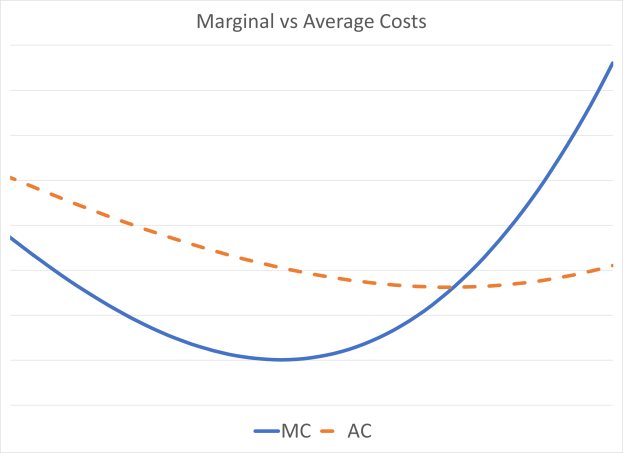
There’s deeper problem with the Holland et al papers. The chart that Fowlie pulls from the article showing that marginal emissions are rising above average emissions while average emissions are falling is not mathematically possible. (See for example, https://www.thoughtco.com/relationship-between-average-and-marginal-cost-1147863) For average emissions to be falling, marginal emissions must be falling and below average emissions. The hourly emissions are not “marginal” but more likely are the first derivative of the marginal emissions (i.e., the marginal emissions are falling at a decreasing rate.) If this relationship holds true for emissions, that also means that the same relationship holds for hourly market prices based on power plant hourly costs.

All of that said, it is important to incentivize charging during high renewable hours, but so long as we are adding renewables in a manner that quantitatively matches the added EV load, regardless of timing, we will still see falling average GHG emissions.

It is mathematically impossible for average emissions to fall while marginal emissions are rising if the marginal emission values are ABOVE the average emissions, as is the case in the Holland et al study. What analysts have heuristically called “marginal” emissions, i.e., hourly incremental fuel changes, are in fact, not “marginal”, but rather the first derivative of the marginal emissions. And as you point out the marginal change includes the addition of renewables as well as the change in conventional generation output. Marginal must include the entire mix of incremental resources. How marginal is measured, whether via change in output or over time doesn’t matter. The bottom line is that the term “marginal” must be used in a rigorous economic context, not in a casual manner as has become common.

Often the marginal costs do not fit the theoretical mathematical construct based on the first derivative in a calculus equation that economists point to. In many cases it is a very large discreet increment, and each consumer must be assigned a share of that large increment in a marginal cost analysis. The single most important fact is that for average costs to be rising, marginal costs must be above average costs. Right now in California, average costs for electricity are rising (rapidly) so marginal costs must be above those average costs. The only possible way of getting to those marginal costs is by going beyond just the hourly CAISO price to the incremental capital additions that consumption choices induce. It’s a crazy idea to claim that the first 99 consumers have a tiny marginal cost and then the 100th is assigned the responsibility for an entire new addition such as another flight scheduled or a new distribution upgrade.

We can consider the analogy to unit commitment, and even further to the continuous operation of nuclear power plants. The airline scheduled that flight in part based on the purchase of the plane ticket, not on the final decision just before the gate was closed. Not flying saved a miniscule amount of fuel, but the initial scheduling decision created the bulk of the fuel use for the flight. In a similar manner a power plant that is committed several days before an expected peak load burns fuels while idling in anticipation of that load. If that load doesn’t arrive, that plant avoids a small amount of fuel use, but focusing only on the hourly price or marginal fuel use ignores the fuel burned at a significant cost up to that point. Similarly, Diablo Canyon is run at a constant load year-round, yet there are significant periods–weeks and even months–where Diablo Canyon’s full operational costs are above the CAISO market clearing price average. The nuclear plant is run at full load constantly because it’s dispatch decision was made at the moment of interconnection, not each hour, or even each week or month, which would make economic sense. Renewables have a similar characteristic where they are “scheduled and dispatched” effectively at the time of interconnection. That’s when the marginal cost is incurred, not as “zero-cost” resources each hour.

Focusing solely on the small increment of fuel used as a true measure of “marginal” reflects a larger problem that is distorting economic analysis. No one looks at the marginal cost of petroleum production as the energy cost of pumping one more barrel from an existing well. It’s viewed as the cost of sinking another well in a high cost region, e.g., Kern County or the North Sea. The same needs to be true of air travel and of electricity generation. Adding one more unit isn’t just another inframarginal energy cost–it’s an implied aggregation of many incremental decisions that lead to addition of another unit of capacity. Too often economics is caught up in belief that its like classical physics and the rules of calculus prevail.

A Residential Energy Retrofit Greenhouse Gas Emission Offset Reverse Auction Program

In most local California jurisdictions, the largest share of stationary emissions will continue to come from the existing buildings. On the other hand, achieving zero net energy (ZNE) or zero net carbon (ZNC) for new developments can be cost prohibitive, particularly if incremental transportation emissions are included. A Residential Retrofit Offset Reverse Auction Program (Retrofit Program) aims to balance emission reductions from both new and existing buildings s to lower overall costs, encourage new construction that is more energy efficient, and incentivize a broader energy efficiency marketplace for retrofitting existing buildings.

The program would collect carbon offset mitigation fees from project developers who are unable to achieve a ZNE or ZNC standard with available technologies and measures. The County would then identify eligible low-income residential buildings to be targeted for energy efficiency and electrification retrofits. Contractors then would be invited to bid on how many buildings they could do for a set amount of money.

The approach proposed here is modeled on the Audubon Society’s and The Nature Conservacy’s BirdReturns Program.[1] That program contracts with rice growers in the Sacramento Valley to provide wetlands in the Pacific Flyway. It asks growers to offer a specified amount of acreage with given characteristics for a set price–that’s the “reverse” part of the auction.

A key impediment to further adoption of energy efficiency measures and appliances is that contractors do not have a strong incentive to “upsell” these measures and products to consumers. In general, contractors pass through most of the hardware costs with little markup; their profits are made on the installation and service labor. In addition, contractors are often asked by homeowners and landlords to provide the “cheapest” alternative measured in initial purchase costs without regard to energy savings or long-term expenditures.

The Retrofit Program is intended to change the decision point for contractors to encourage homeowners and landlords to implement upgrades that would create homes and buildings that are more energy efficient. Contractors would bid to install a certain number of measures and appliances that exceed State and local efficiency standards in exchange for payments from the Retrofit Program. The amount of GHG reductions associated with each type of measure and appliance would be predetermined based on a range of building types (e.g., single-family residential by floor-size category, number of floors, and year built). The contractors can use the funds to either provide incentives to consumers or retain those funds for their own internal use, including increased profits. Contractors may choose to provide more information to consumers on the benefits of improved energy efficiency as a means of increasing sales. Contractors would then be compensated from the Offset Program fund upon showing proof that the measures and appliances were installed. The jurisdiction’s building department would confirm the installation of these measures in the normal course of its permit review work.

Funds for the Retrofit Program would be collected as part of an ordinance for new building standards to achieve the no-net increase in GHG emissions. It also could be included as a mitigation measure for projects falling under the purview of the California Environmental Quality Act (CEQA.)

The Retrofit Program would be financed by mitigation payments made by building developers to achieve a no-net increase in GHG emissions. Buildings would be required to meet the lowest achievable GHG emission levels, but then would pay to mitigate any remainders, including for transportation, charged at the current State Cap and Trade Program auction price for an extended collection of annual allowances[2] that cover emissions for the expected life of the building (e.g., 40 years) (CARB 2024).

M.Cubed proposed this financing mechanism for Sonoma County in its climate action plan.


[1] See https://birdreturns.org/

[2] Referred to as a “strip” in the finance industry.

A Working Lands Carbon Mitigation Bank Program

A number of counties in California are largely agricultural, with a few small communities. Most of that agricultural land is intensively farmed, much of it irrigated. This situation presents the opportunity to sequester large amounts of carbon relative to the total greenhouse gas emissions from all county activities. In other words, the county can approach a level of net-zero emissions with a surplus available to share with other jurisdictions, particularly with those in within a county.

Since many of these counties are already planning to use this sequestration strategy to meet its own emission reduction goals, these reductions will be real, additional, and verifiable, meeting the gold standard for use as credits by other jurisdictions. The county has a strong incentive to ensure that these reductions are of sufficient quality to meet its own targets, which should make these attractive to other jurisdictions, unlike other credits offered in the marketplace.

A county would establish a Carbon Mitigation Bank using a similar framework to habitat conservation mitigation banks.[1] The county would establish the parameters that achieve the requisite carbon sequestration and then collect in-lieu fees to cover the costs of the bank’s expenses. By expanding the number of jurisdictions contributing and receiving coverage, overall carbon emissions can be reduced more cost-effectively.

Sequestration from working lands can be achieved at a lower cost than most alternatives. For this reason, a county can use its surplus to finance much of its share of the sequestration program by offering it to cities in the county at a margin above the implementation cost sufficient to cover the county’s share of the costs as well. For example, it may cost $50 per CO2e ton sequestered, and the County may use only half of the potential sequestration to meet its own target. The County could then offer its surplus credits to the other jurisdictions at $100 per ton, which is likely less than the cost of additional reductions elsewhere, to cover the full program costs.

M.Cubed proposed this financing mechanism for both Yolo and Sonoma in their climate action plans. Both counties could potentially sequesters hundreds of thousands of tons annually, implying this could be a major revenue source for meeting broader targets.

Retail electricity rate reform will not solve California’s problems

Meredith Fowlie wrote this blog on the proposal to drastically increase California utilities’ residential fixed charges at the Energy Institute at Haas blog. I posted this comment (with some additions and edits) in response.

First, infrastructure costs are responsive to changes in both demand and added generation. It’s just that those costs won’t change for a customer tomorrow–it will take a decade. Given how fast transmission retail rates have risen and have none of the added fixed costs listed here, the marginal cost must be substantially above the current average retail rates of 4 to 8 cents/kWh.

Further, if a customer is being charged a fixed cost for capacity that is being shared with other customers, e.g., distribution and transmission wires, they should be able to sell that capacity to other customers on a periodic basis. While many economists love auctions, the mechanism with the lowest ancillary transaction costs is a dealer market akin a grocery store which buys stocks of goods and then resells. (The New York Stock Exchange is a type of dealer market.) The most likely unit of sale would be in cents per kWh which is the same as today. In this case, the utility would be the dealer, just as today. So we are already in the same situation.

Airlines are another equally capital intensive industry. Yet no one pays a significant fixed charge (there are some membership clubs) and then just a small incremental charge for fuel and cocktails. Fares are based on a representative long run marginal cost of acquiring and maintaining the fleet. Airlines maintain a network just as utilities. Economies of scale matter in building an airline. The only difference is that utilities are able to monopolistically capture their customers and then appeal to state-sponsored regulators to impose prices.

Why are California’s utility rates 30 to 50% or more above the current direct costs of serving customers? The IOUs, and PG&E in particular, over procured renewables in the 2010-2012 period at exorbitant prices (averaging $120/MWH) in part in an attempt to block entry of CCAs. That squandered the opportunity to gain the economics benefits from learning by doing that led to the rapid decline in solar and wind prices over the next decade. In addition, PG&E refused to sell a part of its renewable PPAs to the new CCAs as they started up in the 2014-2017 period. On top of that, PG&E ratepayers paid an additional 50% on an already expensive Diablo Canyon due to the terms of the 1996 Settlement Agreement. (I made the calculations during that case for a client.) And on the T&D side, I pointed out beginning in 2010 that the utilities were overforecasting load growth and their recorded data showed stagnant loads. The peak load from 2006 was the record until 2022 and energy loads have remained largely constant, even declining over the period. The utilities finally started listening the last couple of years but all of that unneeded capital is baked into rates. All of these factors point not to the state or even the CPUC (except as an inept monitor) as being at fault, but rather to the utilities’ mismanagement.

Using Southern California Edison’s (SCE) own numbers, we can illustrate the point. SCE’s total bundled marginal costs in its rate filing are 10.50 cents per kWh for the system and 13.64 cents per kWh for residential customers. In comparison, SCE’s average system rate is 17.62 cents per kWh or 68% higher than the bundled marginal cost, and the average residential rate of 22.44 cents per kWh is 65% higher. From SCE’s workpapers, these cost increases come primarily from four sources.

  1. First, about 10% goes towards various public purpose programs that fund a variety of state-initiated policies such as energy efficiency and research. Much of this should be largely funded out of the state’s General Fund as income distribution through the CARE rate instead. And remember that low income customers are already receiving a 35% discount on rates.
  2. Next, another 10% comes roughly from costs created two decades ago in the wake of the restructuring debacle. The state has now decreed that this revenue stream will instead be used to pay for the damages that utilities have caused with wildfires. Importantly, note that wildfire costs of any kind have not actually reached rates yet. In addition, there are several solutions much less costly than the undergrounding proposed by PG&E and SDG&E, including remote rural microgrids.
  3. Approximately 15% is from higher distribution costs, some of which have been created by over-forecasting load growth over the last 15 years; loads have remained stagnant since 2006.
  4. And finally, around 33% is excessive generation costs caused by paying too much for purchased power agreements signed a decade ago.

An issue raised as rooftop solar spreads farther is the claim that rooftop solar customers are not paying their fair share and instead are imposing costs on other customers, who on average have lower incomes than those with rooftop solar. Yet the math behind the true rate burden for other customers is quite straightforward—if 10% of the customers are paying essentially zero (which they are actually not), the costs for the remaining 90% of the customers cannot go up more than 11% [100%/(100%-10%) = 11% ]. If low-income customers pay only 70% of this—the 11%– then their bills might go up about 8%–hardly a “substantial burden.” (70% x 11% = 7.7%)

As for aligning incentives for electrification, we proposed a more direct alternative on behalf of the Local Government Sustainable Energy Coalition where those who replace a gas appliance or furnace with an electric receive an allowance (much like the all-electric baseline) priced at marginal cost while the remainder is priced at the higher fully-loaded rate. That would reduce the incentive to exit the grid when electrifying while still rewarding those who made past energy efficiency and load reduction investments.

The solution to high rates cannot come from simple rate design; as Old Surfer Dude points out, wealthy customers are just going to exit the grid and self provide. Rate design is just rearranging the deck chairs. The CPUC tried the same thing in the late 1990s with telcom on the assumption that customers would stay put. Instead customers migrated to cell phones and dropped their land lines. The real solution is going to require some good old fashion capitalism with shareholders and associated stakeholders absorbing the costs of their mistakes and greed.

Paradigm change: building out the grid with renewables requires a different perspective

Several observers have asserted that we will require baseload generation, probably nuclear, to decarbonize the power grid. Their claim is that renewable generation isn’t reliable enough and too distant from load centers to power an electrified economy.

Problem is that this perspective relies on a conventional approach to understanding and planning for future power needs. That conventional approach generally planned to meet the highest peak loads of the year with a small margin and then used the excess capacity to produce the energy needed in the remainder of the hours. This premise was based on using consumable fuel to store energy for use in hours when electricity was needed.

Renewables such as solar and wind present a different paradigm. Renewables capture and convert energy to electricity as it becomes available. The next step is to stored that energy using technologies such as batteries. That means that the system needs to be built to meet energy requirements, not peak loads.

Hydropower-dominated systems have already been built in this manner. The Pacific Northwest’s complex on the Columbia River and its branches for half a century had so much excess peak capacity that it could meet much of California’s summer demand. Meeting energy loads during drought years was the challenge. The Columbia River system could store up to 40% of the annual runoff in its reservoirs to assure sufficient supply.

For solar and wind, we will build enough capacity that is multiples of the annual peak load so that we can generate enough energy to meet those loads that occur when the sun isn’t shining and wind isn’t blowing. For example in a system relying on solar power, the typical demand load factor is 60%, i.e., the average load is 60% of the peak or maximum load. A typical solar photovoltaic capacity factor is 20%, i.e., it generates an average output that is 20% of the peak output. In this example system, the required solar capacity would be three times the peak demand on the system to produce sufficient stored electricity. The amount of storage capacity would equal the peak demand (plus a small reserve margin) less the amount of expected renewable generation during the peak hour.

As a result, comparing the total amount of generation capacity installed to the peak demand becomes irrelevant. Instead we first plan for total energy need and then size the storage output to meet the peak demand. (And that storage may be virtually free as it is embodied in our EVs.) This turns the conventional planning paradigm on its head.