Tag Archives: energy economics

Discerning what drives rate increases is more complex than shown in LBNL study

The renewables policy team at Lawrence Berkeley National Laboratory (LBNL) released a study maintaining that it identifies the primary drivers of rate increases in the U.S. LBNL also issued a set of slides summarizing the study but there discrepancies between the two. (This post focuses on the study.)

First, this group of authors have been important leaders in tracking technology costs and resource alternatives at a micro level. You can find many of their studies cited in my various posts on renewables and distributed energy resources (DER). This time the authors may have stretched a bit too far.

Unfortunately this study is much more about correlation than causality. The authors hint at a more complex story that would require much more sophisticated regression analysis (e.g., two or three stage and fixed effects regressions) to untangle. Yet the report uses the term “driver” numerous places when “correlation” or “association” would be more appropriate.

Observations about Table 2 that displays the regression results and the discussion about findings in Section 4:

  • 4.2 Price trends varied by state: Prices rose in states that are internalizing environmental and other costs while states with falling rates were continuing to impose environmental hazards and other costs on their citizens as a subsidy to utility shareholders.
  • 4.4 Finding that rising growth decreases rates (load delta): This finding confuses a shift in customer composition with overall causality. The study found it was rising commercial loads, not overall loads, that decreased rates. That means the share of lower cost commercial customers increased, so, of course, the average rate decreased. The residential rates were unchanged statistically.
  • 4.5 Behind the meter (BTM) solar: the most egregious error. The authors acknowledge this issue is problematic with many different viewpoints, but then plow ahead anyway. Customers find the most effective way to respond to rising rates is to install their own generation. This is classic economic cause and effect, yet the authors run a model assuming the reverse.

The problem is that they accept as given the utility narrative that rooftop customers are shirking cost responsibility while ignore the cost saving from serving load themselves. The authors also buy into the false narrative that utilities have substantial “fixed” costs—every other industry that has large fixed costs recover those through variable charges.  That the BTM variable is strongly negative for the 2017-22 period and then positive for 2019-24 is an analytic red flag. (The negative value for the RPS effect from 2016-2021 just as California’s most expensive renewables came on line compared to the other periods is another red flag in the regression analysis overall.)

Our analysis shows instead how California NEM customers have saved money for other customers. The authors do not include that critique of the studies done in California in their citations. We also deeply critiqued the E3 study of Washington’s NEM program, finding numerous analytic and conceptual errors. (Ahmad Faruqui would disavow his Sergici et al 2019 study included as a supporting citation in the LBNL study.)

There are two fundamental conceptual errors in these underlying analyses that the LBNL authors rely on: 1) that utilities have the right to serve 100% of customer loads and customers must pay for the privilege to self serve with their own generation, and 2) that utilities are entitled to full recovery of all of their costs even when sales decrease. Neither of these premises hold in any other industry (even natural gas and water utilities).

Notably they found no statistical effect from energy efficiency programs yet the impacts on utility sales and revenues are identical to BTM solar. No one is calling for customers who install LED lighting, insulation or more efficient appliances to increase their contribution utility revenue requirements to be “fair.” The one difference is that DERs present the opportunity to truly “cut the cord” with the utility if rates become excessive. This is further evidence that this finding that rooftop solar unduly raises the rates for other customers is false and misleading.

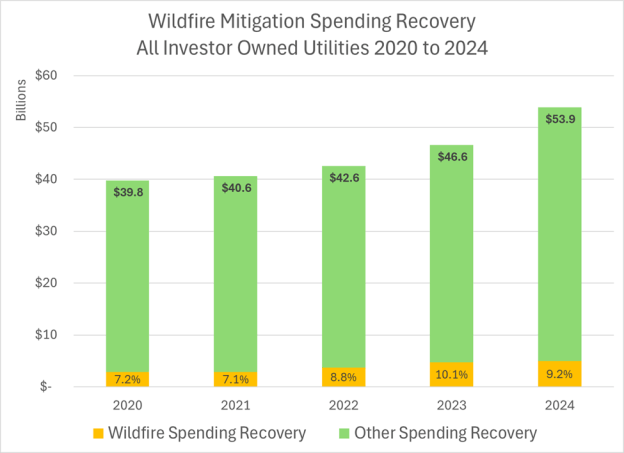
  • 4.9 Wildfire spending as a source of cost increases: the authors attribute a 6 cents/kWh increase in California wildfire spending. That’s incorrect (the PAO took PG&E’s assertion without checking it) as we have tracked the total utility spending—it’s only about 10% or less than 4 cents/kWh of IOU rates. But a portion of that increase already happened prior to 2019, and the wildfire bond adder wasn’t an increase but rather a repurposing of an existing bond cost recovery charge. The rate increase attributable to wildfire spending is less than 3 cents on a statewide basis (rolling in the municipals, e.g., LADWP & SMUD).

The real reason for California rate increases are: 1) unusual exposure to natural gas prices because the IOUs have not hedged power purchases 2) increase in resource adequacy prices because of multiple changes in how this handled (the underlying reason being to squeeze CCAs), 3) unregulated spending in distribution infrastructure the IOUs starting in 2010 and 3) a 150% increase in transmission investment to deliver grid scale renewable generation since 2012. 

A key policy tool intended to promote energy efficiency is instead being used against saving energy

A cornerstone policy meant to promote energy efficiency is now being used as a weapon against energy savings. Decoupling the recovery of utilities’ costs and profits from electricity sales was intended to remove utilities’ opposition to promoting California’s resource loading order of using energy efficiency and distributed energy resources first.[1] Instead, protecting those revenue requirements and the associated utility profits, thus avoiding financial risk to shareholders, has become the paramount objective of the state’s decoupling policy at the expense of both reducing dependence on utility generation and increasing consumer sovereignty.[2] We are told that we need to increase our energy consumption to reduce the energy rates for those who have not reduced their utility purchases. The intent of decoupling has been turned on its head.

The premise of the ”cost shift” argument that asserts saving energy by one customer causes higher rates for other customers relies on an interpretation of decoupling whereby utility shareholders are shielded from suffering any financial losses caused by consumers turning elsewhere to find their energy services. This is one logical extension of decoupling, albeit not the one intended by those who originated this concept. Under this flawed rubric, each customer has an obligation to pay a share of the utility’s fixed and stranded costs. When a customer reduces their usage and their electricity bill, they are shirking this obligation according to the cost-shift argument.

Using the underlying rationale that utilities are guaranteed to recover their costs once approved by the CPUC and FERC, whether a customer-installed resource has a cost more or less than the social marginal cost is irrelevant unless that marginal cost is higher than the retail rate. Under this reasoning the customer owes the full amount of the retail rate and only receives a credit for saving energy that cannot exceed the marginal cost. The customer still owes the difference between the retail rate and the marginal cost and other customers must pick up that foregone sales revenue from the savings. Once a utility is authorized to collect a set amount of revenues, a customer has no escape from the corporate burden.

That presumption eliminates the ability to use market discipline through consumer choice to control rates (except moving out of state or to a municipal utility area). Under this reasoning, the only means of containing utility rates and mitigating bills is via regulatory action by the CPUC and FERC.

The problem is that regulators were supposed to strictly cap utility spending so that consumers could make their own choices about how to best meet their energy needs.[3] The utilities discovered that the regulators were not so vigilant and that the utilities could easily justify added utility-owned resources that were rolled into revenue requirements. The recovery of those costs was then protected from risk of either competition from customer resources or prudency review by policies implementing decoupling.

As a result, California’s utility rates have skyrocketed over the last two decades, with grid costs rising four times faster than inflation. These have reached crisis levels and state policy makers are desperately searching for easy solutions. Hence, the “cost shift” myth identifies the “true villains”—those customers who thought they were doing the right thing. Now they need to be punished.

When faced with declining sales and revenues, every other business cannot simply demand that customers make up the difference between the business’ current costs and its falling revenues. The business instead must either cut costs or provide a better service or product that attracts back those or other customers. The innovation motivated by this “creative destruction” as Joseph Schumpeter described it is at the core of the benefits we accrue from a market economy. Hinder that process and we get stagnation. The phased deregulation of the electricity market started with the 1978 PURPA is an important example of innovation was unleashed by removing the utilities’ ability to veto customers’ investments in their own resources. Without PURPA and the subsequent reforms, we would never had the technological revolution that both gives cost effective renewable energy resources and customers more control over their own energy use.

“Fixed” costs are not an explanation for rising rates

We also know that the supposed “fixed” costs of the utility system are not large. Generation and transmission resources are constantly redeployed among customers which is normal market functionality; these are not fixed costs, rather they are reallocated to customers who use more of those facilities. This is why grocery stores don’t charge customers to simply enter a store where 80% of the costs are don’t change with individual sales. Even in the distribution circuits, customers share most of the network with other customers; these costs are not fixed per-customer. Cell companies rarely require more than 12-month contracts with similar cost structures. (Three-year contracts are for paying off new phones and can be avoided by purchasing unlocked phones.)

The facts are that the various policy program costs are about the same as they have been for two decades at 10% of rates (and within that portion, energy efficiency should be classified as a resource cost just like generation), and the lion’s share of wildfire-related costs, which are only another 10%, were added four years ago and have risen only slightly since. Meanwhile PG&E increased its rates 50% over the last four years and the other two have or will increase their rates substantially.

The CPUC issued an order that the utilities impose a fixed charge of $24 per month for standard residential customers to cover those purported fixed costs. That’s approximately equal to the share of utility costs that might be considered fixed or related to state policy directives.

Rapidly rising rates is evidence that marginal costs are higher than retail rates and customer investment in new resources saves all ratepayers money

A key premise of the cost-shift argument is that these customers’ loads now being met by energy efficiency and DERs can be served by the existing utility system at little additional cost. In other words, these customers departed a system already built to accommodate their usage. That’s incorrect as one customer’s reduced load is an opportunity for another customer’s increased load to be served without an additional generation, transmission and distribution investment at today’s inflated costs.  My more efficient refrigerator makes room for my neighbor’s hot tub, electric vehicle, or perhaps a needed medical appliance.

This premise overlooks that these customer resources have met at least a quarter on the energy demand since 2000. The true customer peak is three hours earlier and at least 12,000 megawatts higher than the metered CAISO peak. Based on historic utility costs over that period, annual utility revenue requirements would have increased $14 billion. California already struggled to bring on enough renewable energy over that period—the costs and environmental consequences of using utility generation would likely be even higher.

Claims that customers who save energy cause higher bills for other customers is premised on the unfounded notion that customers are departing from an already existing system built to accommodate their growing future demand. The cost shift analysis starts with today’s situation and then assumes that a customer who installs energy efficiency or rooftop solar is leaving a system already built to serve their current load.

Customers have also added additional loads, including more than one million electric vehicles.  But for the reduction in loads from customer-installed resources, these additional loads would have required billions of dollars of investment in power supply and distribution capacity.  Now, in many cases utilities built the additional capacity anyway – and it is a shortcoming of regulation that these costs were allowed into customer rates when the needed capacity was supplied by customer resources.

The fact is that a utility system is an aging and dynamic network that is constantly retiring and acquiring equipment to serve an ever-changing group of customers. For California, loads were forecasted to grow another 20% from 2005 to now. Instead, those loads have been flat as consumers have acquired their own resources, including LED lights, insulation, smart thermostats, double paned windows, insulation or solar panels. The metered peak shifted three hours later in the day, but the true customer peak still occurs mid-afternoon but it is met by customer-owned resources instead. A fifth of the true customer peak is now served by rooftop solar and a quarter of the state’s energy load comes from energy efficiency plus DERs. Much of that solar output is captured costlessly in hydro storage and used to meet that later peak.  Any analysis must look at what it would have cost over those two decades to build the resources to serve those loads that instead are now served by individually-invested savings and generation.

We know that generation costs were significantly higher than that today’s costs (thanks to innovation) and that resources located at the point of use saves 30% or more in avoided peak losses and reserve power capacity. We know that those customer resources displaced adding new transmission that costs three times more than the average that is charged in retail rates. We know that the utilities consistently overforecasted the need for distribution infrastructure without consequence, and that the transmission and distribution rate components increased about 300% over the last two decades which is four times faster than inflation. Meanwhile, we also know that utility rates increased at the same pace as utility costs reflected in revenue requirements. This is important because if a other ratepayers were picking up the bills for customers who conserve and self generate, the rates would be increasing faster than revenue requirements as demand decreased. This is the essential element of the “death spiral” concept. There is no evidence of a death spiral yet.

The belief that these “departed” loads could have been served at little additional cost is unfounded based on the empirical evidence. If we conservatively use the average retail generation rate or 8.8 cents per kilowatt-hour in 2023 as representative of the true marginal cost,[4] add 12.5 cents per kilowatt-hour for the marginal cost of transmission, and then add an average of 4.4 cents per kilowatt-hour for avoided distribution costs from the utilities general rate case applications, the base avoided cost is 25.7 cents per kilowatt-hour. We then adjust the generation and transmission costs for 7% line losses and a 15% reserve margin, we are at 30.6 cents per kilowatt-hour for the actual marginal cost at the customer meter. In comparison, the average retail rate was only 27.8 cents per kilowatt in 2023 so customers investing in energy efficiency and rooftop solar are reducing incremental costs by 10%. And of course, this does not include environmental benefits, local economic activity or improved local energy resiliency. The total cost to serve the 89,000 gigawatt-hours saved would be $17 billion or a 30% increase in revenue requirements.

As is often the case, diagnosing the problem doesn’t mean that we have an immediate solution. That said, the objective should be to put utility shareholders at risk for excessive investments made based on optimistic growth forecasts. Having “used and useful” standards for asset utilization rates and unit-of-production depreciation are ways of extending cost recovery that lowers rates. However, those types of solutions are likely to move utilities back to opposing EE programs. The best solution is to create a competitive EE utility like the NW Energy Efficiency Alliance.

Today, we see that California is still struggling to bring on enough clean energy resources to meet its ambitious climate change mitigation goals. Diablo Canyon’s retirement was delayed and the state is not even approaching the threshold for installing renewables to meet the SB 100 clean energy target of 100% by 2045. The only viable alternatives are greater reliance on aggressive energy efficiency paired with electrification and customer-owned renewable generation. Misinterpreting the intention of decoupling should not be used as a barrier to reaching our goals.


[1] California first instituted decoupling in 1978 and then paused it in 1996 for restructuring. The system was restarted in 2002.

[2] It literally takes killing customers to put a utility at financial risk. See “ SDG&E Customers Should Not Pay for 2007 Wildfires: SCOTUS,” NBC 7 News, https://www.nbcsandiego.com/news/local/us-supreme-court-sdge-wildfires-costs-lines-utility-fire-damage/1966157/, October 8, 2019; “PG&E receives maximum sentence for 2010 San Bruno explosion,” ABC 7 News, https://abc7news.com/post/pg-e-receives-maximum-sentence-for-2010-san-bruno-explosion/1722674/, January 28. 2017; “Ex-PG&E execs to pay $117M to settle lawsuit over wildfires,” AP News, https://apnews.com/article/wildfires-business-fires-lawsuits-california-450c961a4c6b467fcfb5465e7b9c5ae7, September 29, 2022; “PG&E Pleads Guilty On 2018 California Camp Fire: ‘Our Equipment Started That Fire’,” NPR CapRadio, https://www.npr.org/2020/06/16/879008760/pg-e-pleads-guilty-on-2018-california-camp-fire-our-equipment-started-that-fire, June 16, 2020. SCE may be facing a similar risk after the Easton Fire in January 2025. “Southern California Edison likely to incur ‘material losses’ related to Eaton fire, executive says,” LA Times, https://www.latimes.com/business/story/2025-04-30/edison-earnings-eaton-fire-losses, April 30, 2025.

[3] Decoupling delinked profits from actual sales and instead linked them to forecasted sales used to justify infrastructure investment. This removed the risk of overforecasting sales and perhaps falling short on recovering costs. And we see evidence of that practice in both PG&E’s and SCE’s forecasts used to justify investments from 2009 to 2018. The regulatory failure is that the CPUC didn’t go back and audit whether the investments were justified given that the sales didn’t materialize. Decoupling only works with a regulatory scheme that gives strong incentives for cost control.

[4] The 2024 rates were much higher for the utilities but it’s more difficult to calculate the average.

PG&E already has $300 million to contribute to removing Potter Valley

PG&E announced that it projects the cost of decommissioning the Scott and Van Horn Dams in the Potter Valley Project will cost $532 million. However, by 2029 PG&E will have already collected from ratepayers $321 million towards that cost in depreciation expenses.

PG&E makes capital investments in generation, transmission and distribution equipment, and then recovers those investments on an annual basis akin to a mortgage payment. The annual cost recovery rate is computed as a sum of the cost of capital, defined as shareholder return and debt interest rate, plus the depreciation expense which is calculated based on the expected life of the equipment.

Depreciation has two parts. The first goes towards recovery of the initial cost of construction. This is on top of the authorized rate of return that covers debt interest and shareholders return on equity. The second is the salvage value which is the expected value of the remaining components at the end of the life of the asset. Except in the case of dams, that salvage value is negative due to the cost of decommissioning.

PG&E is collecting these depreciation expenses including decommissioning costs for its entire fleet of hydropower projects. In effect, PG&E has created an insurance fund for its full portfolio of projects and the cost of any single decommissioning comes from this portfolio insurance fund. While PG&E placed a 25% probability that Potter Valley would be decommissioned, it calculated a portfolio-wide probability of decommissioning at 22%. Many of these projects will not be decommissioned for at least another half century as they were recently relicensed and probably even longer given the value of these assets for power production. Those unexpended decommissioning funds collected for projects likely to operate for the foreseeable future (e.g., the Feather River Project) are intended to be spent on actual projects such as Potter Valley rather than just to continue to accrue income for shareholders and creditors.

As part of its triennial General Rate Case (GRC) application, PG&E estimated the costs to decommission hydropower facilities as part of depreciation studies used to compute capital cost recovery rates. In Chapter 8 of its GRC filing in Application 18-12-009, filed December 2018,[1] PG&E reported the estimated 2022 decommissioning cost for Potter Valley at $196.3 million. PG&E estimated the total decommissioning costs for the projects included in their list of hydropower projects was $830.0 million.

Based on PG&E’s collection of $196 million by 2022 towards Potter Valley’s decommissioning and the authorized rate of return on investment of 7.27%, PG&E will have $321 million already banked in 2029 to commit to the decommissioning. This leaves $211 million or 40% of PG&E’s projected cost to be paid in addition from other sources, including ratepayers.

As an aside, PG&E’s cost estimate is in line with initial estimates our project team made for the Two Basin Solution coalition in 2020. We also found that each of the options cost approximately the same, similar to the results another team I worked on projected in 2006 for decommissioning the Klamath Project.


[1] PG&E, “Hydro Decommissioning WPS Exhibit 5 Chapter 8.pdf”, A.18-12-009, December 2018.

White paper on how rooftop solar is really a benefit to all ratepayers

In cooperation with the California Solar & Storage Association, M.Cubed is releasing a white paper Rooftop Solar Reduces Costs for All Ratepayers.

As California policy makers seek to address energy affordability in 2025, this report shows why rooftop solar can and has helped control rate escalation. This research stands in direct contrast to claims that rooftop solar is to blame for rising rates. The report shows that the real reason electricity rates have increased dramatically in recent years is out-of-control utility spending and utility profit making, enabled by a lack of proper oversight by regulators.

This work builds on the original short report issued in November 2024, and subsequent replies to critiques by the Public Advocates Office and Professor Severin Borenstein. The supporting workpapers can be found here.

Policy makers wanting to address California’s affordability crisis should reject the utility’s so-called “solar cost shift” and instead partner with consumers who have helped save all ratepayers $1.5 billion in 2024 alone by investing in rooftop solar. The state should prioritize these resources that simultaneously reduce carbon, increase resiliency, and minimize grid spending. This realignment of energy priorities away from what works for investor-owned utilities – spending more on the grid – and toward what works for consumers – spending less – is particularly important in the face of increased electricity consumption due to electrification. More rooftop solar is needed, not less, to control costs for all ratepayers and meet the state’s clean energy goals.

Utilities have peddled a false “cost shift” theory that is based on the concept of “departing load.” Utilities claim that the majority of their costs are fixed. When a customer generates their own power from onsite solar panels, the utilities claim this forces all other ratepayers to pick up a larger share of their “fixed” costs. A close look at hard data behind this theory, however, shows a different picture.

While California’s gross consumption – the “plug load” that is actual electricity consumption – has grown, that growth has been offset by customer-sited rooftop solar. This has kept the state’s peak consumption from the grid remarkably flat over the past twenty years, despite population growth, temperature increases, increased economic activity, and the rise in computers and other electronics in homes and businesses. Rooftop solar has not caused departing load in California. It has avoided load growth. By keeping our electric load on the grid flat, rooftop solar has avoided expensive grid expansion projects, in addition to reducing generation expenses, lowering costs for everyone.

Contrary to messaging from utilities and their regulators, California electricity consumption still peaks in mid-afternoon on hot summer days. There has been so much focus on the evening “net peak,” depicted by the “duck curve,” that many people have lost sight of the true peak. The annual peak in plug load happens when the sun is shining brightest. Clear, hot days lead to both high electricity usage from air conditioning and peak solar output.

The “net peak” is grid-based consumption minus generation from utility-scale solar and wind farms. It is an important dynamic to look at as we seek to reduce non-renewable sources of energy, and it shows us that energy storage will be essential going forward. However, an exclusive focus on net peak misses a bigger picture, particularly when looking at previously installed resources, and hides the value of solar energy.
California’s two million rooftop solar systems installed under net metering, including those that do not have batteries, continue to reduce statewide costs year after year by reducing the true peak. While most new solar systems now have batteries to address the evening net peak, historic solar continues to play a critical role in addressing the mid-day true peak.

Utilities and their regulators ignore these facts and focus the blame of rising rates on consumers seeking relief via rooftop solar. Politicians looking to address a growing crisis of energy affordability in California should reject the scapegoating of working- and middle-class families who have invested their own money in rooftop solar, and should instead promote the continued growth of this important distributed resource to meet growing needs for electricity.

The state is at a crossroads. As we power more of our cars, appliances, and heating with electricity, usage will increase dramatically. Relying entirely on utilities to deliver that energy from faraway power plants on long-distance power lines would involve massive delays and cause costs to rise even higher. Aggressive rooftop solar deployment could offset significant portions of the projected demand increase from electrification, helping control costs in the future.

The real reason for rate increases is runaway utility spending, driven by the utilities’ interest in increasing profits. Utility spending on grid infrastructure at the transmission and distribution levels has increased 130%-260% for each of the utilities over the past 8-12 years. These increases in spending track at a nearly 1:1 ratio with rate increases. This demonstrates that rates have gone up because utility spending has gone up. If utility costs were anything close to fixed and rates kept going up, there could be room for a cost shift argument. Or, if utility spending increased and rates increased significantly more, there could be a cost shift. The data shows neither of these trends. Rates have been increasing commensurate with spending, demonstrating that it is utility spending increases that have caused rates to increase, not consumers investing in clean energy.

Inspired by this faulty approach to measuring solar costs and benefits, the CPUC rolled out a transition from net metering to net billing that was abrupt and extreme. It has caused massive layoffs of skilled solar professionals and bankruptcies or closures of long-standing solar businesses. The poorly managed policy change set the market back ten years. A year and a half after the transition, the market still has not recovered.
California needs more rooftop solar and customer-sited batteries to contain costs and thereby rein in rate increases for all California ratepayers. To get the state back on track, policy makers need to stop attacking solar and adopt smart policies without delay.

• Respect the investments of customers who installed solar under NEM-1 and NEM-2. Do not change the terms of those contracts.
• Reject solar-specific taxes or fees in all forms, via the CPUC, the state budget, or local property taxes.
• Cut red tape in permitting and interconnection, and restore the right of solar contractors to install batteries. Do not use contractor licensing rules at the CSLB to restrict solar contractors from installing batteries.
• Establish a Million Solar Batteries initiative that includes virtual power plants and targeted incentives.
• Fix perverse utility profit motives that drive utilities to spend ratepayer money inefficiently, and even unnecessarily, and that motivate them to fight rooftop solar and other alternative ways to power California families and businesses.
• Launch a new investigation into utility oversight and overhaul the regulatory structure such that government regulators have the ability to properly scrutinize and contain utility spending.

California should be proud of its globally significant rooftop solar market. This solar development has diversified resources, served as a check on runaway utility spending, and helped clean the air all while tapping into private investments in clean energy. As the state looks to decarbonize its economy, the need to generate energy while minimizing capital intensive investments in grid infrastructure makes distributed solar and storage an even higher priority. State regulators need to stop being weak in utility oversight and exercise bold leadership for affordable clean energy that will benefit all ratepayers. California can start by getting back to promoting, not attacking, rooftop solar and batteries for all consumers.

How to properly calculate the marginal GHG emissions from electric vehicles and electrification

Recently the questions about whether electric vehicles increase greenhouse gas (GHG) emissions and tracking emissions directly to generation on a 24/7 basis have gained saliency. This focus on immediate grid-created emissions illustrates an important concept that is overlooked when looking at marginal emissions from electricity. The decision to consume electricity is more often created by a single large purchase or action, such as buying a refrigerator or a new electric vehicle, than by small decisions such as opening the refrigerator door or driving to the grocery store. Yet, the conventional analysis of marginal electricity costs and emissions assumes that we can arrive at a full accounting of those costs and emissions by summing up the momentary changes in electricity generation measured at the bulk power markets created by opening that door or driving to the store.

But that’s obviously misleading. The real consumption decision that created the marginal costs and emissions is when that item is purchased and connected to the grid. And on the other side, the comparative marginal decision is the addition of a new resource such as a power plant or an energy efficiency investment to serve that new increment of load.

So in that way, your flight to Boston is not whether you actually get on the plane, which is like opening the refrigerator door, but rather your purchase of the ticket which led to the incremental decision by the airline to add another scheduled flight. It’s the share of the fuel use for that added flight which is marginal, just as buying a refrigerator is responsible for the share of the energy from the generator added to serve the incremental long-term load.

There are growing questions about the use of short run market prices as indicators of market value of generation assets for a number of reasons. This paper critiquing “surge” pricing on the grid has one set of aspects that undermine that principle.

Meredith Fowley at the Energy Institute at Haas compared two approaches to measuring the additional GHG emissions from a new electric vehicle. The NREL paper uses the correct approach of looking at longer term incremental resource additions rather than short run operating emissions. The hourly marginal energy use modeled by Holland et al (2022) is not particularly relevant to the question of GHG emissions from added load for several reasons and for that reason any study that doesn’t use a capacity expansion model will deliver erroneous results. In fact, you will get more accurate results from relying on a simple spreadsheet model using capacity expansion than a complex production cost hourly model.

In the electricity grid, added load generally doesn’t just require increased generation from existing plants, but rather it induces investment in new generation (or energy savings elsewhere, which have zero emissions) to meet capacity demands. This is where economists make a mistake thinking that the “marginal” unit is additional generation from existing plants–in a capacity limited system such as the electricity grid, its investment in new capacity.

That average emissions are falling as shown in Holland et al while hourly “marginal” emissions are rising illustrates this error in construction. Mathematically that cannot be happening if the marginal emission metric is correct. The problem is that Holland et al have misinterpreted the value they have calculated. It is in fact not the first derivative of the average emission function, but rather the second partial derivative. That measures the change in marginal emissions, not marginal emissions themselves. (And this is why long-run marginal costs are the relevant costing and pricing metric for electricity, not hourly prices.) Given that 75% of new generation assets in the U.S. were renewables, it’s difficult to see how “marginal” emissions are rising when the majority of new generation is GHG-free.

The second issue is that the “marginal” generation cannot be identified in ceteris paribus (i.e., all else held constant) isolation from all other policy choices. California has a high RPS and 100% clean generation target in the context of beneficial electrification of buildings and transportation. Without the latter, the former wouldn’t be pushed to those levels. The same thing is happening at the federal level. This means that the marginal emissions from building decarbonization and EVs are even lower than for more conventional emission changes.

Further, those consumers who choose beneficial electrification are much more likely to install distributed energy resources that are 100% emission free. Several studies show that 40% of EV owners install rooftop solar as well, far in excess of the state average, (In Australia its 60% of EV owners.) and they most likely install sufficient capacity to meet the full charging load of their EVs. So the system marginal emissions apply only to 60% of EV owners.

There may be a transition from hourly (or operational) to capacity expansion (or building) marginal or incremental emissions, but the transition should be fairly short so long as the system is operating near its reserve margin. (What to do about overbuilt systems is a different conversation.)

There’s deeper problem with the Holland et al papers. The chart that Fowlie pulls from the article showing that marginal emissions are rising above average emissions while average emissions are falling is not mathematically possible. (See for example, https://www.thoughtco.com/relationship-between-average-and-marginal-cost-1147863) For average emissions to be falling, marginal emissions must be falling and below average emissions. The hourly emissions are not “marginal” but more likely are the first derivative of the marginal emissions (i.e., the marginal emissions are falling at a decreasing rate.) If this relationship holds true for emissions, that also means that the same relationship holds for hourly market prices based on power plant hourly costs.

All of that said, it is important to incentivize charging during high renewable hours, but so long as we are adding renewables in a manner that quantitatively matches the added EV load, regardless of timing, we will still see falling average GHG emissions.

It is mathematically impossible for average emissions to fall while marginal emissions are rising if the marginal emission values are ABOVE the average emissions, as is the case in the Holland et al study. What analysts have heuristically called “marginal” emissions, i.e., hourly incremental fuel changes, are in fact, not “marginal”, but rather the first derivative of the marginal emissions. And as you point out the marginal change includes the addition of renewables as well as the change in conventional generation output. Marginal must include the entire mix of incremental resources. How marginal is measured, whether via change in output or over time doesn’t matter. The bottom line is that the term “marginal” must be used in a rigorous economic context, not in a casual manner as has become common.

Often the marginal costs do not fit the theoretical mathematical construct based on the first derivative in a calculus equation that economists point to. In many cases it is a very large discreet increment, and each consumer must be assigned a share of that large increment in a marginal cost analysis. The single most important fact is that for average costs to be rising, marginal costs must be above average costs. Right now in California, average costs for electricity are rising (rapidly) so marginal costs must be above those average costs. The only possible way of getting to those marginal costs is by going beyond just the hourly CAISO price to the incremental capital additions that consumption choices induce. It’s a crazy idea to claim that the first 99 consumers have a tiny marginal cost and then the 100th is assigned the responsibility for an entire new addition such as another flight scheduled or a new distribution upgrade.

We can consider the analogy to unit commitment, and even further to the continuous operation of nuclear power plants. The airline scheduled that flight in part based on the purchase of the plane ticket, not on the final decision just before the gate was closed. Not flying saved a miniscule amount of fuel, but the initial scheduling decision created the bulk of the fuel use for the flight. In a similar manner a power plant that is committed several days before an expected peak load burns fuels while idling in anticipation of that load. If that load doesn’t arrive, that plant avoids a small amount of fuel use, but focusing only on the hourly price or marginal fuel use ignores the fuel burned at a significant cost up to that point. Similarly, Diablo Canyon is run at a constant load year-round, yet there are significant periods–weeks and even months–where Diablo Canyon’s full operational costs are above the CAISO market clearing price average. The nuclear plant is run at full load constantly because it’s dispatch decision was made at the moment of interconnection, not each hour, or even each week or month, which would make economic sense. Renewables have a similar characteristic where they are “scheduled and dispatched” effectively at the time of interconnection. That’s when the marginal cost is incurred, not as “zero-cost” resources each hour.

Focusing solely on the small increment of fuel used as a true measure of “marginal” reflects a larger problem that is distorting economic analysis. No one looks at the marginal cost of petroleum production as the energy cost of pumping one more barrel from an existing well. It’s viewed as the cost of sinking another well in a high cost region, e.g., Kern County or the North Sea. The same needs to be true of air travel and of electricity generation. Adding one more unit isn’t just another inframarginal energy cost–it’s an implied aggregation of many incremental decisions that lead to addition of another unit of capacity. Too often economics is caught up in belief that its like classical physics and the rules of calculus prevail.

A Residential Energy Retrofit Greenhouse Gas Emission Offset Reverse Auction Program

In most local California jurisdictions, the largest share of stationary emissions will continue to come from the existing buildings. On the other hand, achieving zero net energy (ZNE) or zero net carbon (ZNC) for new developments can be cost prohibitive, particularly if incremental transportation emissions are included. A Residential Retrofit Offset Reverse Auction Program (Retrofit Program) aims to balance emission reductions from both new and existing buildings s to lower overall costs, encourage new construction that is more energy efficient, and incentivize a broader energy efficiency marketplace for retrofitting existing buildings.

The program would collect carbon offset mitigation fees from project developers who are unable to achieve a ZNE or ZNC standard with available technologies and measures. The County would then identify eligible low-income residential buildings to be targeted for energy efficiency and electrification retrofits. Contractors then would be invited to bid on how many buildings they could do for a set amount of money.

The approach proposed here is modeled on the Audubon Society’s and The Nature Conservacy’s BirdReturns Program.[1] That program contracts with rice growers in the Sacramento Valley to provide wetlands in the Pacific Flyway. It asks growers to offer a specified amount of acreage with given characteristics for a set price–that’s the “reverse” part of the auction.

A key impediment to further adoption of energy efficiency measures and appliances is that contractors do not have a strong incentive to “upsell” these measures and products to consumers. In general, contractors pass through most of the hardware costs with little markup; their profits are made on the installation and service labor. In addition, contractors are often asked by homeowners and landlords to provide the “cheapest” alternative measured in initial purchase costs without regard to energy savings or long-term expenditures.

The Retrofit Program is intended to change the decision point for contractors to encourage homeowners and landlords to implement upgrades that would create homes and buildings that are more energy efficient. Contractors would bid to install a certain number of measures and appliances that exceed State and local efficiency standards in exchange for payments from the Retrofit Program. The amount of GHG reductions associated with each type of measure and appliance would be predetermined based on a range of building types (e.g., single-family residential by floor-size category, number of floors, and year built). The contractors can use the funds to either provide incentives to consumers or retain those funds for their own internal use, including increased profits. Contractors may choose to provide more information to consumers on the benefits of improved energy efficiency as a means of increasing sales. Contractors would then be compensated from the Offset Program fund upon showing proof that the measures and appliances were installed. The jurisdiction’s building department would confirm the installation of these measures in the normal course of its permit review work.

Funds for the Retrofit Program would be collected as part of an ordinance for new building standards to achieve the no-net increase in GHG emissions. It also could be included as a mitigation measure for projects falling under the purview of the California Environmental Quality Act (CEQA.)

The Retrofit Program would be financed by mitigation payments made by building developers to achieve a no-net increase in GHG emissions. Buildings would be required to meet the lowest achievable GHG emission levels, but then would pay to mitigate any remainders, including for transportation, charged at the current State Cap and Trade Program auction price for an extended collection of annual allowances[2] that cover emissions for the expected life of the building (e.g., 40 years) (CARB 2024).

M.Cubed proposed this financing mechanism for Sonoma County in its climate action plan.


[1] See https://birdreturns.org/

[2] Referred to as a “strip” in the finance industry.

“Fixed costs” do not mean “fixed charges”

The California Public Utilities Commission has issued a proposed decision that calls for a monthly fixed charge of $24 for most customers. There is no basis in economic principles that calls for collecting “fixed costs” (too often misidentified) in a fixed charge. This so-called principle gets confused with the second-best solution for regulated monopoly pricing where the monopoly has declining marginal costs that are below average costs which has a two part tariff of a lump sum payment and variable prices at marginal costs. (And Ramsey pricing, which California uses a derivative of that in equal percent marginal cost (EPMC) allocation, also is a second-best efficient pricing method that relies solely on volumetric units.) The evidence for a natural monopoly is that average costs are falling over time as sales expand.

However, as shown by the chart above for PG&E’s distribution and transmission (and SCE’s looks similar), average costs as represented in retail rates are rising. This means that marginal costs must be above average costs. (If this isn’t true then a fully detailed explanation is required—none has been presented so far.) The conditions for regulated monopoly pricing with a lump sum or fixed charge component do not exist in California.

Using the logic that fixed costs should be collected through fixed charges, then the marketplace would be rife with all sorts of entry, access and connection fees at grocery stores, nail salons and other retail outlets as well as restaurants, car dealers, etc. to cover the costs of ownership and leases, operational overhead and other invariant costs. Simply put that’s not the case. All of those producers and providers price on a per unit basis because that’s how a competitive market works. In those markets, customers have the ability to choose and move among sellers, so the seller is forced to recover costs on a single unit price. You might respond, well, cell providers have monthly fixed charges. But that’s not true—those are monthly connection fees that represent the marginal cost of interconnecting to a network. And customers have the option of switching (and many do) to a provider with a lower monthly fee. The unit of consumption is interconnection, which is a longer period than the single momentary instance that economists love because they can use calculus to derive it.

Utility regulation is supposed to mimic the outcome of competitive markets, including pricing patterns. That means that fixed cost recovery through a fixed charge must be limited to a customer-dedicated facility which cannot be used by another customer. That would be the service connection, which has a monthly investment recovery cost of about $10 to $15/month. Everything else must be priced on a volumetric basis as would be in a competitive market. (And the rise of DERs is now introducing true competition into this marketplace.)

The problem is that we’re missing the other key aspect of competitive markets—that investors risk losing their investments due to poor management decisions. Virtually all of the excess stranded costs for California IOUs are due poor management, not “state mandates.” You can look at the differences between in-state IOU and muni rates to see the evidence. (And that an IOU has been convicted of killing nearly 100 people due to malfeasance further supports that conclusion.)

There are alternative solutions to California’s current dilemma but utility shareholders must accept their portion of the financial burden. Right now they are shielded completely as evidenced by record profits and rising share prices.

Opinion: What’s wrong with basing electricity fees on household incomes

I coauthored this article in the Los Angeles Daily News with Ahmad Faruqui and Andy Van Horn. We critique the proposed income-graduated fixed charge (IGFC) being considered at the California Public Utilities Commission.

Paradigm change: building out the grid with renewables requires a different perspective

Several observers have asserted that we will require baseload generation, probably nuclear, to decarbonize the power grid. Their claim is that renewable generation isn’t reliable enough and too distant from load centers to power an electrified economy.

Problem is that this perspective relies on a conventional approach to understanding and planning for future power needs. That conventional approach generally planned to meet the highest peak loads of the year with a small margin and then used the excess capacity to produce the energy needed in the remainder of the hours. This premise was based on using consumable fuel to store energy for use in hours when electricity was needed.

Renewables such as solar and wind present a different paradigm. Renewables capture and convert energy to electricity as it becomes available. The next step is to stored that energy using technologies such as batteries. That means that the system needs to be built to meet energy requirements, not peak loads.

Hydropower-dominated systems have already been built in this manner. The Pacific Northwest’s complex on the Columbia River and its branches for half a century had so much excess peak capacity that it could meet much of California’s summer demand. Meeting energy loads during drought years was the challenge. The Columbia River system could store up to 40% of the annual runoff in its reservoirs to assure sufficient supply.

For solar and wind, we will build enough capacity that is multiples of the annual peak load so that we can generate enough energy to meet those loads that occur when the sun isn’t shining and wind isn’t blowing. For example in a system relying on solar power, the typical demand load factor is 60%, i.e., the average load is 60% of the peak or maximum load. A typical solar photovoltaic capacity factor is 20%, i.e., it generates an average output that is 20% of the peak output. In this example system, the required solar capacity would be three times the peak demand on the system to produce sufficient stored electricity. The amount of storage capacity would equal the peak demand (plus a small reserve margin) less the amount of expected renewable generation during the peak hour.

As a result, comparing the total amount of generation capacity installed to the peak demand becomes irrelevant. Instead we first plan for total energy need and then size the storage output to meet the peak demand. (And that storage may be virtually free as it is embodied in our EVs.) This turns the conventional planning paradigm on its head.

The fundamental truth of marginal and average costs

Opponents of increased distributed energy resources who advocate for centralized power distribution insist that marginal costs are substantially below retail rates–as little as 6 cents per kilowatt-hour. Yet average costs generally continue to rise. For example, a claim has been repeatedly asserted that the marginal cost of transmission in California is less than a penny a kilowatt-hour. Yet PG&E’s retail transmission rate component went from 1.469 cents per kWh in 2013 to 4.787 cents in 2022. (SDG&E’s transmission rate is now 7.248 cents!) By definition, the marginal cost must be higher than 4.8 cents (and likely much higher) to increase that much.

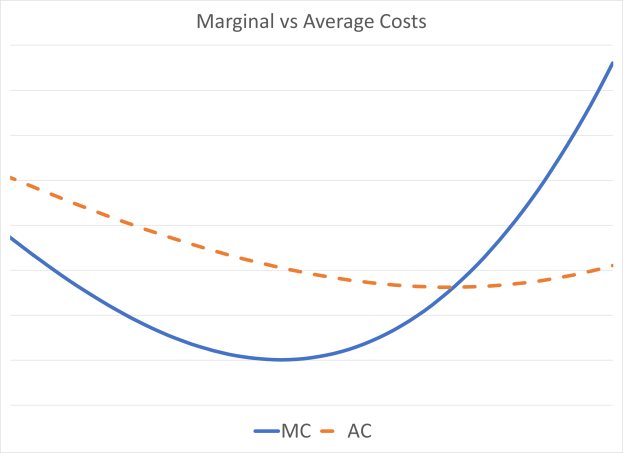
Average costs equals the sum of marginal costs. Or inversely, marginal cost equals the incremental change in average costs when adding a unit of demand or supply. The two concepts are interlinked so that one must speak of one when speaking of the other.

The chart at the top of this post shows the relationship of marginal and average costs. Most importantly, it is not mathematically possible to have rising average costs when marginal costs are below average costs. So any assertion that transmission marginal costs are less than the average costs of transmission given that average costs are rising must be mathematically false.