Tag Archives: marginal cost

How to properly calculate the marginal GHG emissions from electric vehicles and electrification

Recently the questions about whether electric vehicles increase greenhouse gas (GHG) emissions and tracking emissions directly to generation on a 24/7 basis have gained saliency. This focus on immediate grid-created emissions illustrates an important concept that is overlooked when looking at marginal emissions from electricity. The decision to consume electricity is more often created by a single large purchase or action, such as buying a refrigerator or a new electric vehicle, than by small decisions such as opening the refrigerator door or driving to the grocery store. Yet, the conventional analysis of marginal electricity costs and emissions assumes that we can arrive at a full accounting of those costs and emissions by summing up the momentary changes in electricity generation measured at the bulk power markets created by opening that door or driving to the store.

But that’s obviously misleading. The real consumption decision that created the marginal costs and emissions is when that item is purchased and connected to the grid. And on the other side, the comparative marginal decision is the addition of a new resource such as a power plant or an energy efficiency investment to serve that new increment of load.

So in that way, your flight to Boston is not whether you actually get on the plane, which is like opening the refrigerator door, but rather your purchase of the ticket which led to the incremental decision by the airline to add another scheduled flight. It’s the share of the fuel use for that added flight which is marginal, just as buying a refrigerator is responsible for the share of the energy from the generator added to serve the incremental long-term load.

There are growing questions about the use of short run market prices as indicators of market value of generation assets for a number of reasons. This paper critiquing “surge” pricing on the grid has one set of aspects that undermine that principle.

Meredith Fowley at the Energy Institute at Haas compared two approaches to measuring the additional GHG emissions from a new electric vehicle. The NREL paper uses the correct approach of looking at longer term incremental resource additions rather than short run operating emissions. The hourly marginal energy use modeled by Holland et al (2022) is not particularly relevant to the question of GHG emissions from added load for several reasons and for that reason any study that doesn’t use a capacity expansion model will deliver erroneous results. In fact, you will get more accurate results from relying on a simple spreadsheet model using capacity expansion than a complex production cost hourly model.

In the electricity grid, added load generally doesn’t just require increased generation from existing plants, but rather it induces investment in new generation (or energy savings elsewhere, which have zero emissions) to meet capacity demands. This is where economists make a mistake thinking that the “marginal” unit is additional generation from existing plants–in a capacity limited system such as the electricity grid, its investment in new capacity.

That average emissions are falling as shown in Holland et al while hourly “marginal” emissions are rising illustrates this error in construction. Mathematically that cannot be happening if the marginal emission metric is correct. The problem is that Holland et al have misinterpreted the value they have calculated. It is in fact not the first derivative of the average emission function, but rather the second partial derivative. That measures the change in marginal emissions, not marginal emissions themselves. (And this is why long-run marginal costs are the relevant costing and pricing metric for electricity, not hourly prices.) Given that 75% of new generation assets in the U.S. were renewables, it’s difficult to see how “marginal” emissions are rising when the majority of new generation is GHG-free.

The second issue is that the “marginal” generation cannot be identified in ceteris paribus (i.e., all else held constant) isolation from all other policy choices. California has a high RPS and 100% clean generation target in the context of beneficial electrification of buildings and transportation. Without the latter, the former wouldn’t be pushed to those levels. The same thing is happening at the federal level. This means that the marginal emissions from building decarbonization and EVs are even lower than for more conventional emission changes.

Further, those consumers who choose beneficial electrification are much more likely to install distributed energy resources that are 100% emission free. Several studies show that 40% of EV owners install rooftop solar as well, far in excess of the state average, (In Australia its 60% of EV owners.) and they most likely install sufficient capacity to meet the full charging load of their EVs. So the system marginal emissions apply only to 60% of EV owners.

There may be a transition from hourly (or operational) to capacity expansion (or building) marginal or incremental emissions, but the transition should be fairly short so long as the system is operating near its reserve margin. (What to do about overbuilt systems is a different conversation.)

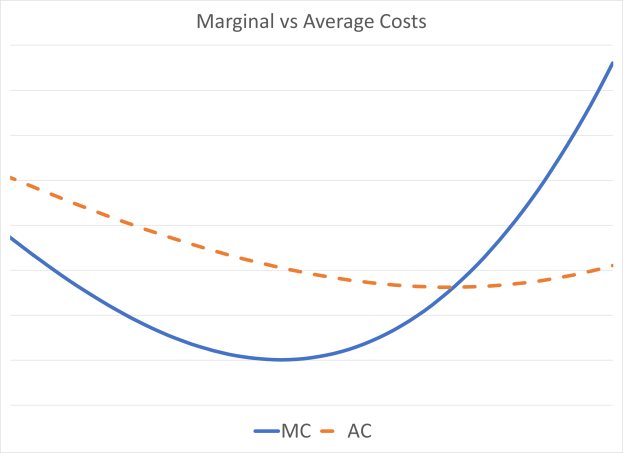
There’s deeper problem with the Holland et al papers. The chart that Fowlie pulls from the article showing that marginal emissions are rising above average emissions while average emissions are falling is not mathematically possible. (See for example, https://www.thoughtco.com/relationship-between-average-and-marginal-cost-1147863) For average emissions to be falling, marginal emissions must be falling and below average emissions. The hourly emissions are not “marginal” but more likely are the first derivative of the marginal emissions (i.e., the marginal emissions are falling at a decreasing rate.) If this relationship holds true for emissions, that also means that the same relationship holds for hourly market prices based on power plant hourly costs.

All of that said, it is important to incentivize charging during high renewable hours, but so long as we are adding renewables in a manner that quantitatively matches the added EV load, regardless of timing, we will still see falling average GHG emissions.

It is mathematically impossible for average emissions to fall while marginal emissions are rising if the marginal emission values are ABOVE the average emissions, as is the case in the Holland et al study. What analysts have heuristically called “marginal” emissions, i.e., hourly incremental fuel changes, are in fact, not “marginal”, but rather the first derivative of the marginal emissions. And as you point out the marginal change includes the addition of renewables as well as the change in conventional generation output. Marginal must include the entire mix of incremental resources. How marginal is measured, whether via change in output or over time doesn’t matter. The bottom line is that the term “marginal” must be used in a rigorous economic context, not in a casual manner as has become common.

Often the marginal costs do not fit the theoretical mathematical construct based on the first derivative in a calculus equation that economists point to. In many cases it is a very large discreet increment, and each consumer must be assigned a share of that large increment in a marginal cost analysis. The single most important fact is that for average costs to be rising, marginal costs must be above average costs. Right now in California, average costs for electricity are rising (rapidly) so marginal costs must be above those average costs. The only possible way of getting to those marginal costs is by going beyond just the hourly CAISO price to the incremental capital additions that consumption choices induce. It’s a crazy idea to claim that the first 99 consumers have a tiny marginal cost and then the 100th is assigned the responsibility for an entire new addition such as another flight scheduled or a new distribution upgrade.

We can consider the analogy to unit commitment, and even further to the continuous operation of nuclear power plants. The airline scheduled that flight in part based on the purchase of the plane ticket, not on the final decision just before the gate was closed. Not flying saved a miniscule amount of fuel, but the initial scheduling decision created the bulk of the fuel use for the flight. In a similar manner a power plant that is committed several days before an expected peak load burns fuels while idling in anticipation of that load. If that load doesn’t arrive, that plant avoids a small amount of fuel use, but focusing only on the hourly price or marginal fuel use ignores the fuel burned at a significant cost up to that point. Similarly, Diablo Canyon is run at a constant load year-round, yet there are significant periods–weeks and even months–where Diablo Canyon’s full operational costs are above the CAISO market clearing price average. The nuclear plant is run at full load constantly because it’s dispatch decision was made at the moment of interconnection, not each hour, or even each week or month, which would make economic sense. Renewables have a similar characteristic where they are “scheduled and dispatched” effectively at the time of interconnection. That’s when the marginal cost is incurred, not as “zero-cost” resources each hour.

Focusing solely on the small increment of fuel used as a true measure of “marginal” reflects a larger problem that is distorting economic analysis. No one looks at the marginal cost of petroleum production as the energy cost of pumping one more barrel from an existing well. It’s viewed as the cost of sinking another well in a high cost region, e.g., Kern County or the North Sea. The same needs to be true of air travel and of electricity generation. Adding one more unit isn’t just another inframarginal energy cost–it’s an implied aggregation of many incremental decisions that lead to addition of another unit of capacity. Too often economics is caught up in belief that its like classical physics and the rules of calculus prevail.

Proposing a Clean Financing Decarbonization Incentive Rate

by Steven J. Moss and Richard J. McCann, M.Cubed

A potentially key barrier to decarbonizing California’s economy is escalating electricity costs.[1] To address this challenge, the Local Government Sustainable Energy Coalition, in collaboration with Santa Barbara Clean Energy, proposes to create a decarbonization incentive rate, which would enable customers who switch heating, ventilation and air conditioning (HVAC) or other appliances from natural gas, fossil methane, or propane to electricity to pay a discounted rate on the incremental electricity consumed.[2] The rate could also be offered to customers purchasing electric vehicles (EVs).

California has adopted electricity rate discounts previously to incentivize beneficial choices, such as retaining and expanding businesses in-state,[3] and converting agricultural pump engines from diesel to electricity to improve Central Valley air quality.[4]

  • Economic development rates (EDR) offer a reduction to enterprises that are considering leaving, moving to or expanding in the state.  The rate floor is calculated as the marginal cost of service for distribution and generation plus non-bypassable charges (NBC). For Southern California Edison, the current standard EDR discount is 12%; 30% in designated enhanced zones.[5]
  • AG-ICE tariff, offered from 2006 to 2014, provided a discounted line extension cost and limited the associated rate escalation to 1.5% a year for 10 years to match forecasted diesel fuel prices.[6] The program led to the conversion of 2,000 pump engines in 2006-2007 with commensurate improvements in regional air quality and greenhouse gas (GHG) emission reductions.[7]

The decarbonization incentive rate (DIR) would use the same principles as the EDR tariff. Most importantly, load created by converting from fossil fuels is new load that has only been recently—if at all–included in electricity resource and grid planning. None of this load should incur legacy costs for past generation investments or procurement nor for past distribution costs. Most significantly, this principle means that these new loads would be exempt from the power cost indifference adjustment (PCIA) stranded asset charge to recover legacy generation costs.

The California Public Utility Commission (CPUC) also ruled in 2007 that NBCs such as for public purpose programs, CARE discount funding, Department of Water Resources Bonds, and nuclear decommissioning, must be recovered in full in discounted tariffs such as the EDR rate. This proposal follows that direction and include these charges, except the PCIA as discussed above.

Costs for incremental service are best represented by the marginal costs developed by the utilities and other parties either in their General Rate Case (GRC) Phase II cases or in the CPUC’s Avoided Cost Calculator. Since the EDR is developed using analysis from the GRC, the proposed DIR is illustrated here using SCE’s 2021 GRC Phase II information as a preliminary estimate of what such a rate might look like. A more detailed analysis likely will arrive at a somewhat different set of rates, but the relationships should be similar.

For SCE, the current average delivery rate that includes distribution, transmission and NBCs is 9.03 cents per kilowatt-hour (kWh). The average for residential customers is 12.58 cents. The system-wide marginal cost for distribution is 4.57 cents per kilowatt-hour;[8] 6.82 cents per kWh for residential customers. Including transmission and NBCs, the system average rate component would be 7.02 cents per kWh, or 22% less. The residential component would be 8.41 cents or 33% less.[9]

The generation component similarly would be discounted. SCE’s average bundled generation rate is 8.59 cents per kWh and 9.87 cents for residential customers. The rates derived using marginal costs is 5.93 cents for the system average and 6.81 cent for residential, or 31% less. For CCA customers, the PCIA would be waived on the incremental portion of the load. Each CCA would calculate its marginal generation cost as it sees fit.

For bundled customers, the average rate would go from 17.62 cents per kWh to 12.95 cents, or 26.5% less. Residential rates would decrease from 22.44 cents to 15.22 cents, or 32.2% less.

Incremental loads eligible for the discounted decarb rate would be calculated based on projected energy use for the appropriate application.  For appliances and HVAC systems, Southern California Gas offers line extension allowances for installing gas services based on appliance-specific estimated consumption (e.g., water heating, cooking, space conditioning).[10] Data employed for those calculations could be converted to equivalent electricity use, with an incremental use credit on a ratepayer’s bill. An alternative approach to determine incremental electricity use would be to rely on the California Energy Commission’s Title 24 building efficiency and Title 20 appliance standard assumptions, adjusted by climate zone.[11]

For EVs, the credit would be based on the average annual vehicle miles traveled in a designated region (e.g., county, city or zip code) as calculated by the California Air Resources Board for use in its EMFAC air quality model or from the Bureau of Automotive Repair (BAR) Smog Check odometer records, and the average fleet fuel consumption converted to electricity. For a car traveling 12,000 miles per year that would equate to 4,150 kWh or 345 kWh per month.


[1] CPUC, “Affordability Phase 3 En Banc,” https://www.cpuc.ca.gov/industries-and-topics/electrical-energy/affordability, February 28-March 1, 2022.

[2] Remaining electricity use after accounting for incremental consumption would be charged at the current otherwise applicable tariff (OAT).

[3] California Public Utilities Commission, Decision 96-08-025. Subsequent decisions have renewed and modified the economic development rate (EDR) for the utilities individually and collectively.

[4] D.05-06-016, creating the AG-ICE tariff for Pacific Gas & Electric and Southern California Edison.

[5] SCE, Schedules EDR-E, EDR-A and EDR-R.

[6] PG&E, Schedule AG-ICE—Agricultural Internal Combustion Engine Conversion Incentive Rate.

[7] EDR and AG-ICE were approved by the Commission in separate utility applications. The mobile home park utility system conversion program was first initiated by a Western Mobile Home Association petition by and then converted into a rulemaking, with significant revenue requirement implications. 

[8] Excluding transmission and NBCs.

[9] Tiered rates pose a significant barrier to electrification and would cause the effective discount to be greater than estimated herein.  The estimates above were based on measuring against the average electricity rate but added demand would be charged at the much higher Tier 2 rate. The decarb allowance could be introduced at a new Tier 0 below the current Tier 1.

[10] SCG, Rule No. 20 Gas Main Extensions, https://tariff.socalgas.com/regulatory/tariffs/tm2/pdf/20.pdf, retrieved March 2022.

[11] See https://www.energy.ca.gov/programs-and-topics/programs/building-energy-efficiency-standards;
https://www.energy.ca.gov/rules-and-regulations/building-energy-efficiency/manufacturer-certification-building-equipment;https://www.energy.ca.gov/rules-and-regulations/appliance-efficiency-regulations-title-20

Why utility prices cannot be set using short-run marginal costs

One commentator on the Energy Institute at Haas’ blog entitled “Everyone Should Pay a ‘Solar Tax’” points out that one version of economic theory holds that short run marginal cost is the appropriate metric for composing efficient prices. And he points out that short-run (SRMC) and long-run marginal costs (LRMC) should converge in equilibrium. So he implicitly says that long run marginal costs are the appropriate metric if as a stable long-run measure is based, as he states, on forecasts.

Even so, he misses an important aspect–using the SRMC for pricing relies on important conditions such as (1) relatively free entry and exit, (2) producers bear full risk for their investments, and (3) no requirements exist for minimum supply (i.e., no reserve margins). He points out that utilities overbuild their transmission and distribution (and I’ll point out their generation) systems. I would assert that is because of the market failures related to the fact that the conditions I listed above are missing–entry is restricted or prohibited, customers bear almost all of the risk, and reserve margins largely eliminates any potential for scarcity rents. In fact, California explicitly chose its reserve margin and resource adequacy procurement standards to eliminate the potential for pricing in the scarcity rents necessary for SRMC and LRMC to converge.

He correctly points out that apparent short run MC are quite low (not quite as close to zero as he asserts though)–a statement that implies that he expects that SRMC in a correctly functioning market would be much higher. In fact, as he states, the SRMC should converge to the LRMC. The fact is that SRMC has not risen to the LRMC on an annual average basis in decades in California (briefly in 2006, 2001 and 2000 (when generators exerted market power) and then back to the early 1980s). So why continue to insist that we should be using the current, incorrect SRMC as the benchmark when we know that it is wrong and we specifically know why its wrong? That we have these market failures to maintain system reliability and address the problems of network and monopolistic externalities is why we have regulation.

The solution is not to try to throw out our current regulatory scheme and then let the market price run free in the current institutional structure with a single dominant player. Avoiding market dominance is the raison d’etre for economic regulation. If that is the goal, the necessary first step is introducing and sustaining enough new entrants to be able to discipline the behavior of the dominant firm. Pricing reform must follow that change, not precede it. Competitive firms will not just spontaneously appear due to pricing reform.

It’s not clear that utilities “must” recover their “fixed” investments costs. Another of the needed fixes to the current regulatory scheme to improve efficiency is having utilities bear the risks of making incorrect investment decisions. Having warned (correctly) the IOUs about overforecasting demand growth for more than a dozen years now, they will not listen such analyses unless they have a financial incentive to do so.

Contrary to claims by this and other commentators, It is not efficient to charge customers a fixed charge beyond the service connection cost (which is about $10/month for residential customers for California IOUs). If the utility charges a fixed cost for the some portion of the rest of the grid, the efficient solution must then allow customers to sell their share of that grid to other customers to achieve Pareto optimal allocations among the customers. We could set up a cumbersome, high transaction cost auction or bulletin board to facilitate these trades, but there is at least another market mechanism that is nearly as efficient with much lower transaction costs–the dealer. (The NYSE uses a dealer market structure with market makers acting as dealers.) In the case of the utility grid, the utility that operates the grid also can act as the dealer. The most likely transaction unit would bein kilowatt-hours. So we’re left back where we started with volumetric rates. The problem with this model is not that it isn’t providing sufficient revenue certainty–that’s not an efficiency criterion. The problem is that the producer isn’t bearing enough of the risk of insufficient revenue recovery.

An alternative solution may be to set the distribution volumetric rate at the LRMC with no assurance of revenue requirement on that portion, and then recover the difference between average cost and LRMC in a fixed charge. This is the classic “lump sum” solution to setting monopoly pricing. The issue has been how to allocate those lump sum payments. However, the true distribution LRMC appears to be higher than average costs now based on how average rates have been rising.

ERCOT has the peak period scarcity price too high

The freeze and resulting rolling outages in Texas in February highlighted the unique structure of the power market there. Customers and businesses were left with huge bills that have little to do with actual generation expenses. This is a consequence of the attempt by Texas to fit into an arcane interpretation of an economic principle where generators should be able to recover their investments from sales in just a few hours of the year. Problem is that basic of accounting for those cashflows does not match the true value of the power in those hours.

The Electric Reliability Council of Texas (ERCOT) runs an unusual wholesale electricity market that supposedly relies solely on hourly energy prices to provide the incentives for incenting new generation investment. However, ERCOT is using the same type of administratively-set subsidies to create enough potential revenue to cover investment costs. Further, a closer examination reveals that this price adder is set too high relative to actual consumer value for peak load power. All of this leads to a conclusion relying solely on short-run hourly prices as a proxy for the market value that accrues to new entrants is a misplaced metric.

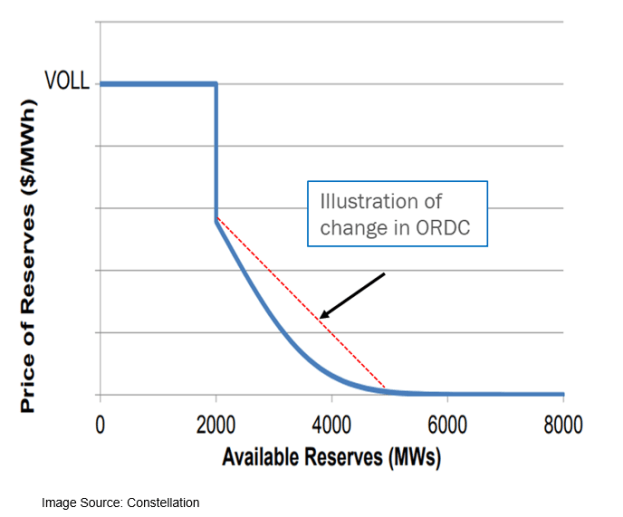
The total ERCOT market first relies on side payments to cover commitment costs (which creates barriers to entry but that’s a separate issue) and second, it transfers consumer value through to the Operating Reserve Demand Curve (ORDC) that uses a fixed value of lost load (VOLL) in an arbitrary manner to create “opportunity costs” (more on that definition at a later time) so the market can have sufficient scarcity rents. This second price adder is at the core of ERCOT’s incentive system–energy prices alone are insufficient to support new generation investment. Yet ERCOT has ignored basic economics and set this value too high based on both available alternatives to consumers and basic regional budget constraints.

I started with an estimate of the number of hours where prices need the ORDC to be at full VOLL of $9000/MWH to recover the annual revenue requirements of combustion turbine (CT) investment based on the parameters we collected for the California Energy Commission. It turns out to be about 20 to 30 hours per year. Even if the cost in Texas is 30% less, this is still more 15 hours annually, every single year or on average. (That has not been happening in Texas to date.) Note for other independent system operators (ISO) such as the California ISO (CAISO), the price cap is $1,000 to $2,000/MWH.

I then calculated the cost of a customer instead using a home generator to meet load during those hours assuming a life of 10 to 20 years on the generator. That cost should set a cap on the VOLL to residential customers as the opportunity cost for them. The average unit is about $200/kW and an expensive one is about $500/kW. That cost ranges from $3 to $5 per kWh or $3,000 to $5,000/MWH. (If storage becomes more prevalent, this cost will drop significantly.) And that’s for customers who care about periodic outages–most just ride out a distribution system outage of a few hours with no backup. (Of course if I experienced 20 hours a year of outage, I would get a generator too.) This calculation ignores the added value of using the generator for other distribution system outages created by events like a hurricane hitting every few years, as happens in Texas. That drives down this cost even further, making the $9,000/MWH ORDC adder appear even more distorted.

The second calculation I did was to look at the cost of an extended outage. I used the outages during Hurricane Harvey in 2017 as a useful benchmark event. Based on ERCOT and U.S. Energy Information Reports reports, it looks like 1.67 million customers were without power for 4.5 days. Using the Texas gross state product (GSP) of $1.9 trillion as reported by the St. Louis Federal Reserve Bank, I calculated the economic value lost over 4.5 days, assuming a 100% loss, at $1.5 billion. If we assume that the electricity outage is 100% responsible for that loss, the lost economic value per MWH is just under $5,000/MWH. This represents the budget constraint on willingness to pay to avoid an outage. In other words, the Texas economy can’t afford to pay $9,000/MWH.

The recent set of rolling blackouts in Texas provides another opportunity to update this budget constraint calculation in a different circumstance. This can be done by determining the reduction in electricity sales and the decrease in state gross product in the period.

Using two independent methods, I come up with an upper bound of $5,000/MWH, and likely much less. One commentator pointed out that ERCOT would not be able achieve a sufficient planning reserve level at this price, but that statement is based on the premises that short-run hourly prices reflect full market values and will deliver the “optimal” resource mix. Neither is true.

This type of hourly pricing overemphasizes peak load reliability value and undervalues other attributes such as sustainability and resilience. These prices do not reflect the full incremental cost of adding new resources that deliver additional benefits during non-peak periods such as green energy, nor the true opportunity cost that is exercised when a generator is interconnected rather than during later operations. Texas has overbuilt its fossil-fueled generation thanks to this paradigm. It needs an external market based on long-run incremental costs to achieve the necessary environmental goals.