Tag Archives: renewables

Another bad legislative idea: Pushing RPS purchase

irena_pv_cost_reductions_to_2025_irena_power_to_change

The California Legislature is considering a bill (AB 893) that would require the state’s regulated utilities (including CCAs as well as investor-owned) to buy at least 4,250 megawatts of renewables before federal tax credits expire in 2022.

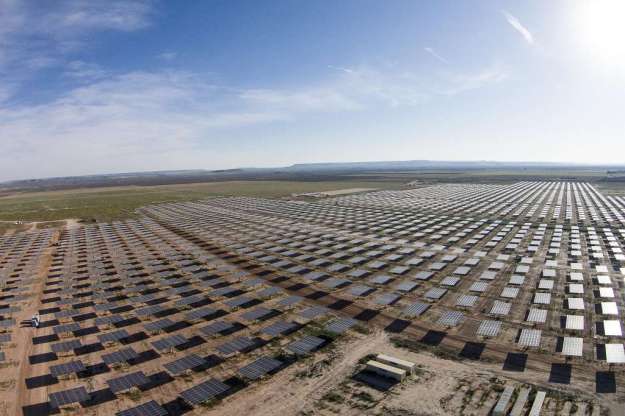
Unfortunately, this will not create the cost savings that seem so obvious. This argument was made by the renewable energy plant owners in the Diablo Canyon Power Plant retirement case (A.16-08-006) and rejected by the CPUC in its decision. While the tax credits lower current costs, these are more than offset by waiting for technology costs to fall even further, as shown by the solar power forecast above. Combined with the time value of money (discounting), the value of waiting far outweighs prematurely buying renewables.

The legislature already passed a bill (SB 1090) that requires the CPUC to ensure that GHG emissions will not rise when Diablo Canyon retires in 2024 and 2025 when approving integrated resource plans. (Whether the governor signs this overly directive law is another question.) And SB 100 requires reaching 100% carbon free by 2045. A study just released by the Energy Institute at Haas indicates that renewables to date have depressed energy market prices, discouraging further investment. And the CAISO is “managing oversupply” created by the current renewable generation.

And there’s a further problem–with a large number of customers moving from the IOUs to CCAs across all three utilities, the question is “who should be responsible for buying this power?” The CCAs will have their own preferences (often locally and community-scale) that will conflict with any choices made by the IOUs. The CCAs are already saddled with poor procurement and portfolio management decisions by the IOUs through exit fees. (PG&E has an embedded risk premium of $33 per megawatt-hour in its RPS portfolio costs.) Why would we want the IOUs to continue to mismanage our power resources?


Bob Dunning gets choice on VCEA wrong

vce_logo_color_white-border

Electricity customers in Davis and Yolo County are in the midst of choosing between the current incumbent electricity utility Pacific Gas & Electric (PG&E) and the new community choice aggregator (CCA) Valley Clean Energy Alliance (VCE). VCE is a joint powers authority (JPA) of the governments of the Yolo County, and the Cities of Davis and Woodland. (The Cities of Winters and West Sacramento have expressed interest in joining VCE as well.) By state law, customers are initially defaulted to the CCA at the outset before being given multiple chances over a six month period to choose to stay with the incumbent investor-owned utility–PG&E in this case.

Bob Dunning in his Davis Enterprise column August 8 confuses a lack of choice with just changing the starting point of the choice. Regardless of whether VCE or PG&E is the default provider, local customers still have exactly the same choice. But by having VCE start as the default provider, we level the playing field with the long-time giant monopoly utility, PG&E. (And customers can return to PG&E after 12 months if they are dissatisfied.) Why should we continue to give the big guy a continued advantage at the outset?

PG&E has all sorts of shareholder money to spend on improving its image and retaining customers. The utility’s biggest problem is that it is spending an additional 3.3 cents per kilowatt-hour to mismanage risk in its portfolio based on calculations I made in the power cost indifference adjustment (PCIA) rulemaking proceedings. Why stay with a company that has such a poor management record?

The 20-year cycle in the electricity world

future_grid_horizon_xl_410_282_c1

The electricity industry in California seems to face a new world about every 20 years.

  • In 1960, California was in a boom of building fossil-fueled power plants to supplement the hydropower that had been a prime motive source.
  • In 1980, the state was shifting focus from rapid growth and large central generation stations to increased energy efficiency and bringing in third-party power developers.
  • That set in motion the next wave of change two decades later. Slowing demand plus exorbitant power contract prices lead to restructuring with substantial divestiture of the utilities’ role in generating power. Unfortunately, that effort ended up half-baked due to several obvious flaws, but out of the wreckage emerged a shift to third-party renewable projects. However, the state still didn’t learn its lesson about how to set appropriate contract prices, and again rates skyrocketed.
  • This has now lead to yet another wave, with two paths. The first is the rapid emergence of distributed energy resources such at solar rooftops and garage batteries, and development of complementary technologies in electric vehicles and building electrification. The second is devolution of power resource acquisition to local entities (CCAs).

Ahead of the tariff, U.S. imported 3 years worth of solar panels from China

1024x1024Panel imports were up 1,200 percent in fourth quarter 2017. That implies that installers were banking supplies to ride out the import tariff imposed by the Trump Administration. Unfortunately, it also means that the rapid technical and cost progress for panels may stall for that three year period.

Comment on “Renewables May Become the Netflix of the Energy Sector” | Greentech Media

The analogy to Netflix is fascinating. As GTM points out, Netflix started out competing with Blockbuster in video DVDs, but then spilled over into video streaming (BTW, a market that Enron famously thought it could corner in the last 1990s.) So Netflix is now competing with both cable and broadcast companies. One can see how renewables could jump out of just electric service to building space conditioning and water heating, and vehicle fueling. Tesla is already developing those options.

Source: Renewables May Become the Netflix of the Energy Sector | Greentech Media

Lomborg has it wrong about California’s cap and trade program. 

Bjorn Lomborg, a Danish political scientist who has pushed for focusing spending on other pressing world needs over reducing climate change risk, has criticized the extension of California’s cap and trade program in the LA Times. I found two serious flaws in Lomborg’s analysis that undermine his conclusions.

The study that Lomberg cites about the electricity market impacts has not been reproduced since such extensive “contract reshuffling” can’t occur in the Western Electricity Coordinating Council (WECC) region or in the CAISO market. That’s just a simplistic modeling exercise not tied to reality. The fact is that thousands of megawatts of coal plants are retiring across the WECC at least in part in response to the cap & trade and renewables portfolio standards (RPS) adopted by California.

And then Lomberg writes “A smarter approach to climate policy — and one befitting California’s role as one of the most innovative states in the country — would be to focus on making green energy cheaper. ” Has Lomberg noticed that new solar and wind installations are now cheaper than new fossil-fueled plants? Contracts are being signed for less than 5 cents per kilowatt-hour–PG&E’s average cost for existing generation is close to 9 cents.

It’s as though Lomberg hasn’t updated his understanding of the energy industry since 2009 when the Copenhagen climate accord was signed.

Repost: A catalog of studies on whether renewables create grid instability | Greentech Media

GTM compiles the studies done over the last month in anticipation of the release of the study ordered by Energy Secretary Rick Perry to examine how increased renewable energy threatens grid reliability.

Source: The Rising Tide of Evidence Against Blaming Wind and Solar for Grid Instability | Greentech Media

Opening up California’s utility procurement process could lead to lower power prices

auction

California passed AB 57 in 2002 to make the power procurement process for electric utilities confidential (as well as subject only to upfront review rather than ongoing prudence standards). The result has been overly high prices locked in for decades.  A new study on the relative gains to landowners who sell the development rights for oil and gas development in Texas shows that using auctions creates more competition among multiple bidders than bilateral negotiations. As a result, landowners get higher prices for their development rights through an auction. The corollary is that California’s electric utilities probably could lower their power purchase costs by moving to public auctions instead. Yet another reason to repeal AB 57.

Clean energy too big to be shut down by Trump – San Francisco Chronicle

I’ve been struck by the lack of panic in the energy industry about President Trump’s decision. This article goes into that underlying confidence that the momentum appears unstoppable.

WASHINGTON — President Trump’s decision to abandon the Paris Accord will slow the battle against climate change in the U.S., but there’s too much momentum in the nation’s clean-energy economy to shut it down, energy experts say.

Source: Clean energy too big to be shut down by Trump – San Francisco Chronicle

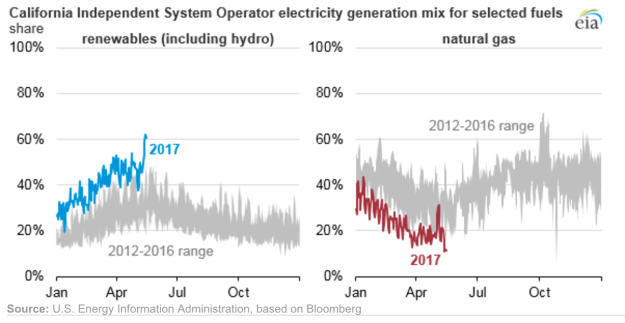
CAISO: Renewables served 42% of California demand on May 16, setting record | Utility Dive

During the 2 p.m. hour, renewables served more than 70% of power demand, setting another record in California.

Source: CAISO: Renewables served 42% of California demand on May 16, setting record | Utility Dive