Tag Archives: SCE

PG&E has cost California over $3 billion by mismanaging its RPS portfolio

CCA Savings

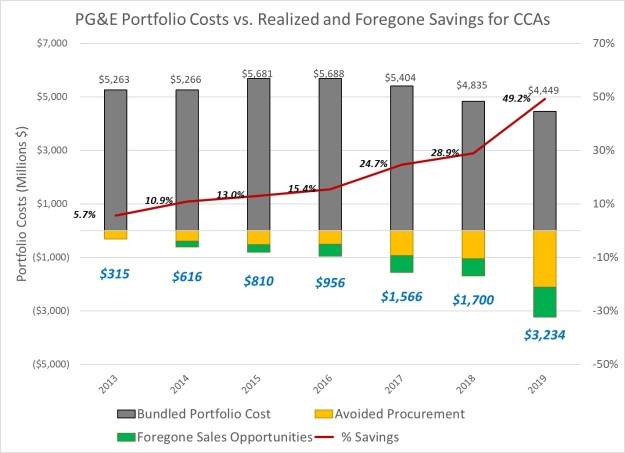
When community choice aggregators take up serving PG&E customers, PG&E saves the cost of having to procure power for the departed load. Instead the CCAs bear that cost for that power. The savings to PG&E’s bundled customers are not fully reflected when calculating the exit fee (known as the power charge indifference adjustment or PCIA) for those CCAs. As a result, the exit fee does not reflect the true value that CCAs provide to PG&E and its bundled customers.

The chart above shows the realized and potential savings to PG&E from the departure of CCA customers. The realized part is the avoided costs of procuring resources to meet that load, shown in yellow. The second part is the foregone sales opportunity if PG&E had sold a portion of its portfolio to the CCAs at the going price when they departed. In 2019, these combined savings could have reached $3.2 billion if PG&E had acted prudently.

Many local governments launched CCAs to address their climate goals, and CCAs issued multiple requests for offers of RPS energy.  However, PG&E failed to respond to this opportunity to sell excess renewable energy no longer needed to serve their customers.  By deciding to hold these unneeded resources in a declining market, PG&E accumulated additional losses every year.  Indeed, the assigned Judge on the exit-fee proceeding at the CPUC concluded that PG&E must benefit from “holding back the RECs [renewable energy credits] for some reason.”

This willingness to hold onto an unneeded resource that loses value every year is contrary to prudent management.  However, shareholders, are shielded entirely from contract that are too costly, and only pay penalties for failing to meet RPS targets.  Instead, ratepayers—both bundled and CCA—pay all of the excessive costs, and shareholders only have a strong incentive to over-procure using those ratepayer dollars to avoid any possibility of reduced shareholder profits.  Holding these contracts also inflates the exit-fee departed customers must pay, making it harder for alternatives like public power and distributed generation to PG&E to thrive.

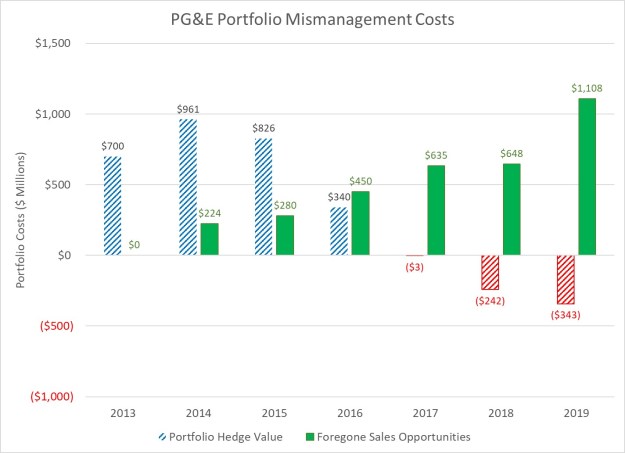
When Sonoma Clean Power launched in 2014, the average price of RPS energy was $128/MWh.  It has declined every year, and now sits at $57/MWh.  PG&E’s decision to not sell excess energy at 2014 prices, and to protect shareholders at the expense of ratepayers has cost customers over $3 billion dollars in the last 6 years as shown in the green columns below.  As RPS prices continue to decline, and the amount of customer departing increases, this figure will continue to increase every year.  Indeed, it surpassed $1.1 billion for 2019 alone.
PGAE Mismanagement Costs

Further, the hedging value of the RPS resources that PG&E listed as key attribute of holding these PPAs instead of disposing of them has diminished dramatically since PG&E pushed that as its strategy in its 2014 Bundled Procurement Plan. As shown in the chart above, the hedge value fell $1.3 billion from 2014 to 2019, from a high of $961 million to a burden of $343 million. PG&E’s hedge now adds $33/MWH to the cost of its renewables portfolio.

In comparison, Southern California Edison’s renewables portfolio costs just under $20/MWH less than PG&E’s. SCE did not rush into signing PPAs like PG&E and did not sign them for as long of terms as PG&E.

 

A counter to UC’s skepticism about CCAs

cce-pic

Kevin Novan from UC Davis wrote an article in the University of California Giannini Foundation’s Agriculture and Resource Economics Update entitled “Should Communities Get into the Power Marketing Business?” Novan was skeptical of the gains from community choice aggregation (CCA), concluding that continued centrally planned procurement was preferable. Other UC-affiliated energy economists have also expressed skepticism, including Catherine Wolfram, Severin Borenstein, and Maximilian Auffhammer.

At the heart of this issue is the question of whether the gains of “perfect” coordination outweigh the losses from rent-seeking and increased risks from centralized decision making. I don’t consider myself an Austrian economist, but I’m becoming a fan of the principle that the overall outcomes of many decentralized decisions is likely to be better than a single “all eggs in one basket” decision. We pretend that the “central” planner is somehow omniscient and prudently minimizes risks. But after three decades of regulatory practice, I see that the regulators are not particularly competent at choosing the best course of action and have difficulty understanding key concepts in risk mitigation.By distributing decision making, we better capture a range of risk tolerances and bring more information to the market place. There are further social gains from dispersed political decision making that brings accountability much closer to home and increases transparency. Of course, there’s a limit on how far decentralization should go–each household can’t effectively negotiate separate power contracts. But we gain much more information by adding a number of generation service providers or “load serving entities” (LSE) to the market.

I found several shortcomings with with Novan’s article that would change the tenor. I take each in turn:

  • He wrote “it remains to be seen whether local governments will make prudent decisions…” However, he did not provide the background which explains at least in part why the CCAs have arisen in the first place. Largely over the last 40 years, the utilities have made imprudent procurement and planning decisions. Whether those have been pushed on the utilities by the CPUC and Legislature or whether the IOUs have some responsibility, the fact is that neither institution sees real consequences for these decisions, neither financially or politically. In fact, the one time that a CPUC commissioner attempted to deliver consequences to the IOUs, she was fired and replaced by a former utility CEO. The appropriate comparison for local government decision making is to the current baseline record, not an academic hypothetical that will never exist. And by the way, government enterprise agencies, including municipal utilities, have a relatively good record as demonstrated as by lower electricity rates and relatively well managed, almost invisible capital intensive water and sanitation utilities. The current CCAs have a more extensive portfolio risk management system than PG&E—my calculation of PG&E’s implicit risk hedge in its renewables portfolio is an astounding 3.3 cents per kilowatt-hour.
  • Novan complains that CCAs have “dual objectives.” In fact they have “triple objectives,” the added one to encourage local economic development (sometimes through lower rates). I suggest reading the mission statements of the CCAs that have been created, including the local Valley Clean Energy Authority .
  • It’s not clear that “purchasing locally produced renewable energy will likely lead to more expensive renewable output” for at least two reasons. The first is that local power can avoid further transmission investment. The current CAISO transmission access charges range from $11 to $39 per megawatt-hour and is forecasted to continue to rise significantly (indicating transmission marginal costs are much above average costs). In a commentary on a UC Energy Institute blog, it was revealed that the Sunrise line may have cost as much as $80 per MWH for power from the desert. This wipes out much of the difference between utility scale and DG solar power. Building locally avoids yet more expensive transmission investment to the southeast desert. [I worked on the DRECP for the CEC.] In addition, local power can avoid distribution investment and will be reflected in the IOU’s distribution resource plans (DRP). And second, the scale economies for solar PV plants largely disappears after about 10 MW. So larger plants don’t necessarily mean cheaper, (especially if they have to implement more extensive environmental mitigation.) [I prepared the Cost of Generation model and report for the CEC from 2001-2013.]
  • It’s not necessary that more renewable capacity is needed for local generation. The average line losses in the CAISO system are about 6%, and those are greater from the far desert region. Whether increased productivity overcomes that difference is an empirical question that I haven’t seen answered satisfactorily yet.
  • Novan left unstated his premise defining “greener” renewables, but I presume that it’s based almost entirely on GHG emissions. However, local power is likely “greener” because it avoids other environmental impacts as well. Local renewables are much more likely to be built on brownfields and even rooftops so there’s not added footprints. In contrast there is growing opposition to new plants in the desert region. The second advantage is the avoidance of added transmission corridors. One only needs to look at the Sunrise and Tehachipi lines to see how those consequences can slow down the process. Local DG can avoid distribution investment that has consequences as well. Further, local power provides local system support that can displace local natural gas generation. In fact, one of the key issues for Southern California is the need to maintain in-basin generation to support imports of renewables across the LA Basin interface. [I assessed the need for local generation in the LA Basin in the face of various environmental regulations for the CEC.]

I was on the City of Davis Community Choice Energy Advisory Committee, and I am testifying on behalf of the California CCAs on the setting of the PCIA in several dockets. I have a Ph.D. from Berkeley’s ARE program and have worked on energy, environmental and water issues for about 30 years.


CCAs add renewables while utilities stand pat

1542383922472

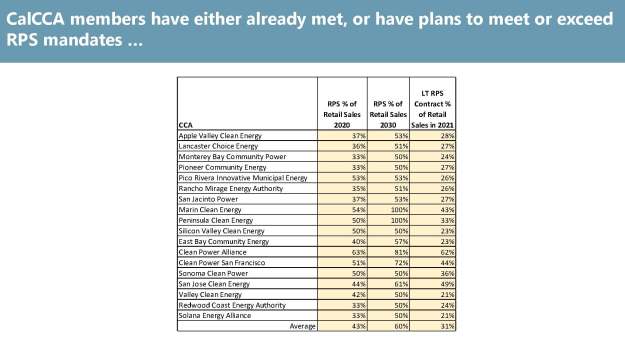
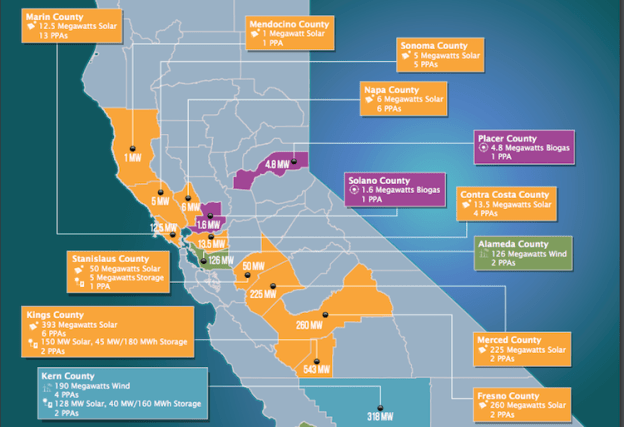
California’s community choice aggegrators (CCAs) are on track to meet their state-mandated renewable portfolio standard obligations. PG&E, SCE and SDG&E have not signed significant new renewable power capacity since 2015, while CCAs have been building new projects. To achieve zero carbon electricity by 2050 will require aggressive plans to procure new renewables soon.

CCAs reach RPS targets with long-term PPAs

Joint CCA Notice of Ex Parte 10.24.16_CCS-RPS

As I listen to the opening of the joint California Customer Choice En Banc held by the CPUC and CEC, I hear Commissioners and speakers claiming that community choice aggregators (CCAs) are taking advantage of the current market and shirking their responsibilities for developing a responsible, resilient resource portfolio.

The CPUC’s view has two problems. The first is an unreasonable expectation that CCAs can start immediately as a full-grown organization with a complete procurement organization, and more importantly, a rock solid credit history. The second is how the CPUC has ignored the fact that the CCAs have already surpassed the state’s RPS targets  in most cases and that they have significant shares of long-term power purchase agreements (PPAs).

State law in fact penalizes excess procurement of RPS-eligible power by requiring that 65% of that specific portfolio be locked into long-term PPAs, regardless of the prudency of that policy. PG&E has already demonstrated that they have been unable to prudently manage its long-term portfolio, incurring a 3.3 cents per kilowatt-hour risk hedge premium on its RPS portfolio. (Admittedly, that provision could be interpreted to be 65% of the RPS target, e.g., 21.5% of a portfolio that has met the 33% RPS target, but that is not clear from the statute.)


Why the CPUC has it wrong on the PCIA

Nick Chaset is the CEO of East Bay Community Energy which is a community choice aggregator (CCA) that serves Alameda County. He also was Commission President Michael Picker’s chief advisor until last year when he left for EBCE. He explains in this article how two proposed decisions that the CPUC is considering are fundamentally wrong and will shift cost onto CCA customers. (I testified on behalf of CalCCA in this proceeding. I’ll have more on this before the Commission’s scheduled vote October 11.)

Figure 1 – CPUC’s Proposed Resource Adequacy Value vs. True Market Values

image3_irdjgcc

Figure 2 – GHG Premium Value Missing from CPUC Proposed Decision

image1_pg37r4r

Figure 3 – Falling Utility Rates as Customers Depart Filed in Their ERRA Rate Applications

image2_ebxv9kg


Another bad legislative idea: Pushing RPS purchase

irena_pv_cost_reductions_to_2025_irena_power_to_change

The California Legislature is considering a bill (AB 893) that would require the state’s regulated utilities (including CCAs as well as investor-owned) to buy at least 4,250 megawatts of renewables before federal tax credits expire in 2022.

Unfortunately, this will not create the cost savings that seem so obvious. This argument was made by the renewable energy plant owners in the Diablo Canyon Power Plant retirement case (A.16-08-006) and rejected by the CPUC in its decision. While the tax credits lower current costs, these are more than offset by waiting for technology costs to fall even further, as shown by the solar power forecast above. Combined with the time value of money (discounting), the value of waiting far outweighs prematurely buying renewables.

The legislature already passed a bill (SB 1090) that requires the CPUC to ensure that GHG emissions will not rise when Diablo Canyon retires in 2024 and 2025 when approving integrated resource plans. (Whether the governor signs this overly directive law is another question.) And SB 100 requires reaching 100% carbon free by 2045. A study just released by the Energy Institute at Haas indicates that renewables to date have depressed energy market prices, discouraging further investment. And the CAISO is “managing oversupply” created by the current renewable generation.

And there’s a further problem–with a large number of customers moving from the IOUs to CCAs across all three utilities, the question is “who should be responsible for buying this power?” The CCAs will have their own preferences (often locally and community-scale) that will conflict with any choices made by the IOUs. The CCAs are already saddled with poor procurement and portfolio management decisions by the IOUs through exit fees. (PG&E has an embedded risk premium of $33 per megawatt-hour in its RPS portfolio costs.) Why would we want the IOUs to continue to mismanage our power resources?