Author Archives: Richard McCann

Unknown's avatar

About Richard McCann

Partner in M.Cubed, an economics and policy consulting firm.

When is $100 billion not that big?

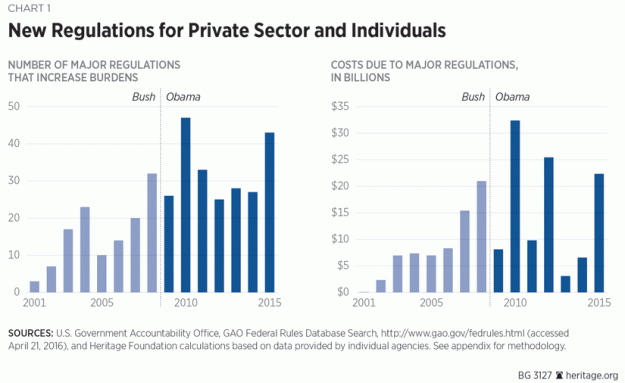
bg-red-tape-rising-2016-chart-1-825

When it’s measured against $18,675 billion ($18.7 trillion) produced by the U.S. economy. The Heritage Foundation issued a report claiming the Obama Administration imposed $107 billion in new burdens over seven years. That sounds like a huge amount, but that’s only 0.6% (six-tenths of a percent) of the economy. And that’s spread over seven years which means that this the reduction in the GDP growth rate was only 0.08% (eight hundredths of a percent) per year. Against an annual average growth rate of over 2%, that’s a trivial amount. Another way to think of it is this way: if you had a dinner bill from Applebee’s for $19, would you not by dinner it if cost a dime more? Probably not–you wouldn’t even notice.

Plus, the HF’s estimate ignores the benefits of those regulations. This graphic from the OMB that shows the estimated relative benefits to costs of regulation.
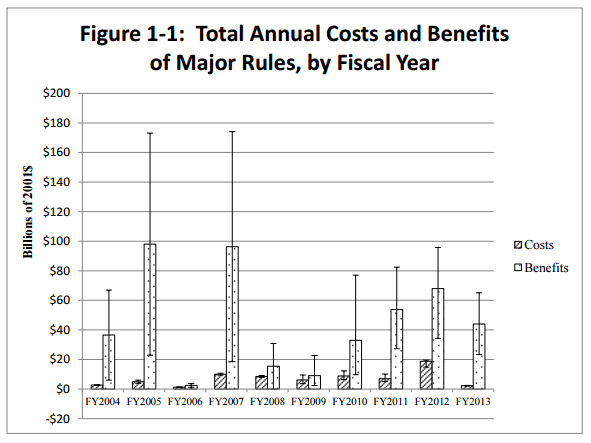
omb

I won’t dig too deeply into the Heritage Foundation’s analysis other than to make a couple of notes about about alternative perspectives that I am familiar with:

  • Heritage Foundation claims that the Clean Power Plan has cost $7.2 billion as the single largest increment. Yet Lawrence Berkeley National Laboratory (which is much better qualified on this issue than the HF) just released a study showing the net financial “costs” of the various renewable portfolio standard (RPS) requirements is actually a benefit $47 to $109 billion. (And that ignores the environmental benefits identified in the report.)
  • After the 2008 financial debacle, the industry was going to face increased regulation to reign in its behavior during the previous decade. So increased regulation under Dodd-Frank is to be expected. And the better question might be what is the drag on the economy from high financial-related transaction costs? One study found that transaction costs may be as high at 45% in the U.S. economy. The financial and legal sectors likely are a bigger drag than government regulation.
  • On FCC net neutrality, see a previous post about how bigger corporations and economic concentration reduces innovation, which leads to reduced growth. Net neutrality is intended to fight that concentration.
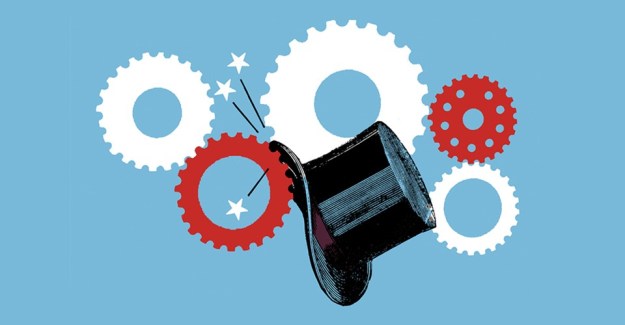

Big Business Is Killing Innovation in the U.S. – The Atlantic

How big business and overconcentration jams the wheels of innovation in the U.S. This is particularly relevant to encouraging new distributed energy resources on the electric utility grid–the poster child for monopolies.

Source: Big Business Is Killing Innovation in the U.S. – The Atlantic

Repost: Lessons From 40 Years of Electricity Market Transformation: Storage Is Coming Faster Than You Think | Greentech Media

Five useful insights into where the electricity industry is headed.

Source: Lessons From 40 Years of Electricity Market Transformation: Storage Is Coming Faster Than You Think | Greentech Media

What lessons should we take from the last wave of California utility reform?

h7main2d

We’re now in the midst of the “third wave” of electricity industry reform in California. The first was in the early 1980s with the rise of independently-owned cogeneration and renewable resources. Mixed with increased energy efficiency, that led to a surplus of power in the late 1990s, which in turn created the push for restructuring and deregulation. Unfortunately, poorly designed markets and other factors precipitated the 2000-01 energy crisis. The rise of renewables and distributed resources is pushing a third wave that may change the industry even more fundamentally.

I wrote a paper in 2002 on how I viewed the history of California’s electricity industry through 2001 and presented this at a conference. (It hasn’t yet been published.) I identify some different factors for why the energy crisis erupted, and what lessons we might learn for this next wave.


Repost: NREL-Four reasons 30% wind and solar is technically no big deal | Utility Dive

Many regions are already operating power systems with more renewable energy than previously thought possible, an NREL analyst points out.

Source: Four reasons 30% wind and solar is technically no big deal | Utility Dive

Using tariffs to achieve valid goals

5992379_orig

President-elect Trump has called for imposing significant tariffs to “bring back jobs to America.” Unfortunately, this will be a fool’s errand. The Smoot-Hawley Tariffs in 1930 were imposed to “save” farming jobs, but instead exacerbated the Great Depression as shown in the chart above. There’s no valid reason to think tariffs will work any better this time around.

Yet, there are a set of valid reasons to impose tariffs, that in a roundabout way could lead to job growth in the U.S. These tariffs could be useful tools to pursue other policy goals by forcing other nations to play on a level field with U.S. industries. The tariffs could be adjusted downward as those countries adopt policies in line with those in the U.S. The World Trade Organization (WTO) allows these types of tariffs if properly designed. Just trying to save jobs doesn’t count, but achieving valid policy goals does.

The policy areas where using flexible tariffs could be fruitful include:

  • environmental and climate change
  • labor and employment
  • product standards

Tariffs to encourage nations to comply with global greenhouse gas reduction goals is one type of environmentally oriented use. Since U.S. companies comply with a wide range of environmental regulations, many of which are intended to preserve natural habitat that has worldwide value, asking other countries to do the same seems to be a valid request. Those nations can ignore those standards if they choose, but U.S. businesses should be allowed to compete as though imported products have incurred similar compliance costs.

Similarly, the U.S. has a wide range of labor employment, workplace and safety standards. Ensuring the well being of those outside of the U.S. if we’re going to buy those products is similarly valid.

Product standards is a third area. Many U.S. products last longer and perform better because they meet stricter standards. The increased longevity of automobiles is largely a byproduct of the increased stringency of emission standards that require engine performance meet those standards for at least 100,000 miles. Improved standards also can lead to reduced waste and increased productivity.

But to justify these tariffs will require that American corporations fully support the application of these standards within the U.S. Whether they can be persuaded to the advantages remains to be seen.

Innovation explains manufacturing job losses, not “bad trade deals”

manuf-jobsvoutput

Much was made during the Presidential campaign of manufacturing jobs being “exported” due to unfavorable trade pacts. Yet when we look at the data since 1960, we don’t see evidence for this claim. If jobs were being exported, then manufacturing output associated with those jobs would be leaving to. Instead, as shown above, we see that manufacturing output (and value added which is the value added to production inputs, e.g., the car value after paying for the iron, aluminum, rubber and plastic) has grown steadily with momentary dips for recessions in 1981, 2001 and 2008. Meanwhile manufacturing jobs remained fairly stable from the peak in 1979 to 2001. And then the bottom fell out: employment fell one-third from 2000 to 2009.

manuf-growthcomps

So if those jobs weren’t exported (obviously since the output growth was largely unchanged), then what might have happened? The chart above provides one explanation: Technological innovation replaced those jobs. The chart compares a rolling five-year average of productivity gains (measured as output per job) to sector job growth. Productivity growth had an early peak in the 1970s that coincided with the flattening of job growth through the 1990s. Then in 2001 productivity growth begins to rise to a new peak just before the Great Recession and manufacturing job growth plunges to new depths. (Note that this contrasts with the decline in overall productivity cited by the St. Louis Federal Reserve Bank that I posted.) Only in the last couple of years has the sector brought back jobs in the recovery.

Data from the countries where the U.S. has supposedly “exported” jobs in fact reinforces this point–they are also losing manufacturing jobs. The simple truth is that, as happened with agriculture at the turn of the 20th century, increased productivity means that fewer jobs are needed to make ever more goods. We could never feed everyone in the world if we had stopped innovation in farming in 1900; change was inevitable and largely beneficial. We can never return to the “good old days.”

Instead of trying to stop the future, we need to turn our attention to how we help those left behind by these changes. In 1900, farmers were able to move to the cities and find jobs that paid better than their farmwork. This time around, that doesn’t seem to be the case–we can’t just “leave it to the market.”


Repost: Higher GDP Growth in the Long Run Requires Higher Productivity Growth–St. Louis FED Regional Economist

US productivity growth 1970-2015

US productivity growth 1970-2015

A good overview of what drives productivity growth and why the U.S. is currently lagging compared to past periods. In essence, we have not had significant growth because we have not had technological innovations that translate into higher output. Bullard says that changes in monetary policy will not change productivity growth and suggests focusing on three areas (although he doesn’t have specific policy proposals.)

Source: Higher GDP Growth in the Long Run Requires Higher Productivity Growth

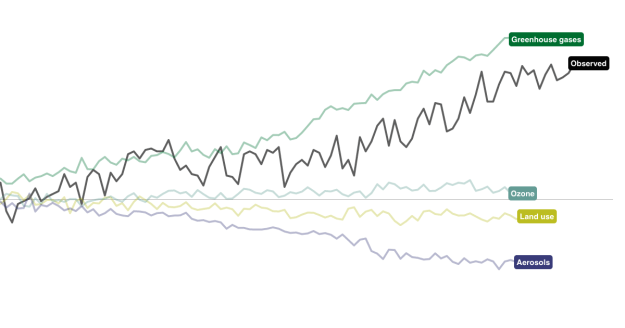
Reblog: What’s Really Warming the World? from Bloomberg News

An interesting presentation separating about a dozen factors, natural and human.

Source: What’s Really Warming the World? Climate deniers blame natural factors; NASA data proves otherwise

Could Trumps win lead to global carbon tariffs?

000_g34cy_0

Former French President Sarkozy suggested that if the U.S. pulled out of the Paris Climate Accord, that the EU impose carbon tariffs on U.S. goods. Many economists have suggested that this may be the best solution to gaining collected global action. So perhaps Trump’s win will actually further action on climate change rather than delay it.