Category Archives: Energy innovation

Emerging technologies and institutional change to meet new challenges while satisfying consumer tastes

One bad legislative idea: Bail out PG&E

104815131-gettyimages-861017202-california-fire-power-530x298

The California Legislature is still struggling with whether and how it should protect PG&E from a $17 billion liability from the Sonoma wildfires that could push the utility into bankruptcy. The latest proposal would have the CPUC conduct a “stress test” on PG&E’s finances if it faced a large liability, and then PG&E could raise rates sufficiently to cover the difference between the total liability and exposure deemed sufficient to maintain financial solvency. We don’t have enough details to understand how well the stress threshold is defined and how it would differ from the current cost of capital evaluations, but this is a bad idea regardless.

Firms need the threat of bankruptcy to perform efficiently and effectively. We’ve already seen how PG&E manages and performs sloppily, whether its maintaining vegetation (which has been a problem since the early 1990s), tracking its pipeline maintenance (which led to the San Bruno accident), or managing risk in its renewable power portfolio (which has added a $33 per megawatt-hour premium to its cost.) Clearly CPUC oversight alone is not doing the job. Outside litigation may be the only way to get PG&E’s attention, especially if it creates an existential threat.

Policymakers have taken the wrong lesson from PG&E’s previous bankruptcy, filed in 2001 during the California energy crisis. The issue there that lead to the final resolution was whether PG&E was required to provide power to its customers at whatever cost. This situation is not about PG&E’s obligations but rather about its management practices, and a bankruptcy court is much less likely to require a cost pass through.

Instead, the state could simply step in buy PG&E for $1 if the utility declares bankruptcy (an option that Governor Gray Davis was too much of a coward to consider in March 2001.) The state could then directly manage the utility, or better yet, parse it  down to eight or ten smaller utilities. (Two studies in PG&E’s 1999 General Rate Case, and the subsequent decision, found that the most efficient utility size is about 500,000 customers. PG&E now has over four million.) Customers would find the utilities more accessible and responsive, and by creating municipal utilities, rates could be much lower with cheaper financing cost. It’s time to rethink where we should head.


Bob Dunning gets choice on VCEA wrong

vce_logo_color_white-border

Electricity customers in Davis and Yolo County are in the midst of choosing between the current incumbent electricity utility Pacific Gas & Electric (PG&E) and the new community choice aggregator (CCA) Valley Clean Energy Alliance (VCE). VCE is a joint powers authority (JPA) of the governments of the Yolo County, and the Cities of Davis and Woodland. (The Cities of Winters and West Sacramento have expressed interest in joining VCE as well.) By state law, customers are initially defaulted to the CCA at the outset before being given multiple chances over a six month period to choose to stay with the incumbent investor-owned utility–PG&E in this case.

Bob Dunning in his Davis Enterprise column August 8 confuses a lack of choice with just changing the starting point of the choice. Regardless of whether VCE or PG&E is the default provider, local customers still have exactly the same choice. But by having VCE start as the default provider, we level the playing field with the long-time giant monopoly utility, PG&E. (And customers can return to PG&E after 12 months if they are dissatisfied.) Why should we continue to give the big guy a continued advantage at the outset?

PG&E has all sorts of shareholder money to spend on improving its image and retaining customers. The utility’s biggest problem is that it is spending an additional 3.3 cents per kilowatt-hour to mismanage risk in its portfolio based on calculations I made in the power cost indifference adjustment (PCIA) rulemaking proceedings. Why stay with a company that has such a poor management record?

The 20-year cycle in the electricity world

future_grid_horizon_xl_410_282_c1

The electricity industry in California seems to face a new world about every 20 years.

  • In 1960, California was in a boom of building fossil-fueled power plants to supplement the hydropower that had been a prime motive source.
  • In 1980, the state was shifting focus from rapid growth and large central generation stations to increased energy efficiency and bringing in third-party power developers.
  • That set in motion the next wave of change two decades later. Slowing demand plus exorbitant power contract prices lead to restructuring with substantial divestiture of the utilities’ role in generating power. Unfortunately, that effort ended up half-baked due to several obvious flaws, but out of the wreckage emerged a shift to third-party renewable projects. However, the state still didn’t learn its lesson about how to set appropriate contract prices, and again rates skyrocketed.
  • This has now lead to yet another wave, with two paths. The first is the rapid emergence of distributed energy resources such at solar rooftops and garage batteries, and development of complementary technologies in electric vehicles and building electrification. The second is devolution of power resource acquisition to local entities (CCAs).

Looking for pumped storage in all the wrong places

castaic_power_plant

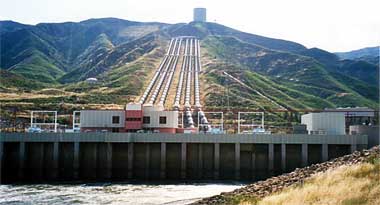
LADWP is proposing to spend $3 billion on a pumped storage facility at the Hoover Dam on the Colorado River. Yet, LADWP has not been using extensively its aging 1,247 MW Castaic pumped storage plant on the State Water Project in the pumping recovery mode. Instead, LADWP runs it more like a standard hydropower plant, and uses pumping to supplement and extend the peak power generation, rather than using it to store excess day time power. And the SWP’s 759 MW pumped storage plant at the Hyatt-Thermalito powerhouse at Lake Oroville has been not been used effectively for decades.

The more prudent course would seem to be to focus on refurbishing and updating existing facilities, with variable speed pumps for example, to deliver utility scale storage that can capture excess renewable energy generation nearer large load centers. The State Water Contractors should be incented to upgrade these facilities through contracts with the state’s electric utilities. Unfortunately, no direct market mechanism exists to provide a true value for these resources so long at the California Public Utilities Commission and the California Independent System Operator avoid developing full pricing. As it stands, the current pricing scheme socializes and subsidizes a number of electricity services such as transmission, unit commitment decisions, and reliability services.

Reaganomics for fuel economy?

electric-car

I chuckled when I saw this article extolling how CAFE fuel economy standards should be replaced with “clean tax cuts.” One proponent said, “If you want more of something, tax it less.”

But apparently, these incentives work only one direction. “It’s very common, historically, for companies to not meet the targets and just pay the fines,” said Josiah Neeley, a senior fellow for the R Street Institute. However, the auto companies were not happy with a proposal to increase the penalty 155%.  Does that mean that the penalty got large enough to incent greater compliance?

Views on a sustainable Davis

ucdwestvillage1068b

Two board member of the Valley Climate Action Center, Gerry Braun and Richard Bourne wrote two articles on making building energy use in Davis sustainable and resilient. VCAC board members, including myself, had input into these articles. They reflect a vision of getting to a zero-net carbon (ZNC) footprint while being economically viable. Both were published in the Davis Enterprise.

Ahead of the tariff, U.S. imported 3 years worth of solar panels from China

1024x1024Panel imports were up 1,200 percent in fourth quarter 2017. That implies that installers were banking supplies to ride out the import tariff imposed by the Trump Administration. Unfortunately, it also means that the rapid technical and cost progress for panels may stall for that three year period.

Electric industry tries the “big lie”

electricity-use-profile

The Edison Electric Institute has floated the idea that demand charges should be renamed as “efficiency rates.” Demand charges measure the maximum use in a month, and once a customer reaches that demand level in a month, a portion of the usage is free below that demand level. Providing power for free encourages more use, not less, which is the opposite of what “efficiency rates” should do.  Apparently this proposal is part of a larger effort to relabel everything that utilities find objectionable, such as distributed energy resources.

Demand charges can have a place in rate making, but the best such tool, made feasible by the rollout of “smart meters,” is daily demand charges that reset each day.


Commentary on CPUC Rate Design Workshop

cartoon

The California Public Utilities Commission (CPUC) held a two-day workshop on rate design principles for commercial and industrial customers. To the the extent possible, rates are designed in California to reflect the temporal changes in underlying costs–the “marginal costs” of power production and delivery.

Professor Severin Borenstein’s opening presentation doesn’t discuss a very important aspect of marginal costs that we have too long ignored in rate making. That’s the issue of “putty/clay” differences. This is an issue of temporal consistency in marginal cost calculation. The “putty” costs are those short term costs of operating the existing infrastructure. The “clay” costs are those of adding infrastructure which are longer term costs. Sometimes the operational costs can be substitutes for infrastructure. However we are now adding infrastructure (clay) in renewables have have negligible operating (putty) costs. The issue we now face is how to transition from focusing on putty to clay costs as the appropriate marginal cost signals.

Carl Linvill from the Regulatory Assistance Project (RAP) made a contrasting presentation that incorporated those differences in temporal perspectives for marginal costs.

Another issue raised by Doug Ledbetter of Opterra is that customers require certainty as well as expected returns to invest in energy-saving projects. We can have certainty for customers if the utilities vintage/grandfather rates and/or structures at the time they make the investment. Then rates / structures for other customers can vary and reflect the benefits that were created by those customers making investments.

Jamie Fine of EDF emphasized that rate design needs to focus on what is actionable by customers more so than on a best reflection of underlying costs. As an intervenor group representative, we are constantly having this discussion with utilities. Often when we make a suggestion about easing customer acceptance, they say “we didn’t think of that,” but then just move along with their original plan. The rise of DERs and CCAs are in part a response to that tone-deaf approach by the incumbent utilities.

Paying off coal miners to improve the environment

4f06c43b7ad545688ca6766cdfeec1c8

Finally, a real world example of how benefit-cost analysis should be used in practice. Alberta takes the revenues that represent a portion of the society wide benefits and distributes those to the losers from the policy change. Economists have almost always ignored the problem of how to compensate losers in changes in social policy, and of course those who keep losing increasingly oppose any more policies. Instead of dreaming up ways to invest carbon market revenues in whiz bang solutions, we first need to focus on who’s being left behind so they are not resentful, and become a key political impediment to doing the right thing.