Tag Archives: climate change

Identifying the barriers to transportation fuel diversity

Tim O’Connor of EDF writes about the benefits of transportation diversification at EDF’s California Dream 2.0. I think that fuel diversity is a useful objective, but achieving that will be difficult due to the network externalities inherent in transportation technologies. Gasoline and diesel vehicles became dominant because having single-fuel refueling networks is more cost effective for both vendors and customers, and reduce the search costs for drivers to find those stations. Think of how many fueling stations someone might have to pass to reach their particular energy source. Investing in a particular fuel requires a certain level of revenue. Note how many local gas stations have closed because they didn’t have enough sales.

For a more recent example, we can look at cell phone operating systems. Initially each manufacturer had their own system, but now virtually all phones are driven by two systems, Android and iOS, while Windows 8 keeps trying to make inroads.

We need to be very aware of the fueling network economics when pushing for new transportation energy sources. Investing in a system is as much a set of business decisions as a policy decision. One approach might be to focus on using particular fuels in a narrow set of sectors and discourage broad sector-wide use. Another might be to use a geographic focus and to set up means of interconnecting across those geographies.

Yet another misconstrued view of “economics” in the climate change debate

Charles Mann wrote an interesting review of several books on climate change in The Atlantic Monthly. He portrays the debate as “Environmentalists” vs. “Economists.”  Unfortunately he describes economists as relying entirely on using central tendency expected values in standard cost-benefit analyses. And he fails to give economists full credit for creating the cap and trade system that he praises as an effective means of generating the change that is required.

The fact is that many economists are changing the debate on climate change to focus on deep uncertainty, to assess the costs of unlikely but catastrophic outcomes, to design effective technology subsidies, and to focus California’s climate change policies on global goals. All of these are important innovations that are affecting the debate over how to address the risks of potential climate change.

It’s important to recognize that we need to decide to act without full knowledge about whether climate change is driven by human activity or will it be of sufficient consequence to affect our civilization. If we live in a forest and there’s risk from a distant fire, we assess whether we need to buy insurance, clear brush around our house or evacuate. The fire may never come to pass–in fact the probability may be quite low, but we know the catastrophic consequences if it arrives. Is acting now to address climate change risk, both mitigation or adaptation, worth it? Economists have the tools to address this question–the problem is that key individuals in the media such as Charles Mann don’t seem to be aware of these, and so neither does the public or decision makers.

Repost: Californians Can Handle the Truth About Gas Prices

Sev Borenstein writes about the two sides of the argument on whether transportation fuels should be rolled into the cap-and-trade program in January 2015.

I have an observation that that has only been alluded to indirectly in the debate. The main point of the legislators’ letter calling for a delay in implementation is that low income groups may be particularly hit. The counter argument that we need the inclusion of transportation fuels under the cap to incent innovation seems to pit the plight of the poor against the investment risk of wealthy entrepreneurs. We haven’t really done a good job of addressing affordability of the transformative policies that can change GHG emissions. The proposal to use carbon tax revenues to rebate to low income taxpayers has been floated at the national level, but of course that died with the rest of the national cap and trade proposal. A similar proposal was made to mitigate electricity price impacts.

Our state legislators are rightfully concerned about the impacts on those among us who have the least. Nevertheless, that problem is easily addresses with the tools and resources that are already available to the state. Those families and households who now qualify for the CARE and FERA electric and natural gas utilities rate discounts can be made eligible for an annual rebate equal to the average annual gasoline consumption multiplied by the amount of the GHG allowance cost embedded in the gasoline price. This rebate could be funded out of the state’s allowance revenue fund. For example, if the price is increased by 15 cents per gallon and the average automobile uses 650 gallons per year, an eligible household could receive $97.50 for each car.

About 30% of households are currently eligible for CARE or FERA. On a statewide basis, the program would cost about $650 million, which is comparable to the cost for CARE for a single utility like PG&E or Southern California Edison. Those legislators who are most concerned can coauthor legislation to put this program in place.

(BTW, I think the DOE fuel use calculator is outdated–on my many trips to LA I haven’t seen these types of fuel economy changes. My average MPG is pretty much the same no matter how much traffic there is on I-5.  But that’s just a fun fact aside…)

Repost: California Dream – How Big Data Can Fight Climate Change in Los Angeles

EDF and UCLA have created an interesting visual presentation on the potential for solar power and energy savings in the LA county, overlaid with socio-economic characteristics. (But I have some trouble with the representation of a few West LA communities as disadvantaged with high health risk–is that the UCLA campus?

What we might expect for diffusion of new decentralized energy technologies?

Technologies and policies that enhance the development of decentralized energy resources have generated increasing interest over the last couple of years.  I’ll write more in the future about what are the underlying drivers, both technological and institutional.

I’ve been interested in the question of where do we stand, and how long might it take for diffusion of these new technologies. We can look back and see how technology transformed lives in just a couple of decades. Compare kitchens from 1900 and 1930; if we walked into the earlier kitchen, most of us would be lost, but we could whip up a meal in 1930.

 1030's Kitchen; Photo Credit - Henry Ford Museum

Or the rapid adoption of autos. In 1909, people could stand in the middle of Pike Street in Seattle and talk:

File:Seattle - Pike Street 1909.jpg

Not so safely in 1930:

Do we stand today at a point just at the onset of a new technological evolution?

One question to be answered is whether our institutional settings will allow these new technologies. In one case, it appears that Germany has already chosen its road. But in the US, whether we rely on central power stations using transmission lines may still be a question in play. That deserves a separate post of its own.

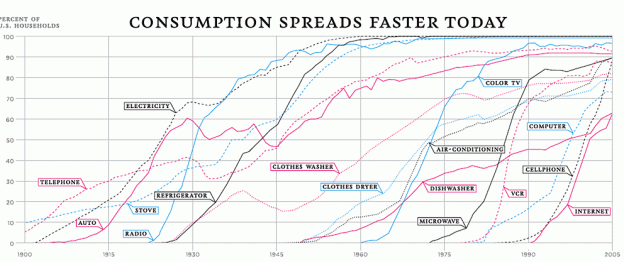
If we assume that we choose the decentralized path, what might we expect in when these technologies are adopted widely. A couple of graphics illustrate historic diffusion rates. This is one from VisualEconomics via The Atlantic:

Another one from Forbes via The Technium shows the parallel development paths (however, I don’t like starting at the year of invention instead of a threshold adoption level):

One might interpret the upper graph as showing accelerating adoption rates. But I interpret the lower chart as illustrating at least two factors that drive diffusion: the relative importance of network infrastructure and the expense relative to individual wealth.  Autos, telephones and electricity all required construction of a large network of roads or wires, often funded with public investment. Individuals can’t choose to adopt the technology until a larger public decision is made to facilitate that adoption.  As to expense, refrigerators and dishwashers were large household investments for many years, and cars are still a large single expenditure. On the other hand, cell phones, radios and televisions quickly became inexpensive which lubricated diffusion. We need another graphic showing how diffusion rates relate to these two different axes.

We are still unsure where decentralized energy technologies will fall among these characteristics. They may seem small and inexpensive, but enough solar panels to power a house will still be several thousand dollars for the foreseeable future. And the how much electric network investment is required to integrate these resources is the center of the debate over technology policies.

Too often studies making forecasts and policy recommendations don’t consider what adoption rates are feasible or probable. However a study comes along and incorporates this concept as its centerpiece. A good example is the Clean Energy Vision Project’s Western Grid 2050 report. Lead by a former colleague Carl Linvill, who’s now at the Regulatory Assistance Project, it looked at several different scenarios for technology diffusion. Such studies give us a better understanding of what’s actually possible rather than what we wish for.

Repost: What’s the Worst That Could Happen?

How do we best induce technological innovation? We’ve already run that experiment

Improvement in new and existing technologies’ performance and costs is a function of responses to a mix of market and regulatory signals. Finding empirical measures of differing innovation influences is difficult due to confounding influences. Yet we may be able to look at broader economic trends to discern the relative merit of different approaches.

The most salient example could be the assessment of comparative performances after the fall of the Berlin Wall. The Allies conducted a 45-year experiment in which Germany was first split after World War II with largely equivalent cultures and per capita endowments, but one used a largely market-based economy and the other relied on central economic planning. When the two nations reunited in 1990, the eastern centrally-planned portion was significantly behind in both overall well-being and in technological innovations and adoption. West Germany had doubled the economic output of centrally-planned East Germany.

More importantly, West Germany had become one of the most technologically-advanced and environmentally-benign economies while East Germany was still reliant on dirty, obsolete technologies. For example, a coal-to-oil refinery in the former East Germany was still using World War II-era technology. West Germany’s better environmental situation probably arose from the fact that firms and the government were in an adversarial setting in which the firms focused on the most efficient use of resources and were insulated from political interest group pressures. On the other hand, resource allocation decisions in East Germany had to also consider interest group pressures that tended to protect old technologies and industries because these were state-owned enterprises.

The transformation of the West German economy, both technologically and institutionally, was akin to what we will need to meet current GHG reduction goals and beyond. This more clearly than any other example demonstrates how reliance on central planning, as attractive as it appears to achieving specific goals, can be overwhelmed by the complexity of our societies and economies. Despite explicit policies to pursue technological innovations, a market-based system progressed much more rapidly and further.

Not talking past each other on California’s transportation fuels cap & trade implementation

Last week, 16 Democratic legislators sent a letter to ARB Chair Mary Nichols asking for a delay in adding transportation fuels to the AB 32 cap and trade program starting January 1, 2015. The legislators raise concerns about how a 15 cent per gallon increase could impact the state’s poor.

I was asked by EDF to sign on to a letter in response. That letter focuses on how much of the anticipated innovation arising from AB 32 is dependent on implementing this phase of cap and trade. However, I think the proposed letter misses an important point by the legislators.

Our state legislators are rightfully concerned about the impacts on those among us who have the least.  Nevertheless, that problem is easily addressed with the tools and resources that are already available to the state. Those families and households who now qualify for the CARE and FERA electric and natural gas utilities rate discounts can be made eligible for an annual rebate equal to the average annual gasoline consumption multiplied by the amount of the GHG allowance cost embedded in the gasoline price.  This rebate could be funded out of the state’s allowance revenue fund. For example, if the price is increased by 15 cents per gallon and the average automobile uses 650 gallons per year, an eligible household could receive $97.50 for each car.

About 30% of households are currently eligible for CARE or FERA. On a statewide basis, the program would cost about $650 million, which is comparable to the cost for CARE for a single utility like PG&E or Southern California Edison. Those legislators who are most concerned can coauthor legislation to put this program in place.


Think Globally, Act Beyond Locally

Two blog posts of interest on how climate change policy needs to focus on the much bigger picture and not just on local, or even statewide, strategies. If local and state policies are not attractive and readily transferable to other jurisdictions then we’re wasting our time (, California…)  Getting the last ton can be counterproductive if it creates too much complexity or becomes politically unpalatable.
Severin Borenstein from UC Berkeley on California’s policies.

And Jeffrey Rissman from Energy Innovation on three policy approaches.