Tag Archives: innovation policy

Questions yet to be answered from the CAISO Symposium

While attending the CAISO Stakeholder Symposium last week I had rush of questions, not all interconnected, about how we manage the transition to the new energy future. I saw two very different views about how the grid might be managed–how will this be resolved? How do we consider path dependence in choosing supporting and “bridge” resources? How do we provide differential reliability to customers? How do we allow utilities to invest beyond the meter?

Jesse Knight, former CPUC Commissioner and now chairman at SDG&E and SCG, described energy utilities as the “last monopoly” in the face of a rapidly changing economic landscape. (Water utilities may have something to say about that.) SDG&E is ahead of the other utilities in recognizing the rise of the decentralized peer-to-peer economy.  On the other hand, Clark Gellings from EPRI described a world in which the transmission operator would have to see “millions” of nodes, both loads and small generators, to operate a robust network. This view is consistent with the continued central management implied by the utility distribution planners at the CPUC’s distribution planning OIR workshop. At the end of the symposium, 3 of the 4 panelist said that the electricity system would be unrecognizable to Thomas Edison. I wonder if Alexander Graham Bell would recognize our telecommunications system?

One question posed to the first “townhall” panel asked what role natural gas would have in the transition to more renewables. I am not aware of any studies conducted on whether and how choices about generation technology today commits us to decisions in the future. Path dependence is an oft overlooked aspect of planning. We can’t make decisions independent of how we chose in the past. That’s why it’s so difficult to move away from fossil fuel dependence now–we committed to it decades ago. We shouldn’t ignore path dependence going forward. Building gas plants now may commit us to using gas for decades until the financial investments are recovered. We may be able to buy our way out through stranded asset payments, but we learned once before that wasn’t a particularly attractive approach. Using forethought and incorporating flexibility requires careful planning.

And along those lines in our breakout session, another question was posed about how to resolve the looming threat of “overgeneration” from renewables, particularly solar.  Much of the problem might be resolved by charging EVs during the day, but it’s unlikely that a sizable number of plug-in hybrids and BEVs will be on the road before the mid-2020s. So the question becomes should we invest in gas-fired generation or battery or pumped storage, both of which have 20-30 year economic lives, or try to find other shorter lived transitions including curtailment contracts or demand response technologies until EVs arrive on the scene? It might even be cost effective to provide subsidies to accelerate adoption of EVs so as to avoid long-lived investments that may become prematurely obsolete.

Pricing for differential reliability among customers also came up. Often ignored in the reliability debate at the CAISO is that the vast majority of outages are at the distribution level. We appear to be overinvested in transmission and generation reliability at the expense of maintaining the integrity of the local grid. We could have system reliability prices that reflect costs of providing flexible service to follow on-site renewable generation. However the utilities already recover most of the capital costs of providing those services through rate of return regulation. The market prices are suppressed (as they are in the real time market where the IOUs dump excess power) so we can’t expect to see good price signals, yet.

Several people talked about partnerships with the utilities in investing in equipment beyond the meter. But the question is will a utility be willing to facilitate such investments if they degrade the value of its current investment in the grid? Fiduciary responsibility under traditional return on capital regulation says only if the cost of the new technology is higher so as to generate higher returns than the current grid investment. That doesn’t sound like a popular recipe for a new energy future.  Instead, we need to come up with creative means of utility shareholders participating in the new marketplace without forcing them down the old regulatory path.

Margaret Jolly from ConEd noted that the stakeholders were holding conversations on the new future but “the customer was not in the room.” Community, political and business leaders who know how electricity is used were not highly evident, and certainly didn’t make any significant statements. I’ve written before about offering more rate options to customers. I wanted to hear more from Ellen Struck about the Pecan Street study, but her comments focused on the industry situation, not customers’ behaviors and choices.

Understanding the Challenges of Modeling AB 32 Policy

A summary of the review of the AB 32 Scoping Plan we conducted in 2008 for EDF.

clotworthy's avatarEnvironmental & Energy Valuation News

The Aspen Environmental Group, M.Cubed for Environmental Defense / by Richard J. McCann
http://www.edf.org/documents/8902_AB32%20EconModeling%20M3%20final.pdf (full report)
http://www.edf.org/documents/8901_AB32%20AspenEnv%20Modeling%20PolicySum.pdf (summary)

[From press release] A new study released today concludes that state-of-the-science economic models, including those used for the California Air Resources Board’s economic analyses of California’s Global Warming Solutions Act (AB 32), are not capable of simulating the fundamental changes in California’s economy that AB 32 measures are likely to cause. While critics of ARB claim that costs might be underestimated, this new study shows that many benefits also are not represented by models and more modeling isn’t as useful as consideration of lessons from prior policies and economics literature.

The study is timely because CARB will vote on the Proposed Scoping Plan to implement the Global Warming Solutions Act of 2006 (AB 32) on December 11, less than a week away.

In the new study, Dr. McCann reveals that current techniques…

View original post 60 more words

Identifying the barriers to transportation fuel diversity

Tim O’Connor of EDF writes about the benefits of transportation diversification at EDF’s California Dream 2.0. I think that fuel diversity is a useful objective, but achieving that will be difficult due to the network externalities inherent in transportation technologies. Gasoline and diesel vehicles became dominant because having single-fuel refueling networks is more cost effective for both vendors and customers, and reduce the search costs for drivers to find those stations. Think of how many fueling stations someone might have to pass to reach their particular energy source. Investing in a particular fuel requires a certain level of revenue. Note how many local gas stations have closed because they didn’t have enough sales.

For a more recent example, we can look at cell phone operating systems. Initially each manufacturer had their own system, but now virtually all phones are driven by two systems, Android and iOS, while Windows 8 keeps trying to make inroads.

We need to be very aware of the fueling network economics when pushing for new transportation energy sources. Investing in a system is as much a set of business decisions as a policy decision. One approach might be to focus on using particular fuels in a narrow set of sectors and discourage broad sector-wide use. Another might be to use a geographic focus and to set up means of interconnecting across those geographies.

Distribution system operator rising

Two recent papers propose a new approach to managing the distribution grid by creating a “distribution system operator” (DSO). The DSO would control the local low-voltage grid between the substations and the customers’ meters, much as the independent system operators (e.g., CAISO, PJM, MISO, NEISO, NYISO) run the high-voltage transmission grid above the substations. The transmission and distribution system would be run as an open-access system, much as how many natural gas utilities are run now.

Lorenzo Kristov and Paul De Martini have written about this approach, focusing on the technical issues. They are agnostic on ownership, and talking with Kristov (frequently) he sees that the DSO can be either owned by the existing utility or spun off.

Former FERC Chair Jon Wellinghoff and James Tong of Clean Power Finance have addressed the ownership / management issue, proposing that the DSO be independent. They also have proposed that regulated utilities be allowed to own distributed generation on the customer side of the meter.

An important issue yet to be addressed in the creation of (I)DSOs though is transition and sustainability. The creation of ISOs has been politically traumatic, and creating IDSOs will face even more risk-averse political opposition, particularly in the West, after the energy debacle of 2000-01. We’ve also seen that ISOs are not particularly cost sensitive because they are largely insulated from direct cost regulation of the capital assets that they manage (a classic “agency” problem.) Since transmission is such a small portion of overall rates, the ISOs have been able to fly under the radar–but that may change soon.

Finally, it’s not clear how shareholders will view the change in asset ownership, management and returns. I wrote about this previously in the emergence of the “peer to peer” economy. Ensuring that shareholders don’t lose substantial value, even as the risk profile changes, will be key to easing the political process. There are alternative models for easing the asset management transition that is not threatening to current shareholders. There are better models than simply relying on regulated utilities to essentially do more of the same. Market forces are important in driving the innovation needed to transition the electricity system.  More on that another time.

What is the true price for renewable energy power?

The renewable energy market has been in upheaval since the collapse of the financing sector in 2008. The withdrawal of easy money and uncertainty over federal tax policy has increased perceived risk.  Large firms have been shedding renewables subsidiaries and promising newcomers have dropped high-profile projects. Waste Management just sold Wheelabrator, exiting the waste-to-energy market. Brightsource suspended its Hidden HIlls solar thermal project. Much of this activity is driven by the perception that wholesale electricity market prices are falling and the underlying fundamentals will lead to further declines.

This perception is misplaced, however. Short run electricity market prices are falling as natural gas becomes cheaper, and more importantly, fossil fuel generation is squeezed out by increasing renewables and falling demand. However, the electricity marketplace hasn’t yet adjusted to the fact that natural gas generation is no longer the only marginal generation resource. In California, the renewables portfolio standard (RPS) makes at least 33% of the marginal generation from renewable resources. When capital costs are correctly figured in, and more long-term contracts are offered to match those deferred resources, power purchase agreement (PPA) prices for the right types of resources should increase, not decrease.

The problem is that the industry hasn’t been able to adjust its procurement model to reflect this new reality. I think this is coming from a combination of utilities continuing to maintain their monopsony (single buyer) position, risk averse regulatory agencies still relying on an obsolete procurement regulatory process, and those agencies enforcing the monopsony power of the utilities in the name of protecting ratepayers. This may not change until there is public acknowledgement that this situation exists. The difficulty is finding the right stakeholders with enough sway to raise the issue.

Repost: California Dream – How Big Data Can Fight Climate Change in Los Angeles

EDF and UCLA have created an interesting visual presentation on the potential for solar power and energy savings in the LA county, overlaid with socio-economic characteristics. (But I have some trouble with the representation of a few West LA communities as disadvantaged with high health risk–is that the UCLA campus?

What we might expect for diffusion of new decentralized energy technologies?

Technologies and policies that enhance the development of decentralized energy resources have generated increasing interest over the last couple of years.  I’ll write more in the future about what are the underlying drivers, both technological and institutional.

I’ve been interested in the question of where do we stand, and how long might it take for diffusion of these new technologies. We can look back and see how technology transformed lives in just a couple of decades. Compare kitchens from 1900 and 1930; if we walked into the earlier kitchen, most of us would be lost, but we could whip up a meal in 1930.

 1030's Kitchen; Photo Credit - Henry Ford Museum

Or the rapid adoption of autos. In 1909, people could stand in the middle of Pike Street in Seattle and talk:

File:Seattle - Pike Street 1909.jpg

Not so safely in 1930:

Do we stand today at a point just at the onset of a new technological evolution?

One question to be answered is whether our institutional settings will allow these new technologies. In one case, it appears that Germany has already chosen its road. But in the US, whether we rely on central power stations using transmission lines may still be a question in play. That deserves a separate post of its own.

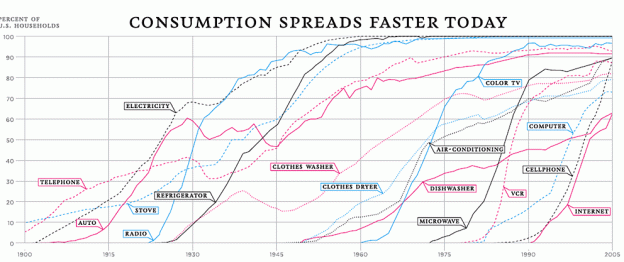
If we assume that we choose the decentralized path, what might we expect in when these technologies are adopted widely. A couple of graphics illustrate historic diffusion rates. This is one from VisualEconomics via The Atlantic:

Another one from Forbes via The Technium shows the parallel development paths (however, I don’t like starting at the year of invention instead of a threshold adoption level):

One might interpret the upper graph as showing accelerating adoption rates. But I interpret the lower chart as illustrating at least two factors that drive diffusion: the relative importance of network infrastructure and the expense relative to individual wealth.  Autos, telephones and electricity all required construction of a large network of roads or wires, often funded with public investment. Individuals can’t choose to adopt the technology until a larger public decision is made to facilitate that adoption.  As to expense, refrigerators and dishwashers were large household investments for many years, and cars are still a large single expenditure. On the other hand, cell phones, radios and televisions quickly became inexpensive which lubricated diffusion. We need another graphic showing how diffusion rates relate to these two different axes.

We are still unsure where decentralized energy technologies will fall among these characteristics. They may seem small and inexpensive, but enough solar panels to power a house will still be several thousand dollars for the foreseeable future. And the how much electric network investment is required to integrate these resources is the center of the debate over technology policies.

Too often studies making forecasts and policy recommendations don’t consider what adoption rates are feasible or probable. However a study comes along and incorporates this concept as its centerpiece. A good example is the Clean Energy Vision Project’s Western Grid 2050 report. Lead by a former colleague Carl Linvill, who’s now at the Regulatory Assistance Project, it looked at several different scenarios for technology diffusion. Such studies give us a better understanding of what’s actually possible rather than what we wish for.

Making Community Solar Gardens Work

California has been quite successful at encouraging the development of (1) large utility-scale renewables through the renewables portfolio standard (RPS) and other measures and (2) small-scale, single structure solar generation through the California Solar Initiative (CSI) and measures such as net energy metering (NEM).  However, there have been numerous market and regulatory barriers to developing and deploying the “in-between” community-scale and neighborhood-scale renewables that hold substantial promise.

Community-scale and neighborhood-scale distributed generation (DG) includes some technologies that simply are not cost-effective at the small scale of a single house or business, but are not large enough to justify the transaction costs of participating in the larger wholesale electricity market.  These resources, such as “community solar gardens”, can meet the demands of many customers who cannot take advantage of adding renewables at their location and can also reduce investment in expensive new transmission projects. Examples of these types of projects are parking structure-scale solar photovoltaics, solar-thermal generation and space cooling, and biogas and biomass projects, some of which could provide district heating.  Technology costs are falling so rapidly that these mid-scale projects are becoming competitive with utility-scale resources when transmission cost savings are factored in. SB 43 (Wolk 2013) recognizes that the promise of mid-scale renewables has not been realized.

In response to SB 43, each of the large investor-owned utilities–PG&E, SCE and SDG&E–have filed proposed tariffs with names such as Enhanced Community Renewables Program or Share the Sun. I filed testimony in the PG&E and SCE cases on behalf of the Sierra Club addressing shortcomings in those programs that would inhibit development of community solar gardens. SDG&E’s proposal, while not perfect, better meets the law’s objectives. After the hearings, the CPUC postponed a proposed decision from the July 1 deadline to October.

SB 43’s requirement that the investor-owned utilities “provide support for enhanced community renewables programs” is a critical step forward for California’s distributed energy goals.  The CSI is the state’s premier distributed generation program.  In SB 43 the Legislature expressed its intent that the “green tariff shared renewables program seeks to build on the success of the California Solar Initiative by expanding access to all eligible renewable energy resources to all ratepayers who are currently unable to access the benefits of onsite generation.”  SB 43 advances the success of the CSI into the area of multifamily residential and multitenant commercial properties and introduces all types of renewable energy resources.  Customers who, for various reasons, cannot benefit from the current net metering programs, will be able to benefit through SB 43.

The Legislature clearly intends for this program to lead to a transformation in the energy market akin to the success for single customers of the CSI. This necessary market transformation extends to multifamily and commercial lease properties that are currently beyond the CSI and Self Generation Incentive Programs (SGIP). The Commission should ensure that utilities’ programs under SB 43 provides the market transformation that is necessary for this underserved segment.

State regulations calls for all new residential dwellings to consume zero-net energy (ZNE) by 2020, and all new commercial properties by 2030.  Fully implementing the market transformation identified in SB 43 is one of the obvious means to achieve this target.  The CSI option has already facilitated many examples of feasible ZNE single-family homes using renewables well ahead of the 2020 deadline.  There are several market barriers to integrating renewables in a similar manner on multifamily and commercial leased properties and on single-family that are not favorably located or that have other impediments.

A properly-designed community solar garden program should provide a critical work-around for the split-incentive problem that has plagued local renewable development in California.  The split-incentive problem arises from the fact that multi-tenant structures, both commercial and residential, may not be able to implement solar or other renewable resources due to the fact that lessees are not the owners of the shared space where renewables could be sited.  The problem of split-incentives between landlords and tenants has long been recognized, and has been the focus of energy efficiency programs.

As a corollary, the Commission should provide individual developers and property owners the opportunity to integrate energy efficiency and DG measures to achieve the best mix for meeting environmental and economic goals. Each project is unique so that a “one size fits all” approach that requires sale of all output into the wholesale market with buyback from customers who may have no connection with the project will only discourage enhanced development.

For distributed generation to expand in California there must be a cost-effective path for residential and commercial tenants, as well as not-well-situated buildings, to install solar and other renewables and share the costs among other customers. The focus to date has been on either utility-scale or single-building scale projects, but the most promise may be in mid-scale projects that can serve a community or a neighborhood cost-effectively through a combination of scale economies and avoided transmission and distribution investment.  But to achieve this objective requires changes from current utility practices.

An update: Here’s the link to the decision on this CPUC case issued in January. And here’s the link to scoping memo for the phase of this proceeding.

Repost: Millennials and the Future of Electric Utilities

An insightful discussion about the new type of consumers that utilities will be facing–consumers who now expect to have customized experiences for no added cost.

One potential diversion though: The Brookings Institute description of Millenials–socially conscious, distrust of big companies, more favorable to government regulation–was used to describe the Baby Boomers 50 years ago. The actual changes didn’t really pan out that way. How the marketplace evolves is still uncertain.

The “Peer Economy” and the new future decentralized energy system

Sunil Paul of Side Car wrote on LinkedIn about how the emergence of the “peer economy” has allowed the emergence of new economic transactions.  Side Car uses a smartphone app much like Uber and Lyft to connect riders with drivers to connect for quickly arranged trips.

Paul writes: “The peer economy is the growing business segment of transactions between individuals – one person to another – without a middleman to manage and package it. Think eBay for everything. ” He goes on to say, “(t)o win in the emerging peer economy, it’s important for companies and organizations to listen to what is possible with the technology and connect that with the needs of consumers and businesses. ”

The electricity industry appears to be on the verge of entering the transition to the peer economy with self-sustaining households and neighborhood microgrids. The single largest barrier is institutional, not technological, from the incumbent utility industry. We need to consider innovative strategies and policies to have them embrace this transition rather than resist it.

At M.Cubed we’re working on those solutions–the objective is not to try to bull over the utilities because that is a sure loser in the political world. There are ways for change the perspective so that the the utilities can see their advantage. We did that for the mobilehome park industry in California when we got PG&E to back conversion of aging master-metered electricity and gas systems to utility ownership. Look for more from us on this topic in the near future.