Tag Archives: solar rooftop

Discerning what drives rate increases is more complex than shown in LBNL study

The renewables policy team at Lawrence Berkeley National Laboratory (LBNL) released a study maintaining that it identifies the primary drivers of rate increases in the U.S. LBNL also issued a set of slides summarizing the study but there discrepancies between the two. (This post focuses on the study.)

First, this group of authors have been important leaders in tracking technology costs and resource alternatives at a micro level. You can find many of their studies cited in my various posts on renewables and distributed energy resources (DER). This time the authors may have stretched a bit too far.

Unfortunately this study is much more about correlation than causality. The authors hint at a more complex story that would require much more sophisticated regression analysis (e.g., two or three stage and fixed effects regressions) to untangle. Yet the report uses the term “driver” numerous places when “correlation” or “association” would be more appropriate.

Observations about Table 2 that displays the regression results and the discussion about findings in Section 4:

  • 4.2 Price trends varied by state: Prices rose in states that are internalizing environmental and other costs while states with falling rates were continuing to impose environmental hazards and other costs on their citizens as a subsidy to utility shareholders.
  • 4.4 Finding that rising growth decreases rates (load delta): This finding confuses a shift in customer composition with overall causality. The study found it was rising commercial loads, not overall loads, that decreased rates. That means the share of lower cost commercial customers increased, so, of course, the average rate decreased. The residential rates were unchanged statistically.
  • 4.5 Behind the meter (BTM) solar: the most egregious error. The authors acknowledge this issue is problematic with many different viewpoints, but then plow ahead anyway. Customers find the most effective way to respond to rising rates is to install their own generation. This is classic economic cause and effect, yet the authors run a model assuming the reverse.

The problem is that they accept as given the utility narrative that rooftop customers are shirking cost responsibility while ignore the cost saving from serving load themselves. The authors also buy into the false narrative that utilities have substantial “fixed” costs—every other industry that has large fixed costs recover those through variable charges.  That the BTM variable is strongly negative for the 2017-22 period and then positive for 2019-24 is an analytic red flag. (The negative value for the RPS effect from 2016-2021 just as California’s most expensive renewables came on line compared to the other periods is another red flag in the regression analysis overall.)

Our analysis shows instead how California NEM customers have saved money for other customers. The authors do not include that critique of the studies done in California in their citations. We also deeply critiqued the E3 study of Washington’s NEM program, finding numerous analytic and conceptual errors. (Ahmad Faruqui would disavow his Sergici et al 2019 study included as a supporting citation in the LBNL study.)

There are two fundamental conceptual errors in these underlying analyses that the LBNL authors rely on: 1) that utilities have the right to serve 100% of customer loads and customers must pay for the privilege to self serve with their own generation, and 2) that utilities are entitled to full recovery of all of their costs even when sales decrease. Neither of these premises hold in any other industry (even natural gas and water utilities).

Notably they found no statistical effect from energy efficiency programs yet the impacts on utility sales and revenues are identical to BTM solar. No one is calling for customers who install LED lighting, insulation or more efficient appliances to increase their contribution utility revenue requirements to be “fair.” The one difference is that DERs present the opportunity to truly “cut the cord” with the utility if rates become excessive. This is further evidence that this finding that rooftop solar unduly raises the rates for other customers is false and misleading.

  • 4.9 Wildfire spending as a source of cost increases: the authors attribute a 6 cents/kWh increase in California wildfire spending. That’s incorrect (the PAO took PG&E’s assertion without checking it) as we have tracked the total utility spending—it’s only about 10% or less than 4 cents/kWh of IOU rates. But a portion of that increase already happened prior to 2019, and the wildfire bond adder wasn’t an increase but rather a repurposing of an existing bond cost recovery charge. The rate increase attributable to wildfire spending is less than 3 cents on a statewide basis (rolling in the municipals, e.g., LADWP & SMUD).
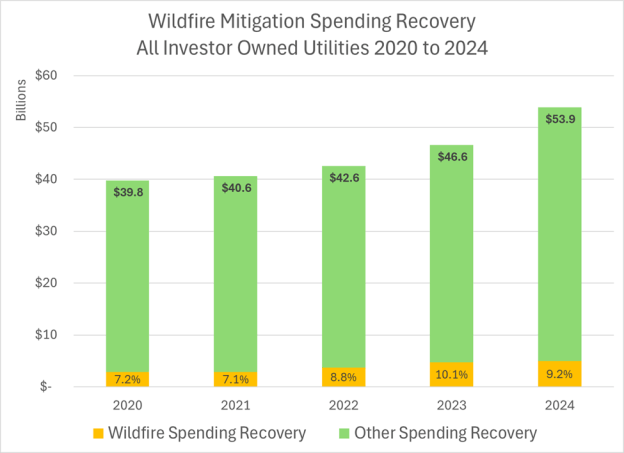
The real reason for California rate increases are: 1) unusual exposure to natural gas prices because the IOUs have not hedged power purchases 2) increase in resource adequacy prices because of multiple changes in how this handled (the underlying reason being to squeeze CCAs), 3) unregulated spending in distribution infrastructure the IOUs starting in 2010 and 3) a 150% increase in transmission investment to deliver grid scale renewable generation since 2012. 

Response to Borenstein’s critique of our assessment of the benefits of rooftop solar

Severin Borenstein at the Energy Institute at the Haas Business School posted a reply[1] to our analysis[2] of the Public Advocates Office’s claim[3] of a large “cost shift” created by rooftop solar customers to other customers. Here is my extended reply to Borenstein’s critique.

  • Issues of agreement: Borenstein acknowledges that the PAO used an incorrect capacity factor to calculate the total amount of rooftop solar generation. He also acknowledged that the monthly bill payments from rooftop solar customers should be included in the calculation, an error that both PAO and he has previously committed. Further, he agreed, with caveats, that the rate reductions and subsidy savings for low-income CARE customers should be included. Those elements alone add up to reducing PAO’s claimed cost shift approaching $2 billion or 25%
  • Self generation: Borenstein and the PAO ignore the fact that self generation is not included in any utility resource planning. Rooftop solar generation is counted in load forecasts as a load reduction just like energy efficiency. Grid investments, generation capacity and operational decisions such as reserve margins all focus solely on metered load that excludes all self generation.. Borenstein mistakenly asserts that grid and self-provided power mingles, obviating the right to self generation. If there is generation and consumption onsite at the same time, those electrons do not touch the grid. Along with the fact that the energy does not mix, legal precedents and analysis by leading regulators contradict Borenstein’s (and PAO’s) position. Further, the NEM tariffs explicitly recognize the right to self generate for the term of the tariff.
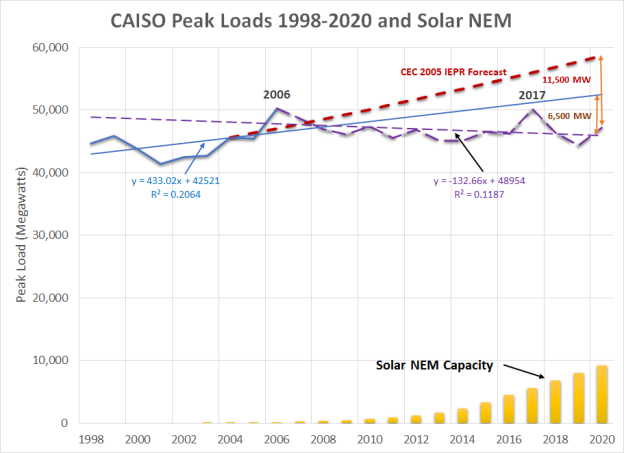
  • Historic utility savings: Borenstein, like PAO, creates a confusing “apples-to-oranges” comparison of historic costs vs. projected future savings. The Avoided Cost Calculator does not include information about historic costs and therefore cannot be used to calculate historic savings from previously installed rooftop solar systems. Using this tool to estimate how much utilities would have spent were it not for previous solar installations is highly inaccurate. The ACC does not have this data. Rates do not reflect future value. In addition, Borenstein ignores suppression of peak load growth since 2006 by the addition of rooftop solar. He confuses the total customer peak served by all resources including rooftop solar with the CAISO metered peak served only by utility resources, asserting that rooftop solar provides little value to meeting today’s metered peak. Only by recreating the costs that would have been borne by ratepayers over the last two decades can the actual savings and reduction in rates be calculated.
  • Customer Bill Payment: While he agrees bill payments should be included in the PAO’s analysis, but he focuses only on the cost-shift burden and fails to acknowledge the contribution to utility fixed costs made by these customers. The appropriate comparison is customer bill payments compared to utility fixed costs per customer. My analysis shows solar customers more than cover utility fixed costs.
  • Overall savings provided to all ratepayers from rooftop solar conservatively is $1.5 billion in 2024.

Further observations

To start, the focus of our analysis is on the Public Advocates Office (PAO) report issued in August 2024. We used PAO’s own spreadsheet as the base of the analysis and supplemented that with other sources. The critique of Borenstein’s analysis is collateral and, compared to that of the PAO analysis, is limited to the questions of self generation and how to calculate the cost savings created by rooftop solar. His capacity factor, inclusion of CARE customers and applicable retail rates are much closer to those that I used. I pointed out in my blog post that Borenstein had not made the mistakes that PAO had made on technical issues.

Yet on the other hand, Borenstein’s own spreadsheet was documented in a small, cryptic “Readme” file,[4] and the final calculation of the “cost shift” was a set of raw values with no internal calculations. When I recreated those calculations, I could not exactly duplicate what Borenstein presented. Similarly, the PAO’s spreadsheet was sparse on documentation. Most of what is shown in my workpapers are my own additions, not PAO’s.

Finally, many of the sources that Borenstein refers to are in fact himself. The NRDC citation relies on his own Next10 report. The LAO report cites back to his own blog post. He refers to his own critique of NEM from four years ago to criticize the NEM 3.0/NBT framework that was finalized two years later. That analysis is likely now obsolete.

As for being an “industry consultant,” a sample of our recent clients shows their diversity where we have worked for environmental organizations, water districts and utilities, agricultural and business associations intervening at the CPUC, CCAs, county governments, tribes, regional energy networks, state agencies, and lately solar advocates. We must present analyses that are sufficiently balanced so as to be credible with all of these different stakeholders. Further, our work is carefully documented and our data and assumptions completely transparent, unlike the work of Borenstein or the PAO.

(I will also note that Borenstein has apparently blocked me on LinkedIn so that he can exclude me from the discussion taking place on his post there.)


[1] See https://energyathaas.wordpress.com/2025/01/27/guess-what-didnt-kill-rooftop-solar/

[2] See https://mcubedecon.com/2024/11/14/how-californias-rooftop-solar-customers-benefit-other-ratepayers-financially-to-the-tune-of-1-5-billion/

[3] See https://www.publicadvocates.cpuc.ca.gov/-/media/cal-advocates-website/files/press-room/reports-and-analyses/240822-public-advocates-office-2024-nem-cost-shift-fact-sheet.pdf

[4] Published with his April 2024 blog post.

Replying to PAO’s response on its rooftop solar “cost shift” analysis

The Public Advocates Office (PAO) issued a response November 25, 2024 to M.Cubed’s critique of the PAO report issued August 22, 2024 asserting that rooftop solar customers had created an $8.5 billion annual “cost shift” to other ratepayers. M.Cubed’s analysis walked through the PAO analysis step by step and documented the flaws and errors in that analysis, arriving at the conclusion rooftop customers had created a net benefit of $1.5 billion per year in 2024. Here, we reply to the PAO’s flawed assessment.

It is readily apparent that the PAO did not examine the workpapers issued by M.Cubed supporting the calculations. Instead, the PAO generally asserted with no additional evidence that it was correct in all ways. Again, there is no supporting analysis beyond three simplistic calculations to back up the original claim.


How California’s Rooftop Solar Customers Benefit Other Ratepayers Financially to the Tune of $1.5 Billion

The California Public Utilities Commission’s (CPUC) Public Advocates Office (PAO) issued in August 2024 an analysis that purported to show current rooftop solar customers are causing a “cost shift” onto non-solar customers amounting to $8.5 billion in 2024. Unfortunately, this rather simplistic analysis started from an incorrect base and left out significant contributions, many of which are unique to rooftop solar, made to the utilities’ systems and benefitting all ratepayers. After incorporating this more accurate accounting of benefits, the data (presented in the chart above) shows that rooftop solar customers will in fact save other ratepayers approximately $1.5 billion in 2024.

The following steps were made to adjust the original analysis presented by the PAO:

  1. Rates & Solar Output: The PAO miscalculates rates and overestimates solar output. Retail rates were calculated based on utilities’ advice letters and proceeding workpapers. They incorporate time-of-use rates according to the hours when an average solar customer is actually using and exporting electricity.  The averages are adjusted to include the share of net energy metering (NEM 1.0 and 2.0) and net billing tariff (NBT or “NEM 3.0”) customers (8% to 18% depending on the utility) who are receiving the California Alternate Rates for Energy program’s (CARE) low-income rate discount. (PAO assumed that all customers were non-CARE). In addition, the average solar panel capacity factor was reduced to 17.5% based on the state’s distributed solar database.[1] Accurately accounting for rates and solar outputs amounts to a $2.457 billion in benefits ignored by the PAO analysis.
  2. Self Generation: The PAO analysis included solar self-consumption as being obligated to pay full retail rates. Customers are not obligated to pay for energy to the utility for self generation. Solar output that is self-consumed by the solar customer was removed from the calculation. Inappropriately including self consumption as “lost” revenue in PAO analysis amounts to $3.989 billion in a phantom cost shift that should be set aside.
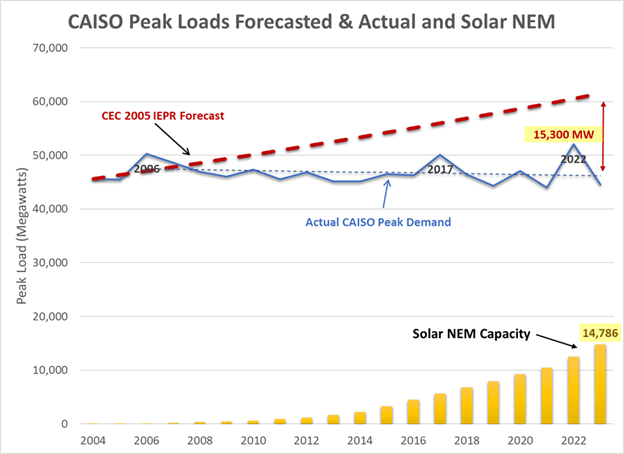
  3. Historic Utility Savings: The PAO fails to account for the full and accurate amount of savings and the shift in the system created by rooftop solar that has lowered costs and rates. The historic savings are based on distributed solar displacing 15,000 megawatts of peak load and 23,000 gigawatt-hours of energy since 2006 compared to the California Energy Commission’s (CEC) 2005 Integrated Energy Policy Report forecast.[2] Deferred generation capacity valuation starts with the CEC’s cost of a combustion turbine[3] and is trended to the marginal costs filed in the most recent decided general rate cases. Generation energy is the mix of average California Independent System Operator (CAISO) market prices in 2023,[4] and utilities’ average renewable energy contract prices.[5] Avoided transmission costs are conservatively set at the current unbundled retail transmission rate components. Distribution investment savings are the weighted average of the marginal costs included in the utilities’ general case filings from 2007 to 2021. Accounting for utility savings from distributed solar amounts to $2.165 billion ignored by the PAO’s calculation.
  4. Displaced CARE Subsidy: The PAO analysis does not account for savings from solar customers who would otherwise receive CARE subsidies. When CARE customers buy less energy from the utilities, it reduces the total cost of the CARE subsidy born by other ratepayers. This is equally true for energy efficiency. The savings to all non-CARE customers from displacing electricity consumption by CARE customers with self generation is calculated from the rate discount times that self generation. Accounting for reduced CARE subsidies amounts to $157 million in benefits ignored by the PAO analysis.
  5. Customer Bill Payments: The PAO analysis does not account for payments towards fixed costs made by solar customers. Most NEM customers do not offset all of their electricity usage with solar.[6] NEM customers pay an average of $80 to $160 per month, depending on the utility, after installing solar.[7] Their monthly bill payments more than cover what are purported fixed costs, such as the service transformer. A justification for the $24 per month customer charge was a purported under collection from rooftop solar customers.[8] Subtracting the variable costs represented by the Avoided Cost Calculator from these monthly payments, the remainder is the contribution to utility fixed costs, amounting to an average of $70 per month. (In comparison for example, PG&E proposed an average fixed charge of $51 per month in the income graduated fixed charge proceeding.[9]) There is no data available on average NBT bills, but NBT customers also pay at least $15 per month in a minimum fixed charge today.[10] Accounting for fixed cost payments adds $1.18 billion in benefits ignored by the PAO analysis.

The correct analytic steps are as follows:

NEM Net Benefits = [(kWh Generation [Corrected] – kWh Self Use) x Average Retail Rate Compensation [Corrected] )]
– [(kWh Generation [Corrected] – kWh Self Use) x Historic Utility Savings ($/kWh)]
– [CARE/FERA kWh Self Use x CARE/FERA Rate Discount ($/kWh)]
– [(kWh Delivered x (Average Retail Rate ($/kWh) – Historic Utility Savings $(kWh))]

NBT Net Benefits = [(kWh Generation [Corrected] – kWh Self Use) x Average Retail Rate Compensation [Corrected])]
– [(kWh Generation [Corrected] – kWh Self Use) x Avoided Cost (Corrected) ($/kWh)]
– [CARE/FERA kWh Self Use x CARE/FERA Rate Discount ($/kWh)]
– [(Net kWh Delivered x (Average Retail Rate ($/kWh) – Historic Utility Savings $(kWh))]

This analysis is not a value of solar nor a full benefit-cost analysis. It is only an adjusted ratepayer-impact test calculation that reflects the appropriate perspective given the PAO’s recent published analysis. A full benefit-cost analysis would include a broader assessment of impacts on the long-term resource plan, environmental impacts such as greenhouse gas and criteria air pollutant emissions, changes in reliability and resilience, distribution effects including from shifts in environmental impacts, changes in economic activity, and acceleration in technological innovation. Policy makers may also want to consider other non-energy benefits as well such local job creation and supporting minority owned businesses.

This analysis applies equally to one conducted by Severin Borenstein at the University of California’s Energy Institute at Haas. Borenstein arrived at an average retail rate similar to the one used in this analysis, but he also included an obligation for self generation to pay the retail rate, ignored historic utility cost savings and did not include existing bill contributions to fixed costs.

The supporting workpapers are posted here.

Thanks to Tom Beach at Crossborder Energy for a more rigorous calculation of average retail rates paid by rooftop solar customers.


[1] PAO assumed a solar panel capacity factor of 20%, which inflates the amount of electricity that comes from solar. For a more accurate calculation see California Distributed Generation Statistics, https://www.californiadgstats.ca.gov/charts/.

[2] This estimate is conservative because it does not include the accumulated time value of money created by investment begun 18 years ago. It also ignores the savings in reduced line losses (up to 20% during peak hours), avoided reserve margins of at least 15%, and suppressed CAISO market prices from a 13% reduction in energy sales.

[3] CEC, Comparative Costs of California Central Station Electricity Generation Technologies, CEC-200-2007-011-SF, December 2007.

[4] CAISO, 2023 Annual Report on Market Issues & Performance, Department of Market Monitoring, July 29, 2024.

[5] CPUC, “2023 Padilla Report: Costs and Cost Savings for the RPS Program,” May 2023.

[6] Those customers who offset all of their usage pay minimum bills of at least $12 per month.

[7] PG&E, SCE and SDG&E data responses to CALSSA in CPUC Proceeding R.20-08-020, escalated from 2020 to 2024 average rates.

[8] CPUC Decision 24-05-028.

[9] CPUC Proceeding Rulemaking 22-07-005.

[10] The average bill for NBT customer is not known at this time.

Retail electricity rate reform will not solve California’s problems

Meredith Fowlie wrote this blog on the proposal to drastically increase California utilities’ residential fixed charges at the Energy Institute at Haas blog. I posted this comment (with some additions and edits) in response.

First, infrastructure costs are responsive to changes in both demand and added generation. It’s just that those costs won’t change for a customer tomorrow–it will take a decade. Given how fast transmission retail rates have risen and have none of the added fixed costs listed here, the marginal cost must be substantially above the current average retail rates of 4 to 8 cents/kWh.

Further, if a customer is being charged a fixed cost for capacity that is being shared with other customers, e.g., distribution and transmission wires, they should be able to sell that capacity to other customers on a periodic basis. While many economists love auctions, the mechanism with the lowest ancillary transaction costs is a dealer market akin a grocery store which buys stocks of goods and then resells. (The New York Stock Exchange is a type of dealer market.) The most likely unit of sale would be in cents per kWh which is the same as today. In this case, the utility would be the dealer, just as today. So we are already in the same situation.

Airlines are another equally capital intensive industry. Yet no one pays a significant fixed charge (there are some membership clubs) and then just a small incremental charge for fuel and cocktails. Fares are based on a representative long run marginal cost of acquiring and maintaining the fleet. Airlines maintain a network just as utilities. Economies of scale matter in building an airline. The only difference is that utilities are able to monopolistically capture their customers and then appeal to state-sponsored regulators to impose prices.

Why are California’s utility rates 30 to 50% or more above the current direct costs of serving customers? The IOUs, and PG&E in particular, over procured renewables in the 2010-2012 period at exorbitant prices (averaging $120/MWH) in part in an attempt to block entry of CCAs. That squandered the opportunity to gain the economics benefits from learning by doing that led to the rapid decline in solar and wind prices over the next decade. In addition, PG&E refused to sell a part of its renewable PPAs to the new CCAs as they started up in the 2014-2017 period. On top of that, PG&E ratepayers paid an additional 50% on an already expensive Diablo Canyon due to the terms of the 1996 Settlement Agreement. (I made the calculations during that case for a client.) And on the T&D side, I pointed out beginning in 2010 that the utilities were overforecasting load growth and their recorded data showed stagnant loads. The peak load from 2006 was the record until 2022 and energy loads have remained largely constant, even declining over the period. The utilities finally started listening the last couple of years but all of that unneeded capital is baked into rates. All of these factors point not to the state or even the CPUC (except as an inept monitor) as being at fault, but rather to the utilities’ mismanagement.

Using Southern California Edison’s (SCE) own numbers, we can illustrate the point. SCE’s total bundled marginal costs in its rate filing are 10.50 cents per kWh for the system and 13.64 cents per kWh for residential customers. In comparison, SCE’s average system rate is 17.62 cents per kWh or 68% higher than the bundled marginal cost, and the average residential rate of 22.44 cents per kWh is 65% higher. From SCE’s workpapers, these cost increases come primarily from four sources.

  1. First, about 10% goes towards various public purpose programs that fund a variety of state-initiated policies such as energy efficiency and research. Much of this should be largely funded out of the state’s General Fund as income distribution through the CARE rate instead. And remember that low income customers are already receiving a 35% discount on rates.
  2. Next, another 10% comes roughly from costs created two decades ago in the wake of the restructuring debacle. The state has now decreed that this revenue stream will instead be used to pay for the damages that utilities have caused with wildfires. Importantly, note that wildfire costs of any kind have not actually reached rates yet. In addition, there are several solutions much less costly than the undergrounding proposed by PG&E and SDG&E, including remote rural microgrids.
  3. Approximately 15% is from higher distribution costs, some of which have been created by over-forecasting load growth over the last 15 years; loads have remained stagnant since 2006.
  4. And finally, around 33% is excessive generation costs caused by paying too much for purchased power agreements signed a decade ago.

An issue raised as rooftop solar spreads farther is the claim that rooftop solar customers are not paying their fair share and instead are imposing costs on other customers, who on average have lower incomes than those with rooftop solar. Yet the math behind the true rate burden for other customers is quite straightforward—if 10% of the customers are paying essentially zero (which they are actually not), the costs for the remaining 90% of the customers cannot go up more than 11% [100%/(100%-10%) = 11% ]. If low-income customers pay only 70% of this—the 11%– then their bills might go up about 8%–hardly a “substantial burden.” (70% x 11% = 7.7%)

As for aligning incentives for electrification, we proposed a more direct alternative on behalf of the Local Government Sustainable Energy Coalition where those who replace a gas appliance or furnace with an electric receive an allowance (much like the all-electric baseline) priced at marginal cost while the remainder is priced at the higher fully-loaded rate. That would reduce the incentive to exit the grid when electrifying while still rewarding those who made past energy efficiency and load reduction investments.

The solution to high rates cannot come from simple rate design; as Old Surfer Dude points out, wealthy customers are just going to exit the grid and self provide. Rate design is just rearranging the deck chairs. The CPUC tried the same thing in the late 1990s with telcom on the assumption that customers would stay put. Instead customers migrated to cell phones and dropped their land lines. The real solution is going to require some good old fashion capitalism with shareholders and associated stakeholders absorbing the costs of their mistakes and greed.

What rooftop solar owners understand isn’t mythological

Severin Borenstein wrote another blog attacking rooftop solar (a pet peeve of his at least a decade because these weren’t being installed in “optimal” locations in the state) entitled “Myths that Solar Owners Tell Themselves.” Unfortunately he set up a number of “strawman” arguments that really have little to do with the actual issues being debated right now at the CPUC. Here’s responses to each his “myths”:

Myth #1 – Customers are paid only 4 cents per kWh for exports: He’s right in part, but then he ignores the fact that almost all of the power sent out from rooftop panels are used by their neighbors and never gets to the main part of the grid. The utility is redirecting the power down the block.

Myth #2 – The utility sells the power purchased at retail back to other customers at retail so the net so it’s a wash: Borenstein’s claim ignores the fact that when the NEM program began the utilities were buying power that cost more than the retail rate at the time. During NEM 1.0 the IOUs were paying in excess of 10c/kwh for renewable power (RPS) power purchase agreements (PPAs). Add the 4c/kWh for transmission and that’s more than the average rate of 13c/kWh that prevailed during that time. NEM 2.0 added a correction for TOU pricing (that PG&E muffled by including only the marginal generation cost difference by TOU rather than scaling) and that adjusted the price some. But those NEM customers signed up not knowing what the future retail price would be. That’s the downside of failing to provide a fixed price contract tariff option for solar customers back then. So now the IOUs are bearing the consequences of yet another bad management decision because they were in denial about what was coming.

Myth #3 – Rooftop solar is about disrupting the industry: Here Borenstein appears to be unaware of the Market Street Railway case that states that utilities are not protected from technological change. Protecting companies from the consequences of market forces is corporate socialism. If we’re going to protect shareholders from risk (and its even 100% protection), then the grid should be publicly owned instead. Sam Insull set up the regulatory scam a century ago arguing that income assurance was needed for grid investment, and when the whole scheme collapsed in the Depression, the Public Utility Holding Company Act of 1935 (PUHCA)was passed. Shareholders need to pick their poison—either be exposed to risk or transfer their assets public ownership, but wealthy shareholders should not be protected.

Myth #3A – Utilities made bad investments and should bear the risks: Borenstein is arguing since the utilities have run the con for the last decade and gotten approval from the CPUC, they should be protected. Yet I submitted testimony repeatedly starting in 2010 both PG&E’s and SCE’s GRCs that warned that they had overforecasted load growth. I was correct—statewide retail sales are about the same today as they were in 2006. Grid investment would have been much different if those companies had listened and corrected their forecasts. Further the IOUs know how to manipulate their regulatory filings to ensure that they still get their internally targeted income. Decoupling that ensures that the utility receives its guaranteed income regardless of sales further shields them. From 1994 to 2017, PG&E hit its average allowed rate of return within 0.1%. (More on this later.) A UCB economics graduate student found that the return on equity is up to 4% too high (consistent with analysis I’ve done).

Myth #3B – Time to take away the utility’s monopoly: No, we no longer need to have monopoly electric service. The same was said about telecommunications three decades ago. Now we have multiple entities vying for our dollars. The CPUC conducted a study in 1999 that was included in PG&E’s GRC proposed decision (thanks to the late Richard Bilas) that showed that economies of scale disappeared after several hundred thousand customers (and that threshold is likely lower now.) And microgrids are becoming cost effective, especially as PG&E’s rates look like they will surpass 30 cents per kWh by 2026.

Myth #4 – There aren’t barriers to the poor putting panels on their roofs: First, the barriers are largely regulatory, not financial. The CPUC has erected them to prevent aggregation of low-income customers to be able to buy into larger projects that serve these communities.

Second, there are many market mechanisms today where those with lower income are offered products or services at a higher long term price in return for low or no upfront costs. Are we also going to heavily tax car purchases because car leasing is effectively more expensive? What about house ownership vs. rentals? There are issues to address with equity, but to zero in on one small example while ignoring the much wider prevalence sets  up another strawman argument.

Further, there are better ways to address the inequity in rooftop solar distribution. That inequity isn’t occurring duo to affordability but rather because of split incentives between landlords and tenants.

A much easier and more direct fix would be to modify Public Utilities Code Sections 218 to allow local sales among customers or by landlords or homeowner associations to tenants and 739.5 to allow more flexibility in pricing those sales. But allowing those changes will require that the utilities give up iron-fisted control of electricity production.

Myth #5 – Rooftop solar is the only thing that makes it cost-effective to electrify: Borenstein focuses on the what source of high rates. Rooftop solar might be raising rates, but it probably delivered as much in offsetting savings. At most those customers increased rates by 10%, but utility rates are 70-100% above the direct marginal costs of service. The sources of that difference are manifest. PG&E has filed in its 2023 GRC a projected increase in the average standard residential rate to 38 cents per kWh by 2026, and perhaps over 40 cents once undergrounding to mitigate wildfire is included. The NREL studies on microgrids show that individual home microgrids cost about 34 cents per kWh now and battery storage prices are still dropping. Exiting the grid starts to look a lot more attractive.

Maybe if we look only at the status quo as unchanging and accept all of the utilities’ claims about their “necessary” management decisions and the return required to attract investors, then these arguments might hold water. But none of these factors are true based on the empirical work presented in many forums including at the CPUC over the last decade. These beliefs are not so mythological.

Finally, Borenstein finishes with “(a)nd we all need to be open to changing our minds as a result of changing technology and new data.” Yet he has been particularly unyielding on this issue for years, and has not reexamined his own work on electricity markets from two decades ago. The meeting of open minds requires a two-way street.

Guidelines For Better Net Metering; Protecting All Electricity Customers And The Climate

Authors Ahmad Faruqui, Richard McCann and Fereidoon Sioshansi[1] respond to Professor Severin Borenstein’s much-debated proposal to reform California’s net energy metering, which was first published as a blog and later in a Los Angeles Times op-ed.

Deciding if solar installation is suboptimal requires that the initial premises be specified correctly

A recent article “Heterogeneous Solar Capacity Benefits, Appropriability, and the Costs of Suboptimal Siting” in the Journal of the Association of Environmental and Resource Economists finds that distributed solar (e.g., rooftop solar) is not being installed a manner that “optimally” mitigates air pollution damages from electricity generation across the U.S. Unfortunately the paper is built on two premises that do not reflect the reality of available options and appropriate pricing signals.

First, the authors appear to be relying on the premise that sufficient solar, grid-scale or distributed, can be installed cost-effectively across the U.S. While the paper includes geographic variations in generation per installed kilowatt of capacity, it says nothing about the similarly widely varying costs per kilowatt-hour. They do not acknowledge that panels in the Pacific Northwest will cost twice that of those in the Desert Southwest. This importance of this disparity is compounded by the underestimate of the social cost of carbon and the possible conflation of sulfur dioxide and particulate matter damages. The currently accepted social cost of GHG emissions developed by the U.S. Environmental Protection Agency (US EPA) is ranges from $50 to $150 per tonne in 2030 (and recent studies have estimated that this is too low), compared to the outdated $41 per tonne in the article. Most of the SO2 damages arise from creating PM so there is likely double counting for these criteria pollutants. (The study also ignore the strong correlation between GHG and SO2 emissions as coal is the biggest source of both.) The study also fails to account for the enormous transmission costs that would be incurred moving solar output from the Desert Southwest to the Northeast to mitigate the purported damages.

Second, the authors try to claim that rooftop solar has not relieved transmission congestion by looking at grid congestion prices. The problem is that this method is like looking at an empty barn and saying a horse never lived there. Congestion pricing is based on the current transmission capacity situation. It says nothing about the history of transmission congestion or the ability and efforts to look forward to mitigate congestion. The study found that congestion prices were often negative or small in areas with substantial rooftop solar capacity. That doesn’t show that the solar capacity has little value–instead it shows that it actually relieved the congestion effectively–a completely opposite conclusion.

In contrast, the California Independent System Operator (CAISO) calculated in 2017 (contemporaneously with the article’s baseline) that at least $2.6 billion in transmission projects had been deferred. And given the utilities’ poor records on load forecasting, these savings have likely grown substantially. CAISO had anticipated and already relieved the congestion that the authors’ purported metric was searching for.

This disparity in economic results highlights the nature of investing in long-lived infrastructure that requires multiple years to build–one cannot wait for a shortfall to emerge to respond because that’s too late. Instead, one must anticipate those events and act even when its uncertain. This study is yet another example of how relying on the premise that short-run electricity market prices are reflective of long-run marginal costs is mistaken and should be set aside for policy analysis.

What is the real threat to electrification? Not solar rooftops

The real threat to electrification are the rapidly escalating costs in the distribution system, not some anomaly in rate design related to net energy metering. As I have written here several times, rooftop solar if anything has saved ratepayers money so far, just as energy efficiency has done so. PG&E’s 2023 GRC is asking for a 66% increase in distribution rates by 2026 and average rates will approach 40 cents/kWh. We need to be asking why are these increases happening and what can we do to make electricity affordable for everyone.

Perhaps most importantly, the premise that there’s a “least cost” choice put forward by economists at the Energy Institute at Haas among others implies that there’s some centralized social welfare function. This is a mythological construct created for the convenience of economists (of which I’m one) to point to an “efficient” solution. Other societal objectives beyond economic efficiency include equitably allocating cost responsibility based on economic means, managing and sharing risks under uncertainty, and limiting political power that comes from economic assets. Efficiency itself is limited in what it tells us due to the multitude of market imperfections. The “theory of the second best” states that in an economic sector with uncorrected market failures, actions to correct market failures in another related sector with the intent of increasing economic efficiency may actually decrease overall economic efficiency. In the utility world for example, shareholders are protected from financial losses so revenue shortfalls are allocated to customers even as their demands fall. This blunts the risk incentive that is central to economic efficiency. Claiming that adding a fixed charge will “improve” efficiency has little basis without a complete, fundamental assessment of the sector’s market functionality.

The real actors here are individual customers who are making individual decisions in our current economic resource allocation system, and not a central entity dictating choices to each of us. Different customers have different preferences in what they value and what they fear. Rooftop installations have been driven to a large extent by a dread of utility mismanagement that makes expectations about future rates much more uncertain.

The single most important trait of a market economy is the discipline imposed by appropriately assigning risk burden to the decision make and not pricing design. The latter is the tail wagging the dog. Market distortions are universally caused by separating consequences from decisions. And right now the only ability customers have to exercise control over their electricity bills is to somehow exit the system. If we take away that means of discipline we will never be able to control electricity rates in a way that will lead to effective electrification.

Has rooftop solar cost California ratepayers more than the alternatives?

The Energy Institute’s blog has an important premise–that solar rooftop customers have imposed costs on other ratepayers with few benefits. This premise runs counter to the empirical evidence.

First, these customers have deferred an enormous amount of utility-scale generation. In 2005 the CEC forecasted the 2020 CAISO peak load would 58,662 MW. The highest peak after 2006 has been 50,116 MW (in 2017–3,000 MW higher than in August 2020). That’s a savings of 8,546 MW. (Note that residential installations are two-thirds of the distributed solar installations.) The correlation of added distributed solar capacity with that peak reduction is 0.938. Even in 2020, the incremental solar DER was 72% of the peak reduction trend. We can calculate the avoided peak capacity investment from 2006 to today using the CEC’s 2011 Cost of Generation model inputs. Combustion turbines cost $1,366/kW (based on a survey of the 20 installed plants–I managed that survey) and the annual fixed charge rate was 15.3% for a cost of $209/kW-year. The total annual savings is $1.8 billion. The total revenue requirements for the three IOUs plus implied generation costs for DA and CCA LSEs in 2021 was $37 billion. So the annual savings that have accrued to ALL customers is 4.9%. Given that NEM customers are about 4% of the customer base, if those customers paid nothing, everyone else’s bill would only go up by 4% or less than what rooftop solar has saved so far.

In addition, the California Independent System Operator (CAISO) calculated in 2018 that at least $2.6 billion in transmission projects had been deferred through installed distributed solar. Using the amount installed in 2017 of 6,785 MW, the avoided costs are $383/kW or $59/kW-year. This translates to an additional $400 million per year or about 1.1% of utility revenues.

The total savings to customers is over $2.2 billion or about 6% of revenue requirements.

Second, rooftop solar isn’t the most expensive power source. My rooftop system installed in 2017 costs 12.6 cents/kWh (financed separately from our mortgage). In comparison, PG&E’s RPS portfolio cost over 12 cents/kWh in 2019 according to the CPUC’s 2020 Padilla Report, plus there’s an increments transmission cost approaching 4 cents/kWh, so we’re looking at a total delivered cost of 16 cents/kwh for existing renewables. (Note that the system costs to integrate solar are largely the same whether they are utility scale or distributed).

Comparing to the average IOU RPS portfolio cost to that of rooftop solar is appropriate from the perspective of a customer. Utility customers see average, not marginal, costs and average cost pricing is widely prevalent in our economy. To achieve 100% renewable power a reasonable customer will look at average utility costs for the same type of power. We use the same principle by posting on energy efficient appliances the expect bill savings based on utility rates–-not on the marginal resource acquisition costs for the utilities.

And customers who would choose to respond to the marginal cost of new utility power instead will never really see those economic savings because the supposed savings created by that decision will be diffused across all customers. In other words, other customers will extract all of the positive rents created by that choice. We could allow for bypass pricing (which industrial customers get if they threaten to leave the service area) but currently we force other customers to bear the costs of this type of pricing, not shareholders as would occur in other industries. Individual customers are currently the decision making point of view for most energy use purposes and they base those on average cost pricing, so why should we have a single carve out for a special case that is quite similar to energy efficiency?

I wrote more about whether a fixed connection cost is appropriate for NEM customers and the complexity of calculating that charge earlier this week.