Author Archives: Richard McCann

Unknown's avatar

About Richard McCann

Partner in M.Cubed, an economics and policy consulting firm.

Moving beyond the easy stuff: Mandates or pricing carbon?

figure-1

Meredith Fowlie at the Energy Institute at Haas posted a thought provoking (for economists) blog on whether economists should continue promoting pricing carbon emissions.

I see, however, that this question should be answered in the context of an evolving regulatory and technological process.

Originally, I argued for a broader role for cap & trade in the 2008 CARB AB32 Scoping Plan on behalf of EDF. Since then, I’ve come to believe that a carbon tax is probably preferable over cap & trade when we turn to economy wide strategies for administrative reasons. (California’s CATP is burdensome and loophole ridden.) That said, one of my prime objections at the time to the Scoping Plan was the high expense of mandated measures, and that it left the most expensive tasks to be solved by “the market” without giving the market the opportunity to gain the more efficient reductions.

Fast forward to today, and we face an interesting situation because the cost of renewables and supporting technologies have plummeted. It is possible that within the next five years solar, wind and storage will be less expensive than new fossil generation. (The rest of the nation is benefiting from California initial, if mismanaged, investment.) That makes the effective carbon price negative in the electricity sector. In this situation, I view RPS mandates as correcting a market failure where short term and long term prices do not and cannot converge due to a combination of capital investment requirements and regulatory interventions. The mandates will accelerate the retirement of fossil generation that is not being retired currently due to mispricing in the market. As it is, many areas of the country are on their way to nearly 100% renewable (or GHG-free) by 2040 or earlier.

But this and other mandates to date have not been consumer-facing. Renewables are filtered through the electric utility. Building and vehicle efficiency standards are imposed only on new products and the price changes get lost in all of the other features. Other measures are focused on industry-specific technologies and practices. The direct costs are all well hidden and consumers generally haven’t yet been asked to change their behavior or substantially change what they buy.

But that all would seem to change if we are to take the next step of gaining the much deeper GHG reductions that are required to achieve the more ambitious goals. Consumers will be asked to get out of their gas-fueled cars and choose either EVs or other transportation alternatives. And even more importantly, the heating, cooling, water heating and cooking in the existing building stock will have to be changed out and electrified. (Even the most optimistic forecasts for biogas supplies are only 40% of current fossil gas use.) Consumers will be presented more directly with the costs for those measures. Will they prefer to be told to take specific actions, to receive subsidies in return for higher taxes, or to be given more choice in return for higher direct energy use prices?

The two problems to be addressed head on by nuclear power advocates

6e0c32214e80ee9f4fbabf2e4ffe6fcd

Nuclear power advocates bring up the technology as a supposedly necessary part of a zero-GHG portfolio to address climate change. They insist that the “next generation” technology will be a winner if it is allowed to be developed.

Nevertheless, nuclear has two significant problems beyond whatever is in the next generation technology:

  1. Construction cost overruns are the single biggest liability that has been killing the technology. While most large engineering projects have contingencies for 25-30% overruns, almost all nuclear plants have overruns that are multiples of the original cost estimates. This has been driving the most experienced engineering/construction firms into bankruptcies. Until that problem is resolved, all energy providers should be very leery of making commitments to a technology that takes at least 7 years to build.
  2. We still haven’t addressed waste disposal and storage over the course of decades, much less millennia. No other energy technology presents such a degree of catastrophic failure from a single source. Again, this liability needs to be addressed head on and not ignored or dismissed if the technology is to be pursued.

The Business Roundtable takes the wrong lesson from California’s energy costs

solar-panel-price-drop-global-solar-installations-bnef

The California Business Roundtable authored an article in the San Francisco Chronicle claiming that the we only need to look to California’s energy prices to see what would happen with the “Green New Deal” proposed by the Congressional Democrats.

That article has several errors and is misleading in others aspects. First, California’s electricity rates are high because of the renewable contracts signed nearly a decade ago when renewables were just evolving and much higher cost. California’s investment was part of the reason that solar and wind costs are now lower than existing coals plants (new study shows 75% of coal plants are uneconomic) and competitive with natural gas. Batteries that increase renewable operations have almost become cost effective. It also claims that reliability has “gone down” when in fact we still have a large reserve margin. The California Independent System Operator in fact found a 23% reserve margin when the target is only 17%. We also have the ability to install batteries quickly to solve that issue. PG&E is installing over 500 MW of batteries right now to replace a large natural gas plant.

For the rest of the U.S., consumers will benefit from these lower costs today. Californians have paid too much for their power to date, due to mismanagement by PG&E and the other utilities, but elsewhere will be able to avoid these foibles.

(Graphic: BNEF)

A different turn in PG&E’s future

masthead3

M.Cubed partner Steven Moss wrote this editorial “Publisher’s View: Pacific Gas and Electric Company” in the Potrero View on how PG&E might move forward into the future.

Charging with the sun…really!

MITSUBISHI MOTOR SALES OF AMERICA, INC. CYPRESS CHARGING STATION

Severin Borenstein at the University of California’s Energy Institute at Haas posted on whether a consumer buying an electric vehicle was charging it with power from renewables. I have been considering the issue of how our short-run electricity markets are incomplete and misleading. I posted this response on that blog:

As with many arguments that look quite cohesive, it is based on key unstated premises that if called into question undermine the conclusions. I would relabel the “correct” perspective as the “conventional” which assumes that the resources at the margin are defined by short-run operational decisions. This is the basic premise of the FERC-designed power market framework–somehow all of those small marginal energy increases eventually add up into one large new powerplant. This is the standard economic assumption that a series of “putty” transactions in the short term will evolve into a long term “clay” investment. (It’s all of those calculus assumptions about continuity that drive this.) This was questionable in 1998 as it became apparent that the capacity market would have to run separately from the energy market, and is now even more questionable as we replace fossil fuel with renewables.

I would call the fourth perspective as “dynamic”. From this perspective these short run marginal purchases on the CAISO are for balancing to meet current demand. As Marc Joseph pointed out, all of the new incremental demand is being met in a completely separate market that only uses the CAISO as a form of a day to day clearinghouse–the bilateral PPAs. No load serving entity is looking to the CAISO as their backstop resource source. Those long term PPAs are almost universally renewables–even in states without RPS standards. In addition, fossil fueled plants–coal and gas–are being retired and replaced by solar and wind, and that is an additional marginal resource not captured in the CAISO market.

So when a consumer buys a new EV, that added load is being met with renewables added to either meet new load or replace retired fossil. Because these renewables have zero operating costs, they don’t show up in the CAISO’s “marginal” resources for simple accounting reasons, not for fundamental economic reasons. And when that consumer also adds solar panels at the same time, those panels don’t show up at all in the CAISO transactions and are ignored under the conventional view.

There is an issue of resource balancing costs in the CAISO incurred by one type of resource versus another, but that cost is only a subcomponent of the overall true marginal cost from a dynamic perspective.

So how we view the difference between “putty” and “clay” increments is key to assessing whether a consumer is charging their EV with renewables or not.

Study shows RPS spillover positive to other states

honda-windfarm

A study in the Journal of the Association of Environmental and Resource Economics entitled “External Impacts of Local Energy Policy: The Case of Renewable Portfolio Standards” finds that increasing the renewable portfolio standard (RPS) in one state reduces coal generation in neighboring states through trading of renewable energy credits (RECs). This contrasts with findings on greenhouse gas emission “leakage” under California’s cap and trade program put forth by the authors at the Energy Institute at Haas at the University of California here and here.

These latter set of findings has been used California Public Utilities Commissioners to argue against the use of RECs and implication that community choice aggregators (CCAs) are not moving forward increased renewables generation. This new study appears to land on the side of the CCAs which have argued that even relying on RECs in the short run have a positive effect reducing GHG emissions in the West.

A transparent municipal utility’s reserve target

Reserves chart

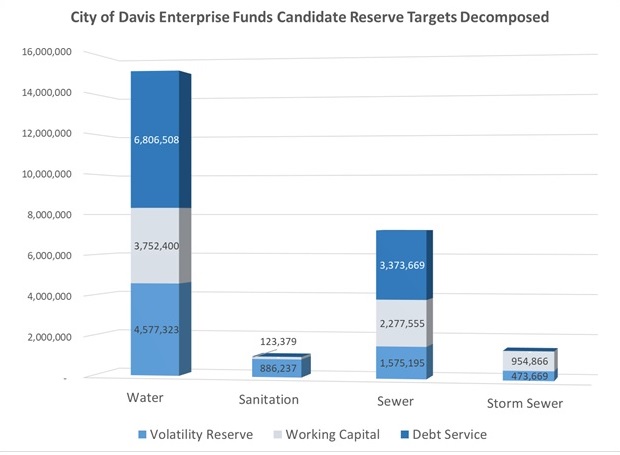
As one of my civic activities, I sat on the City of Davis Utility Rates Advisory Commission. In my final action with that commission, along with Elaine Roberts-Musser and Lorenzo Kristov, we prepared what might be a first-of-its kind enterprise fund reserve policy for the four utilities managed by the city. Up to this point, the URAC had been presented with rates development reports that appeared to use somewhat arbitrary, and inconsistent, methods of setting reserve targets. The city also appeared to be holding tens of millions of dollars in those funds that might be unneeded to meet expected reserve requirements.

With the City Council’s approval and support from the staff and the Finance and Budget Commission, we identified the elements that needed to be covered by reserves, including working capital, debt covenants, unanticipated capital replacements, and revenue-expense volatility. The first two elements were fairly straightforward to calculate, and unanticipated replacements didn’t appear to be significant. It was the analysis of the relationship of revenue and expense volatility where the report innovates. Previous studies had used some variation of a percentage of capital assets with no underlying explanation. Our solution was to derive an estimate of the outerbound of an annual revenue shortfall for a utility as buffer to allow rate or management adjustments.

In the end, the target reserves generally didn’t change much, but the City now has a transparent target that it can use to determine when it has excess funds that might be used in different fashions instead.

Using floods to replenish groundwater

ALMOND  ORCHARD FLOODING

M.Cubed produced four reports for Sustainable Conservation on using floodwaters to recharge aquifers in California’s Central Valley. The first is on expected costs. The next three are a set on the benefits, participation incentives and financing options for using floodwaters in wetter years to replenish groundwater aquifers. We found that costs would range around $100 per acre-foot, and beneficiaries include not only local farmers, but also downstream communities with lower flood control costs, upstream water users with more space for storage instead of flood control, increased hydropower generation, and more streamside habitat. We discussed several different approaches to incentives based on our experience in a range of market-based regulatory settings and the water transfer market.

With the PPIC’s release of Water and the Future of the San Joaquin Valley, which forecasts a loss of 500,000 acres of agricultural production due to reduced groundwater pumping under the State Groundwater Management Act (SGMA), local solutions that mitigate groundwater restrictions should be moving to the fore.

Don Cameron at Terranova Ranch started doing this deliberately earlier this decade, and working with Phil Bachand and UC Davis, more study has shown the effectiveness, and the lack of risk to crops, from this strategy. The Department of Water Resources has implemented the Flood-MAR program to explore this alternative further. The Flood-MAR whitepaper explores many of these issues, but its list of beneficiaries is incomplete, and the program appears to not yet moved on to how to effectively implement these programs integrated with the local SGMA plans. Our white papers could be useful starting points for that discussion.

(Image Source: Chico Enterprise-Record)


Reverse auctions for storage gaining favor

power_auction_xl_721_420_80_s_c1

Two recent reports highlight the benefits of using “reverse auctions”. In a reverse auction, the buyer specifies a quantity to be purchased, and sellers bid to provide a portion of that quantity.  An article in Utility Dive summarizes some of the experiences with renewable market auctions.  A separate report in the Review of Environmental Economics and Policy goes further to lay out five guidelines:

  1. Encourage a Large Number of Auction Participants
  2. Limit the Amount of Auctioned Capacity
  3. Leverage Policy Frameworks and Market Structures
  4. Earmark a Portion of Auctioned Capacity for Less-mature Technologies
  5. Balance Penalizing Delivery Failures and Fostering Competition

This policy prescription requires well-informed policy makers balancing different factors–not a task that is well suited to a state legislature. How to develop such a coherent policy can done in two ways. The first is to let the a state commission work through a proceeding to set an overall target and structure. But perhaps a more fruitful approach would be to let local utilities, such as California’s community choice aggregators (CCAs) to set up individual auctions, maybe even setting their own storage targets and then experimenting with different approaches.

California has repeatedly made errors by overly relying on centralized market structures that overcommit or mismatch resource acquisition. This arises because a mistake by a single central buyer is multiplied across all load while a mistake by one buyer within a decentralized market is largely isolated to the load of that one buyer. Without perfect foresight and a distinct lack of mechanisms to appropriately share risk between buyers and sellers, we should be designing an electricity market that mitigates risks to consumers rather than trying to achieve a mythological “optimal” result.

Misunderstanding the Green New Deal

gndbygeneration-img-1440x680

The media and the public appears to have confused the Green Party’s platform calling for 100% renewable energy by 2030 with the goals in the Joint Resolution for a Green New Deal introduced by Senator Edward Markey (D-MA) and Representative Alexandria Ocasio-Cortez (D-NY). The Joint Resolution calls for a “10-year national mobilization,” but contains no deadlines other than zero greenhouse-gas emissions by 2050, which is 30+ years from now. Given that we went from horse and buggies and wood stoves to widespread automobile use and electrification in 30 years at the beginning of the twentieth century, such a transformation doesn’t seem imposing.