Category Archives: Energy innovation

Emerging technologies and institutional change to meet new challenges while satisfying consumer tastes

Problems with “Residential storage can undercut benefits of rooftop solar, says new study” | (A response to a Utility Dive article)

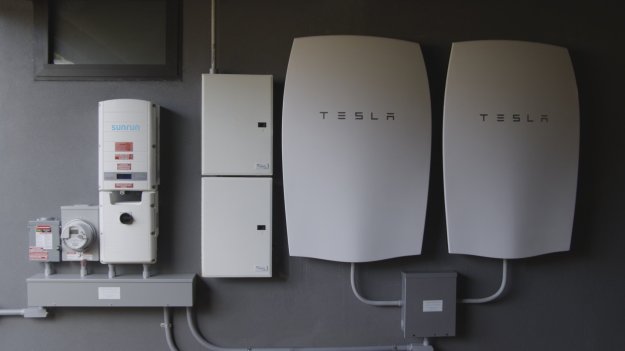
A new study in Nature Energy finds storing rooftop solar can increase emissions and energy consumption.

My thoughts: Here’s the key statement for the finding in this report: “based on today’s Texas grid mix, which is primarily made up of fossil fuels.” If the either the marginal generation on the grid is low or no GHG (e.g., renewables overgeneration which is an increasing problem in California) or the connection to the grid is cut or restricted (e.g., in a microgrid), then this premise doesn’t hold.

This study relies on fossil fueled generation being the marginal energy source. It also focuses solely on operational changes with existing resources. The appropriate frame is looking at the change in generation investment with and without storage, so for example more renewables become cost effective with storage so the overall generation mix changes.

The second problem is that most of the production cost models are yet incapable of capturing reduction in flexible capacity use. That’s why the California Energy Commission has had DNV and LBNL working on modeling those resources. So the emission savings are underestimated.

The third problem is that savings in residual unit commitment (RUC) is underestimated in the models. These are gas units running on standby with no-load, to be available the next day for ramping, load following or reliability. Storage reduces the need for these resources as well. NREL recently released a study on the value of storage that captures this benefit.

If these findings are valid, then the existing Helms pumped storage plant is also increasing GHG emissions. One could go so far as to say that the value of pondage hydropower storage may be so diminished that relicensing conditions that require run of river operations may have little effect on costs and GHG emissions.

Source: Residential storage can undercut benefits of rooftop solar, says new study | Utility Dive
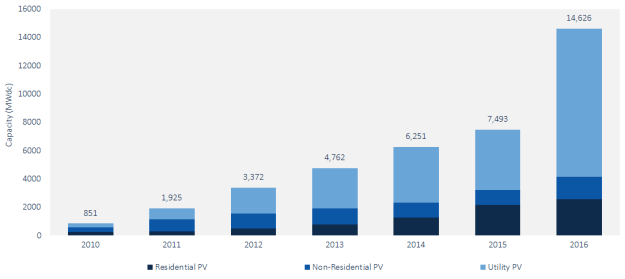

Repost: US Solar Market Grows 95% in 2016, Smashes Records | Greentech Media

GTM Research and SEIA present data from the upcoming U.S. Solar Market Insight report.

Source: US Solar Market Grows 95% in 2016, Smashes Records | Greentech Media

Repost: Wind capacity blows past hydro to become most plentiful US renewable | Utility Dive

Installed wind capacity is more than 82,000 MW, according to a trade group, making it the nation’s largest renewable resource ahead of hydro.

Source: Wind capacity blows past hydro to become most plentiful US renewable | Utility Dive

And then this…Trump’s energy plan doesn’t mention solar – The Washington Post

After the release of a study showing solar now employs more than oil, gas and coal combined.

Source: Trump’s energy plan doesn’t mention solar, an industry that just added 51,000 jobs – The Washington Post

Repost: 1 Out of 50 New US Jobs Came From the Solar Industry in 2016 | Greentech Media

Source: 1 Out of 50 New US Jobs Came From the Solar Industry in 2016 | Greentech Media

When is $100 billion not that big?

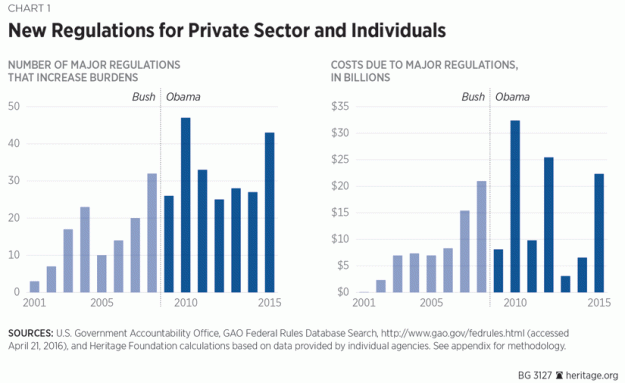
bg-red-tape-rising-2016-chart-1-825

When it’s measured against $18,675 billion ($18.7 trillion) produced by the U.S. economy. The Heritage Foundation issued a report claiming the Obama Administration imposed $107 billion in new burdens over seven years. That sounds like a huge amount, but that’s only 0.6% (six-tenths of a percent) of the economy. And that’s spread over seven years which means that this the reduction in the GDP growth rate was only 0.08% (eight hundredths of a percent) per year. Against an annual average growth rate of over 2%, that’s a trivial amount. Another way to think of it is this way: if you had a dinner bill from Applebee’s for $19, would you not by dinner it if cost a dime more? Probably not–you wouldn’t even notice.

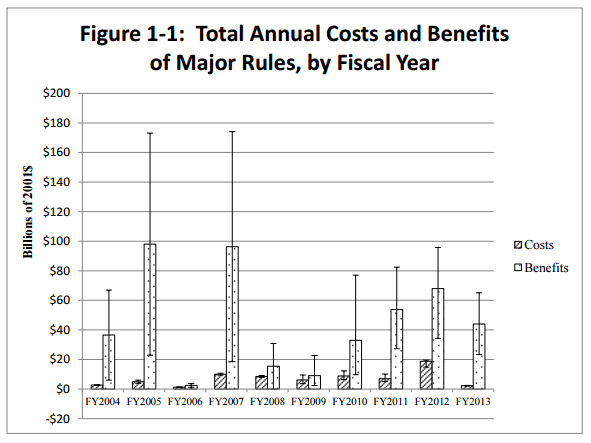
Plus, the HF’s estimate ignores the benefits of those regulations. This graphic from the OMB that shows the estimated relative benefits to costs of regulation.

omb

I won’t dig too deeply into the Heritage Foundation’s analysis other than to make a couple of notes about about alternative perspectives that I am familiar with:

  • Heritage Foundation claims that the Clean Power Plan has cost $7.2 billion as the single largest increment. Yet Lawrence Berkeley National Laboratory (which is much better qualified on this issue than the HF) just released a study showing the net financial “costs” of the various renewable portfolio standard (RPS) requirements is actually a benefit $47 to $109 billion. (And that ignores the environmental benefits identified in the report.)
  • After the 2008 financial debacle, the industry was going to face increased regulation to reign in its behavior during the previous decade. So increased regulation under Dodd-Frank is to be expected. And the better question might be what is the drag on the economy from high financial-related transaction costs? One study found that transaction costs may be as high at 45% in the U.S. economy. The financial and legal sectors likely are a bigger drag than government regulation.
  • On FCC net neutrality, see a previous post about how bigger corporations and economic concentration reduces innovation, which leads to reduced growth. Net neutrality is intended to fight that concentration.

Repost: Lessons From 40 Years of Electricity Market Transformation: Storage Is Coming Faster Than You Think | Greentech Media

Five useful insights into where the electricity industry is headed.

Source: Lessons From 40 Years of Electricity Market Transformation: Storage Is Coming Faster Than You Think | Greentech Media

What lessons should we take from the last wave of California utility reform?

h7main2d

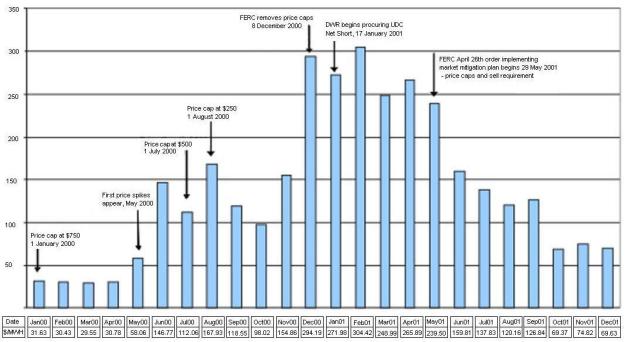
We’re now in the midst of the “third wave” of electricity industry reform in California. The first was in the early 1980s with the rise of independently-owned cogeneration and renewable resources. Mixed with increased energy efficiency, that led to a surplus of power in the late 1990s, which in turn created the push for restructuring and deregulation. Unfortunately, poorly designed markets and other factors precipitated the 2000-01 energy crisis. The rise of renewables and distributed resources is pushing a third wave that may change the industry even more fundamentally.

I wrote a paper in 2002 on how I viewed the history of California’s electricity industry through 2001 and presented this at a conference. (It hasn’t yet been published.) I identify some different factors for why the energy crisis erupted, and what lessons we might learn for this next wave.


Repost: NREL-Four reasons 30% wind and solar is technically no big deal | Utility Dive

Many regions are already operating power systems with more renewable energy than previously thought possible, an NREL analyst points out.

Source: Four reasons 30% wind and solar is technically no big deal | Utility Dive

Reblog: A true accounting of federal subsidies for solar and clean coal | Utility Dive

A detailed discussion about the successes, failures, and intent of these two federal programs.

Source: What Trump and Clinton miss about clean coal and renewables subsidies | Utility Dive