Tag Archives: CPUC

A key policy tool intended to promote energy efficiency is instead being used against saving energy

A cornerstone policy meant to promote energy efficiency is now being used as a weapon against energy savings. Decoupling the recovery of utilities’ costs and profits from electricity sales was intended to remove utilities’ opposition to promoting California’s resource loading order of using energy efficiency and distributed energy resources first.[1] Instead, protecting those revenue requirements and the associated utility profits, thus avoiding financial risk to shareholders, has become the paramount objective of the state’s decoupling policy at the expense of both reducing dependence on utility generation and increasing consumer sovereignty.[2] We are told that we need to increase our energy consumption to reduce the energy rates for those who have not reduced their utility purchases. The intent of decoupling has been turned on its head.

The premise of the ”cost shift” argument that asserts saving energy by one customer causes higher rates for other customers relies on an interpretation of decoupling whereby utility shareholders are shielded from suffering any financial losses caused by consumers turning elsewhere to find their energy services. This is one logical extension of decoupling, albeit not the one intended by those who originated this concept. Under this flawed rubric, each customer has an obligation to pay a share of the utility’s fixed and stranded costs. When a customer reduces their usage and their electricity bill, they are shirking this obligation according to the cost-shift argument.

Using the underlying rationale that utilities are guaranteed to recover their costs once approved by the CPUC and FERC, whether a customer-installed resource has a cost more or less than the social marginal cost is irrelevant unless that marginal cost is higher than the retail rate. Under this reasoning the customer owes the full amount of the retail rate and only receives a credit for saving energy that cannot exceed the marginal cost. The customer still owes the difference between the retail rate and the marginal cost and other customers must pick up that foregone sales revenue from the savings. Once a utility is authorized to collect a set amount of revenues, a customer has no escape from the corporate burden.

That presumption eliminates the ability to use market discipline through consumer choice to control rates (except moving out of state or to a municipal utility area). Under this reasoning, the only means of containing utility rates and mitigating bills is via regulatory action by the CPUC and FERC.

The problem is that regulators were supposed to strictly cap utility spending so that consumers could make their own choices about how to best meet their energy needs.[3] The utilities discovered that the regulators were not so vigilant and that the utilities could easily justify added utility-owned resources that were rolled into revenue requirements. The recovery of those costs was then protected from risk of either competition from customer resources or prudency review by policies implementing decoupling.

As a result, California’s utility rates have skyrocketed over the last two decades, with grid costs rising four times faster than inflation. These have reached crisis levels and state policy makers are desperately searching for easy solutions. Hence, the “cost shift” myth identifies the “true villains”—those customers who thought they were doing the right thing. Now they need to be punished.

When faced with declining sales and revenues, every other business cannot simply demand that customers make up the difference between the business’ current costs and its falling revenues. The business instead must either cut costs or provide a better service or product that attracts back those or other customers. The innovation motivated by this “creative destruction” as Joseph Schumpeter described it is at the core of the benefits we accrue from a market economy. Hinder that process and we get stagnation. The phased deregulation of the electricity market started with the 1978 PURPA is an important example of innovation was unleashed by removing the utilities’ ability to veto customers’ investments in their own resources. Without PURPA and the subsequent reforms, we would never had the technological revolution that both gives cost effective renewable energy resources and customers more control over their own energy use.

“Fixed” costs are not an explanation for rising rates

We also know that the supposed “fixed” costs of the utility system are not large. Generation and transmission resources are constantly redeployed among customers which is normal market functionality; these are not fixed costs, rather they are reallocated to customers who use more of those facilities. This is why grocery stores don’t charge customers to simply enter a store where 80% of the costs are don’t change with individual sales. Even in the distribution circuits, customers share most of the network with other customers; these costs are not fixed per-customer. Cell companies rarely require more than 12-month contracts with similar cost structures. (Three-year contracts are for paying off new phones and can be avoided by purchasing unlocked phones.)

The facts are that the various policy program costs are about the same as they have been for two decades at 10% of rates (and within that portion, energy efficiency should be classified as a resource cost just like generation), and the lion’s share of wildfire-related costs, which are only another 10%, were added four years ago and have risen only slightly since. Meanwhile PG&E increased its rates 50% over the last four years and the other two have or will increase their rates substantially.

The CPUC issued an order that the utilities impose a fixed charge of $24 per month for standard residential customers to cover those purported fixed costs. That’s approximately equal to the share of utility costs that might be considered fixed or related to state policy directives.

Rapidly rising rates is evidence that marginal costs are higher than retail rates and customer investment in new resources saves all ratepayers money

A key premise of the cost-shift argument is that these customers’ loads now being met by energy efficiency and DERs can be served by the existing utility system at little additional cost. In other words, these customers departed a system already built to accommodate their usage. That’s incorrect as one customer’s reduced load is an opportunity for another customer’s increased load to be served without an additional generation, transmission and distribution investment at today’s inflated costs.  My more efficient refrigerator makes room for my neighbor’s hot tub, electric vehicle, or perhaps a needed medical appliance.

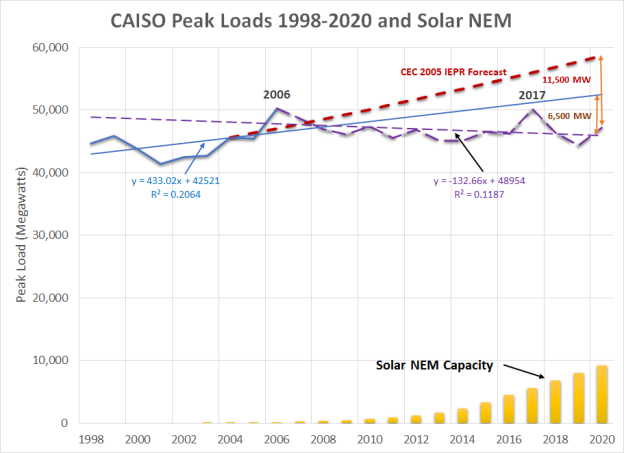
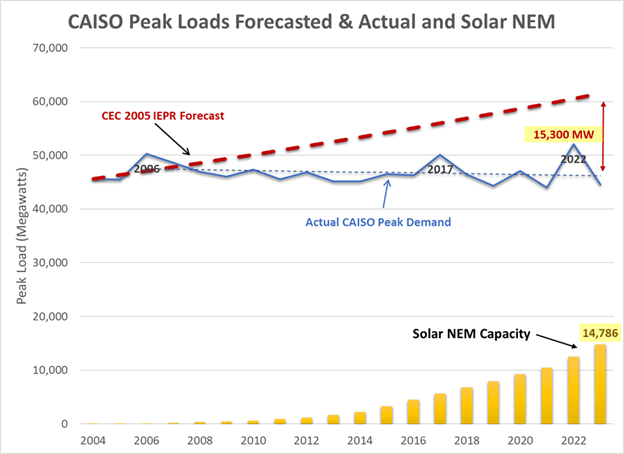
This premise overlooks that these customer resources have met at least a quarter on the energy demand since 2000. The true customer peak is three hours earlier and at least 12,000 megawatts higher than the metered CAISO peak. Based on historic utility costs over that period, annual utility revenue requirements would have increased $14 billion. California already struggled to bring on enough renewable energy over that period—the costs and environmental consequences of using utility generation would likely be even higher.

Claims that customers who save energy cause higher bills for other customers is premised on the unfounded notion that customers are departing from an already existing system built to accommodate their growing future demand. The cost shift analysis starts with today’s situation and then assumes that a customer who installs energy efficiency or rooftop solar is leaving a system already built to serve their current load.

Customers have also added additional loads, including more than one million electric vehicles.  But for the reduction in loads from customer-installed resources, these additional loads would have required billions of dollars of investment in power supply and distribution capacity.  Now, in many cases utilities built the additional capacity anyway – and it is a shortcoming of regulation that these costs were allowed into customer rates when the needed capacity was supplied by customer resources.

The fact is that a utility system is an aging and dynamic network that is constantly retiring and acquiring equipment to serve an ever-changing group of customers. For California, loads were forecasted to grow another 20% from 2005 to now. Instead, those loads have been flat as consumers have acquired their own resources, including LED lights, insulation, smart thermostats, double paned windows, insulation or solar panels. The metered peak shifted three hours later in the day, but the true customer peak still occurs mid-afternoon but it is met by customer-owned resources instead. A fifth of the true customer peak is now served by rooftop solar and a quarter of the state’s energy load comes from energy efficiency plus DERs. Much of that solar output is captured costlessly in hydro storage and used to meet that later peak.  Any analysis must look at what it would have cost over those two decades to build the resources to serve those loads that instead are now served by individually-invested savings and generation.

We know that generation costs were significantly higher than that today’s costs (thanks to innovation) and that resources located at the point of use saves 30% or more in avoided peak losses and reserve power capacity. We know that those customer resources displaced adding new transmission that costs three times more than the average that is charged in retail rates. We know that the utilities consistently overforecasted the need for distribution infrastructure without consequence, and that the transmission and distribution rate components increased about 300% over the last two decades which is four times faster than inflation. Meanwhile, we also know that utility rates increased at the same pace as utility costs reflected in revenue requirements. This is important because if a other ratepayers were picking up the bills for customers who conserve and self generate, the rates would be increasing faster than revenue requirements as demand decreased. This is the essential element of the “death spiral” concept. There is no evidence of a death spiral yet.

The belief that these “departed” loads could have been served at little additional cost is unfounded based on the empirical evidence. If we conservatively use the average retail generation rate or 8.8 cents per kilowatt-hour in 2023 as representative of the true marginal cost,[4] add 12.5 cents per kilowatt-hour for the marginal cost of transmission, and then add an average of 4.4 cents per kilowatt-hour for avoided distribution costs from the utilities general rate case applications, the base avoided cost is 25.7 cents per kilowatt-hour. We then adjust the generation and transmission costs for 7% line losses and a 15% reserve margin, we are at 30.6 cents per kilowatt-hour for the actual marginal cost at the customer meter. In comparison, the average retail rate was only 27.8 cents per kilowatt in 2023 so customers investing in energy efficiency and rooftop solar are reducing incremental costs by 10%. And of course, this does not include environmental benefits, local economic activity or improved local energy resiliency. The total cost to serve the 89,000 gigawatt-hours saved would be $17 billion or a 30% increase in revenue requirements.

As is often the case, diagnosing the problem doesn’t mean that we have an immediate solution. That said, the objective should be to put utility shareholders at risk for excessive investments made based on optimistic growth forecasts. Having “used and useful” standards for asset utilization rates and unit-of-production depreciation are ways of extending cost recovery that lowers rates. However, those types of solutions are likely to move utilities back to opposing EE programs. The best solution is to create a competitive EE utility like the NW Energy Efficiency Alliance.

Today, we see that California is still struggling to bring on enough clean energy resources to meet its ambitious climate change mitigation goals. Diablo Canyon’s retirement was delayed and the state is not even approaching the threshold for installing renewables to meet the SB 100 clean energy target of 100% by 2045. The only viable alternatives are greater reliance on aggressive energy efficiency paired with electrification and customer-owned renewable generation. Misinterpreting the intention of decoupling should not be used as a barrier to reaching our goals.


[1] California first instituted decoupling in 1978 and then paused it in 1996 for restructuring. The system was restarted in 2002.

[2] It literally takes killing customers to put a utility at financial risk. See “ SDG&E Customers Should Not Pay for 2007 Wildfires: SCOTUS,” NBC 7 News, https://www.nbcsandiego.com/news/local/us-supreme-court-sdge-wildfires-costs-lines-utility-fire-damage/1966157/, October 8, 2019; “PG&E receives maximum sentence for 2010 San Bruno explosion,” ABC 7 News, https://abc7news.com/post/pg-e-receives-maximum-sentence-for-2010-san-bruno-explosion/1722674/, January 28. 2017; “Ex-PG&E execs to pay $117M to settle lawsuit over wildfires,” AP News, https://apnews.com/article/wildfires-business-fires-lawsuits-california-450c961a4c6b467fcfb5465e7b9c5ae7, September 29, 2022; “PG&E Pleads Guilty On 2018 California Camp Fire: ‘Our Equipment Started That Fire’,” NPR CapRadio, https://www.npr.org/2020/06/16/879008760/pg-e-pleads-guilty-on-2018-california-camp-fire-our-equipment-started-that-fire, June 16, 2020. SCE may be facing a similar risk after the Easton Fire in January 2025. “Southern California Edison likely to incur ‘material losses’ related to Eaton fire, executive says,” LA Times, https://www.latimes.com/business/story/2025-04-30/edison-earnings-eaton-fire-losses, April 30, 2025.

[3] Decoupling delinked profits from actual sales and instead linked them to forecasted sales used to justify infrastructure investment. This removed the risk of overforecasting sales and perhaps falling short on recovering costs. And we see evidence of that practice in both PG&E’s and SCE’s forecasts used to justify investments from 2009 to 2018. The regulatory failure is that the CPUC didn’t go back and audit whether the investments were justified given that the sales didn’t materialize. Decoupling only works with a regulatory scheme that gives strong incentives for cost control.

[4] The 2024 rates were much higher for the utilities but it’s more difficult to calculate the average.

Response to Borenstein’s critique of our assessment of the benefits of rooftop solar

Severin Borenstein at the Energy Institute at the Haas Business School posted a reply[1] to our analysis[2] of the Public Advocates Office’s claim[3] of a large “cost shift” created by rooftop solar customers to other customers. Here is my extended reply to Borenstein’s critique.

  • Issues of agreement: Borenstein acknowledges that the PAO used an incorrect capacity factor to calculate the total amount of rooftop solar generation. He also acknowledged that the monthly bill payments from rooftop solar customers should be included in the calculation, an error that both PAO and he has previously committed. Further, he agreed, with caveats, that the rate reductions and subsidy savings for low-income CARE customers should be included. Those elements alone add up to reducing PAO’s claimed cost shift approaching $2 billion or 25%
  • Self generation: Borenstein and the PAO ignore the fact that self generation is not included in any utility resource planning. Rooftop solar generation is counted in load forecasts as a load reduction just like energy efficiency. Grid investments, generation capacity and operational decisions such as reserve margins all focus solely on metered load that excludes all self generation.. Borenstein mistakenly asserts that grid and self-provided power mingles, obviating the right to self generation. If there is generation and consumption onsite at the same time, those electrons do not touch the grid. Along with the fact that the energy does not mix, legal precedents and analysis by leading regulators contradict Borenstein’s (and PAO’s) position. Further, the NEM tariffs explicitly recognize the right to self generate for the term of the tariff.
  • Historic utility savings: Borenstein, like PAO, creates a confusing “apples-to-oranges” comparison of historic costs vs. projected future savings. The Avoided Cost Calculator does not include information about historic costs and therefore cannot be used to calculate historic savings from previously installed rooftop solar systems. Using this tool to estimate how much utilities would have spent were it not for previous solar installations is highly inaccurate. The ACC does not have this data. Rates do not reflect future value. In addition, Borenstein ignores suppression of peak load growth since 2006 by the addition of rooftop solar. He confuses the total customer peak served by all resources including rooftop solar with the CAISO metered peak served only by utility resources, asserting that rooftop solar provides little value to meeting today’s metered peak. Only by recreating the costs that would have been borne by ratepayers over the last two decades can the actual savings and reduction in rates be calculated.
  • Customer Bill Payment: While he agrees bill payments should be included in the PAO’s analysis, but he focuses only on the cost-shift burden and fails to acknowledge the contribution to utility fixed costs made by these customers. The appropriate comparison is customer bill payments compared to utility fixed costs per customer. My analysis shows solar customers more than cover utility fixed costs.
  • Overall savings provided to all ratepayers from rooftop solar conservatively is $1.5 billion in 2024.

Further observations

To start, the focus of our analysis is on the Public Advocates Office (PAO) report issued in August 2024. We used PAO’s own spreadsheet as the base of the analysis and supplemented that with other sources. The critique of Borenstein’s analysis is collateral and, compared to that of the PAO analysis, is limited to the questions of self generation and how to calculate the cost savings created by rooftop solar. His capacity factor, inclusion of CARE customers and applicable retail rates are much closer to those that I used. I pointed out in my blog post that Borenstein had not made the mistakes that PAO had made on technical issues.

Yet on the other hand, Borenstein’s own spreadsheet was documented in a small, cryptic “Readme” file,[4] and the final calculation of the “cost shift” was a set of raw values with no internal calculations. When I recreated those calculations, I could not exactly duplicate what Borenstein presented. Similarly, the PAO’s spreadsheet was sparse on documentation. Most of what is shown in my workpapers are my own additions, not PAO’s.

Finally, many of the sources that Borenstein refers to are in fact himself. The NRDC citation relies on his own Next10 report. The LAO report cites back to his own blog post. He refers to his own critique of NEM from four years ago to criticize the NEM 3.0/NBT framework that was finalized two years later. That analysis is likely now obsolete.

As for being an “industry consultant,” a sample of our recent clients shows their diversity where we have worked for environmental organizations, water districts and utilities, agricultural and business associations intervening at the CPUC, CCAs, county governments, tribes, regional energy networks, state agencies, and lately solar advocates. We must present analyses that are sufficiently balanced so as to be credible with all of these different stakeholders. Further, our work is carefully documented and our data and assumptions completely transparent, unlike the work of Borenstein or the PAO.

(I will also note that Borenstein has apparently blocked me on LinkedIn so that he can exclude me from the discussion taking place on his post there.)


[1] See https://energyathaas.wordpress.com/2025/01/27/guess-what-didnt-kill-rooftop-solar/

[2] See https://mcubedecon.com/2024/11/14/how-californias-rooftop-solar-customers-benefit-other-ratepayers-financially-to-the-tune-of-1-5-billion/

[3] See https://www.publicadvocates.cpuc.ca.gov/-/media/cal-advocates-website/files/press-room/reports-and-analyses/240822-public-advocates-office-2024-nem-cost-shift-fact-sheet.pdf

[4] Published with his April 2024 blog post.

Replying to PAO’s response on its rooftop solar “cost shift” analysis

The Public Advocates Office (PAO) issued a response November 25, 2024 to M.Cubed’s critique of the PAO report issued August 22, 2024 asserting that rooftop solar customers had created an $8.5 billion annual “cost shift” to other ratepayers. M.Cubed’s analysis walked through the PAO analysis step by step and documented the flaws and errors in that analysis, arriving at the conclusion rooftop customers had created a net benefit of $1.5 billion per year in 2024. Here, we reply to the PAO’s flawed assessment.

It is readily apparent that the PAO did not examine the workpapers issued by M.Cubed supporting the calculations. Instead, the PAO generally asserted with no additional evidence that it was correct in all ways. Again, there is no supporting analysis beyond three simplistic calculations to back up the original claim.


“Fixed costs” do not mean “fixed charges”

The California Public Utilities Commission has issued a proposed decision that calls for a monthly fixed charge of $24 for most customers. There is no basis in economic principles that calls for collecting “fixed costs” (too often misidentified) in a fixed charge. This so-called principle gets confused with the second-best solution for regulated monopoly pricing where the monopoly has declining marginal costs that are below average costs which has a two part tariff of a lump sum payment and variable prices at marginal costs. (And Ramsey pricing, which California uses a derivative of that in equal percent marginal cost (EPMC) allocation, also is a second-best efficient pricing method that relies solely on volumetric units.) The evidence for a natural monopoly is that average costs are falling over time as sales expand.

However, as shown by the chart above for PG&E’s distribution and transmission (and SCE’s looks similar), average costs as represented in retail rates are rising. This means that marginal costs must be above average costs. (If this isn’t true then a fully detailed explanation is required—none has been presented so far.) The conditions for regulated monopoly pricing with a lump sum or fixed charge component do not exist in California.

Using the logic that fixed costs should be collected through fixed charges, then the marketplace would be rife with all sorts of entry, access and connection fees at grocery stores, nail salons and other retail outlets as well as restaurants, car dealers, etc. to cover the costs of ownership and leases, operational overhead and other invariant costs. Simply put that’s not the case. All of those producers and providers price on a per unit basis because that’s how a competitive market works. In those markets, customers have the ability to choose and move among sellers, so the seller is forced to recover costs on a single unit price. You might respond, well, cell providers have monthly fixed charges. But that’s not true—those are monthly connection fees that represent the marginal cost of interconnecting to a network. And customers have the option of switching (and many do) to a provider with a lower monthly fee. The unit of consumption is interconnection, which is a longer period than the single momentary instance that economists love because they can use calculus to derive it.

Utility regulation is supposed to mimic the outcome of competitive markets, including pricing patterns. That means that fixed cost recovery through a fixed charge must be limited to a customer-dedicated facility which cannot be used by another customer. That would be the service connection, which has a monthly investment recovery cost of about $10 to $15/month. Everything else must be priced on a volumetric basis as would be in a competitive market. (And the rise of DERs is now introducing true competition into this marketplace.)

The problem is that we’re missing the other key aspect of competitive markets—that investors risk losing their investments due to poor management decisions. Virtually all of the excess stranded costs for California IOUs are due poor management, not “state mandates.” You can look at the differences between in-state IOU and muni rates to see the evidence. (And that an IOU has been convicted of killing nearly 100 people due to malfeasance further supports that conclusion.)

There are alternative solutions to California’s current dilemma but utility shareholders must accept their portion of the financial burden. Right now they are shielded completely as evidenced by record profits and rising share prices.

Opinion: What’s wrong with basing electricity fees on household incomes

I coauthored this article in the Los Angeles Daily News with Ahmad Faruqui and Andy Van Horn. We critique the proposed income-graduated fixed charge (IGFC) being considered at the California Public Utilities Commission.

Retail electricity rate reform will not solve California’s problems

Meredith Fowlie wrote this blog on the proposal to drastically increase California utilities’ residential fixed charges at the Energy Institute at Haas blog. I posted this comment (with some additions and edits) in response.

First, infrastructure costs are responsive to changes in both demand and added generation. It’s just that those costs won’t change for a customer tomorrow–it will take a decade. Given how fast transmission retail rates have risen and have none of the added fixed costs listed here, the marginal cost must be substantially above the current average retail rates of 4 to 8 cents/kWh.

Further, if a customer is being charged a fixed cost for capacity that is being shared with other customers, e.g., distribution and transmission wires, they should be able to sell that capacity to other customers on a periodic basis. While many economists love auctions, the mechanism with the lowest ancillary transaction costs is a dealer market akin a grocery store which buys stocks of goods and then resells. (The New York Stock Exchange is a type of dealer market.) The most likely unit of sale would be in cents per kWh which is the same as today. In this case, the utility would be the dealer, just as today. So we are already in the same situation.

Airlines are another equally capital intensive industry. Yet no one pays a significant fixed charge (there are some membership clubs) and then just a small incremental charge for fuel and cocktails. Fares are based on a representative long run marginal cost of acquiring and maintaining the fleet. Airlines maintain a network just as utilities. Economies of scale matter in building an airline. The only difference is that utilities are able to monopolistically capture their customers and then appeal to state-sponsored regulators to impose prices.

Why are California’s utility rates 30 to 50% or more above the current direct costs of serving customers? The IOUs, and PG&E in particular, over procured renewables in the 2010-2012 period at exorbitant prices (averaging $120/MWH) in part in an attempt to block entry of CCAs. That squandered the opportunity to gain the economics benefits from learning by doing that led to the rapid decline in solar and wind prices over the next decade. In addition, PG&E refused to sell a part of its renewable PPAs to the new CCAs as they started up in the 2014-2017 period. On top of that, PG&E ratepayers paid an additional 50% on an already expensive Diablo Canyon due to the terms of the 1996 Settlement Agreement. (I made the calculations during that case for a client.) And on the T&D side, I pointed out beginning in 2010 that the utilities were overforecasting load growth and their recorded data showed stagnant loads. The peak load from 2006 was the record until 2022 and energy loads have remained largely constant, even declining over the period. The utilities finally started listening the last couple of years but all of that unneeded capital is baked into rates. All of these factors point not to the state or even the CPUC (except as an inept monitor) as being at fault, but rather to the utilities’ mismanagement.

Using Southern California Edison’s (SCE) own numbers, we can illustrate the point. SCE’s total bundled marginal costs in its rate filing are 10.50 cents per kWh for the system and 13.64 cents per kWh for residential customers. In comparison, SCE’s average system rate is 17.62 cents per kWh or 68% higher than the bundled marginal cost, and the average residential rate of 22.44 cents per kWh is 65% higher. From SCE’s workpapers, these cost increases come primarily from four sources.

  1. First, about 10% goes towards various public purpose programs that fund a variety of state-initiated policies such as energy efficiency and research. Much of this should be largely funded out of the state’s General Fund as income distribution through the CARE rate instead. And remember that low income customers are already receiving a 35% discount on rates.
  2. Next, another 10% comes roughly from costs created two decades ago in the wake of the restructuring debacle. The state has now decreed that this revenue stream will instead be used to pay for the damages that utilities have caused with wildfires. Importantly, note that wildfire costs of any kind have not actually reached rates yet. In addition, there are several solutions much less costly than the undergrounding proposed by PG&E and SDG&E, including remote rural microgrids.
  3. Approximately 15% is from higher distribution costs, some of which have been created by over-forecasting load growth over the last 15 years; loads have remained stagnant since 2006.
  4. And finally, around 33% is excessive generation costs caused by paying too much for purchased power agreements signed a decade ago.

An issue raised as rooftop solar spreads farther is the claim that rooftop solar customers are not paying their fair share and instead are imposing costs on other customers, who on average have lower incomes than those with rooftop solar. Yet the math behind the true rate burden for other customers is quite straightforward—if 10% of the customers are paying essentially zero (which they are actually not), the costs for the remaining 90% of the customers cannot go up more than 11% [100%/(100%-10%) = 11% ]. If low-income customers pay only 70% of this—the 11%– then their bills might go up about 8%–hardly a “substantial burden.” (70% x 11% = 7.7%)

As for aligning incentives for electrification, we proposed a more direct alternative on behalf of the Local Government Sustainable Energy Coalition where those who replace a gas appliance or furnace with an electric receive an allowance (much like the all-electric baseline) priced at marginal cost while the remainder is priced at the higher fully-loaded rate. That would reduce the incentive to exit the grid when electrifying while still rewarding those who made past energy efficiency and load reduction investments.

The solution to high rates cannot come from simple rate design; as Old Surfer Dude points out, wealthy customers are just going to exit the grid and self provide. Rate design is just rearranging the deck chairs. The CPUC tried the same thing in the late 1990s with telcom on the assumption that customers would stay put. Instead customers migrated to cell phones and dropped their land lines. The real solution is going to require some good old fashion capitalism with shareholders and associated stakeholders absorbing the costs of their mistakes and greed.

Guidelines For Better Net Metering; Protecting All Electricity Customers And The Climate

Authors Ahmad Faruqui, Richard McCann and Fereidoon Sioshansi[1] respond to Professor Severin Borenstein’s much-debated proposal to reform California’s net energy metering, which was first published as a blog and later in a Los Angeles Times op-ed.

Proposing a Clean Financing Decarbonization Incentive Rate

by Steven J. Moss and Richard J. McCann, M.Cubed

A potentially key barrier to decarbonizing California’s economy is escalating electricity costs.[1] To address this challenge, the Local Government Sustainable Energy Coalition, in collaboration with Santa Barbara Clean Energy, proposes to create a decarbonization incentive rate, which would enable customers who switch heating, ventilation and air conditioning (HVAC) or other appliances from natural gas, fossil methane, or propane to electricity to pay a discounted rate on the incremental electricity consumed.[2] The rate could also be offered to customers purchasing electric vehicles (EVs).

California has adopted electricity rate discounts previously to incentivize beneficial choices, such as retaining and expanding businesses in-state,[3] and converting agricultural pump engines from diesel to electricity to improve Central Valley air quality.[4]

  • Economic development rates (EDR) offer a reduction to enterprises that are considering leaving, moving to or expanding in the state.  The rate floor is calculated as the marginal cost of service for distribution and generation plus non-bypassable charges (NBC). For Southern California Edison, the current standard EDR discount is 12%; 30% in designated enhanced zones.[5]
  • AG-ICE tariff, offered from 2006 to 2014, provided a discounted line extension cost and limited the associated rate escalation to 1.5% a year for 10 years to match forecasted diesel fuel prices.[6] The program led to the conversion of 2,000 pump engines in 2006-2007 with commensurate improvements in regional air quality and greenhouse gas (GHG) emission reductions.[7]

The decarbonization incentive rate (DIR) would use the same principles as the EDR tariff. Most importantly, load created by converting from fossil fuels is new load that has only been recently—if at all–included in electricity resource and grid planning. None of this load should incur legacy costs for past generation investments or procurement nor for past distribution costs. Most significantly, this principle means that these new loads would be exempt from the power cost indifference adjustment (PCIA) stranded asset charge to recover legacy generation costs.

The California Public Utility Commission (CPUC) also ruled in 2007 that NBCs such as for public purpose programs, CARE discount funding, Department of Water Resources Bonds, and nuclear decommissioning, must be recovered in full in discounted tariffs such as the EDR rate. This proposal follows that direction and include these charges, except the PCIA as discussed above.

Costs for incremental service are best represented by the marginal costs developed by the utilities and other parties either in their General Rate Case (GRC) Phase II cases or in the CPUC’s Avoided Cost Calculator. Since the EDR is developed using analysis from the GRC, the proposed DIR is illustrated here using SCE’s 2021 GRC Phase II information as a preliminary estimate of what such a rate might look like. A more detailed analysis likely will arrive at a somewhat different set of rates, but the relationships should be similar.

For SCE, the current average delivery rate that includes distribution, transmission and NBCs is 9.03 cents per kilowatt-hour (kWh). The average for residential customers is 12.58 cents. The system-wide marginal cost for distribution is 4.57 cents per kilowatt-hour;[8] 6.82 cents per kWh for residential customers. Including transmission and NBCs, the system average rate component would be 7.02 cents per kWh, or 22% less. The residential component would be 8.41 cents or 33% less.[9]

The generation component similarly would be discounted. SCE’s average bundled generation rate is 8.59 cents per kWh and 9.87 cents for residential customers. The rates derived using marginal costs is 5.93 cents for the system average and 6.81 cent for residential, or 31% less. For CCA customers, the PCIA would be waived on the incremental portion of the load. Each CCA would calculate its marginal generation cost as it sees fit.

For bundled customers, the average rate would go from 17.62 cents per kWh to 12.95 cents, or 26.5% less. Residential rates would decrease from 22.44 cents to 15.22 cents, or 32.2% less.

Incremental loads eligible for the discounted decarb rate would be calculated based on projected energy use for the appropriate application.  For appliances and HVAC systems, Southern California Gas offers line extension allowances for installing gas services based on appliance-specific estimated consumption (e.g., water heating, cooking, space conditioning).[10] Data employed for those calculations could be converted to equivalent electricity use, with an incremental use credit on a ratepayer’s bill. An alternative approach to determine incremental electricity use would be to rely on the California Energy Commission’s Title 24 building efficiency and Title 20 appliance standard assumptions, adjusted by climate zone.[11]

For EVs, the credit would be based on the average annual vehicle miles traveled in a designated region (e.g., county, city or zip code) as calculated by the California Air Resources Board for use in its EMFAC air quality model or from the Bureau of Automotive Repair (BAR) Smog Check odometer records, and the average fleet fuel consumption converted to electricity. For a car traveling 12,000 miles per year that would equate to 4,150 kWh or 345 kWh per month.


[1] CPUC, “Affordability Phase 3 En Banc,” https://www.cpuc.ca.gov/industries-and-topics/electrical-energy/affordability, February 28-March 1, 2022.

[2] Remaining electricity use after accounting for incremental consumption would be charged at the current otherwise applicable tariff (OAT).

[3] California Public Utilities Commission, Decision 96-08-025. Subsequent decisions have renewed and modified the economic development rate (EDR) for the utilities individually and collectively.

[4] D.05-06-016, creating the AG-ICE tariff for Pacific Gas & Electric and Southern California Edison.

[5] SCE, Schedules EDR-E, EDR-A and EDR-R.

[6] PG&E, Schedule AG-ICE—Agricultural Internal Combustion Engine Conversion Incentive Rate.

[7] EDR and AG-ICE were approved by the Commission in separate utility applications. The mobile home park utility system conversion program was first initiated by a Western Mobile Home Association petition by and then converted into a rulemaking, with significant revenue requirement implications. 

[8] Excluding transmission and NBCs.

[9] Tiered rates pose a significant barrier to electrification and would cause the effective discount to be greater than estimated herein.  The estimates above were based on measuring against the average electricity rate but added demand would be charged at the much higher Tier 2 rate. The decarb allowance could be introduced at a new Tier 0 below the current Tier 1.

[10] SCG, Rule No. 20 Gas Main Extensions, https://tariff.socalgas.com/regulatory/tariffs/tm2/pdf/20.pdf, retrieved March 2022.

[11] See https://www.energy.ca.gov/programs-and-topics/programs/building-energy-efficiency-standards;
https://www.energy.ca.gov/rules-and-regulations/building-energy-efficiency/manufacturer-certification-building-equipment;https://www.energy.ca.gov/rules-and-regulations/appliance-efficiency-regulations-title-20

PG&E takes a bold step on enabling EV back up power, but questions remain

PG&E made exciting announcements about partnerships with GM and Ford last week to test using electric vehicles (EVs) for backup power for residential customers. (Ford also announced an initiative to create an open source charging standard.) PG&E also announced an initiative to install circuit breakers that facilitate use of onsite backup power. PG&E is commended for stepping forward to align its corporate strategy with the impending technology wave that could increase consumer energy independence.

I wrote about the promise of EVs in this role (“Electric vehicles as the next smartphone”) when I was struck by Ford’s F-150 Lightning ads last summer and how the consumer segment that buys pickups isn’t what we usually think of as the “EV crowd.” These initiatives could be game changers.

That said, several questions arise about PG&E’s game plan and whether the utility is still planning to hold customers captive:

  • How does PG&E plan to recover the costs for what are “beyond the meter” devices that typically is outside of what’s allowed? And how are the risks in these investments to be shared between shareholders and ratepayers? Will PG&E get an “authorized” rate of return with default assurances of costs being approved for recovery from ratepayers? How will PG&E be given appropriate incentives on making timely investments with appropriate risk, especially given the utility’s poor track record in acquiring renewable resources?
  • What will be the relationships between PG&E and the participating auto manufacturers? Will the manufacturers be required to partner with PG&E going forward? Will the manufacturers be foreclosed from offering products and services that would allow customers to exit PG&E’s system through self generation? Will PG&E close out other manufacturers from participating or set up other access barriers that prevent them from offering alternatives?
  • Delivering PG&E’s “personal microgrid backup power transfer meter device” is a good first step, but it requires disconnecting the solar panels to use, which means that it only support fossil fueled generators and grid-connected batteries. This device needs a switch for the solar panels as well. Further, it appears the device will only be available to customers who participate in PG&E’s Residential Generator and Battery Rebate Program. Can PG&E continue to offer this feature to vendors who offer only fossil-fueled generators? How will PG&E mitigate the local air pollution impacts from using fossil-fueled back up generators (BUGs) for extended periods? (California already has 8,000 megawatts of BUGs.)
  • How will these measures be integrated with the planned system reinforcements in PG&E’s 2022 Wildfire Mitigation Plan Update to reduce the costs of undergrounding lines? Will PG&E allow these back up sources and devices for customers who are interested in extended energy independence, particularly those who want to ride out a PSPS event?
  • How will community choice aggregators (CCAs) or other local governments participate? Will communities be able to independently push these options to achieve their climate action and adaptation plan (CAAP) goals?

Are PG&E’s customers about to walk?

In the 1990s, California’s industrial customers threatened to build their own self-generation plants and leave the utilities entirely. Escalating generation costs due to nuclear plant cost overruns and too-generous qualifying facilities (QF) contracts had driven up rates, and the technology that made QFs possible also allowed large customers to consider self generating. In response California “restructured” its utility sector to introduce competition in the generation segment and to get the utilities out of that part of the business. Unfortunately the initiative failed, in a big way, and we were left with a hybrid system which some blame for rising rates today.

Those rising rates may be introducing another threat to the utilities’ business model, but it may be more existential this time. A previous blog post described how Pacific Gas & Electric’s 2022 Wildfire Mitigation Plan Update combined with the 2023 General Rate Application could lead to a 50% rate increase from 2020 to 2026. For standard rate residential customers, the average rate could by 41.9 cents per kilowatt-hour.

For an average customer that translates to $2,200 per year per kilowatt of peak demand. Using PG&E’s cost of capital, that implies that an independent self-sufficient microgrid costing $15,250 per kilowatt could be funded from avoiding paying PG&E bills.

The National Renewable Energy Laboratory (NREL) study referenced in this blog estimates that a stand alone residential microgrid with 7 kilowatts of solar paired with a 5 kilowatt / 20 kilowatt-hour battery would cost between $35,000 and $40,000. The savings from avoiding PG&E rates could justify spending $75,000 to $105,000 on such a system, so a residential customer could save up to $70,000 by defecting from the grid. Even if NREL has underpriced and undersized this example system, that is a substantial margin.

This time it’s not just a few large customers with choice thermal demands and electricity needs—this would be a large swath of PG&E’s residential customer class. It would be the customers who are most affluent and most able to pay PG&E’s extraordinary costs. If many of these customers view this opportunity to exit favorably, the utility could truly face a death spiral that encourages even more customers to leave. Those who are left behind will demand more relief in some fashion, but those customers who already defected will not be willing to bail out the company.

In this scenario, what is PG&E’s (or Southern California Edison’s and San Diego Gas & Electric’s) exit strategy? Trying to squeeze current NEM customers likely will only accelerate exit, not stifle it. The recent two-day workshop on affordability at the CPUC avoided discussing how utility investors should share in solving this problem, treating their cost streams as inviolable. The more likely solution requires substantial restructuring of PG&E to lower its revenue requirements, including by reducing income to shareholders.