Tag Archives: M.Cubed

Non-Profit Utilities Could Cure What Ails California Electricity

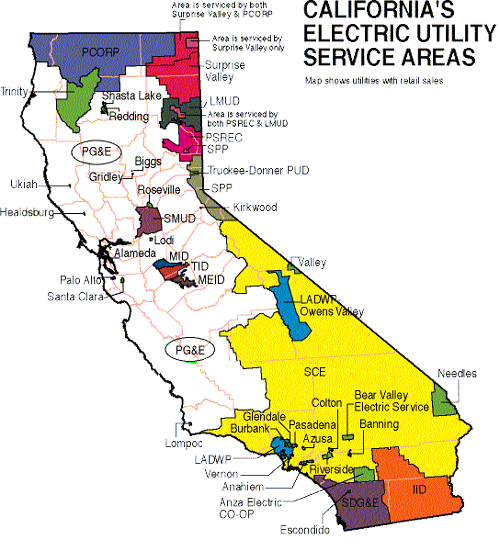
electricservicearea

Severin Borenstein at the Energy Institute at Haas, asks “Would Non-Profit Utilities Cure What Ails California Electricity?” I am posting my response here as that I find his post overlooks several important points and distinctions.

I’ll start by saying I wrote an op-ed in the Sacramento Bee in the early 2000s noting that creating a new municipal utility was not going to deliver the same low rates as existing munis and I’m still aware that such a transfer is unlikely to reduce rates much. But it does change the governance structure in a way that is likely to be more accountable and less influenced by the private interests of utility shareholders. Communities are joining together to push for acquisition of PG&E by a cooperative, which would have a similar governance structure to a municipal utility.

First, the complaint about government is largely about agencies that I will call “ministerial” or “administrative”. These agencies issue permits and licenses or provide social services. In contrast, the government agencies that deliver utility services, which are “enterprises” largely deliver service with few complaints. About 80% of water utilities and almost all wastewater utilities are publicly owned. I work in the water arena as well, and the only utility that I hear complaints about from customers is LADWP (both water and power sides). (The SDCWA-MWD fight is between agencies’ managements, not from customers). On the other hand, all three or California’s electric IOUs are the target of customers’ ire. And the IOU staffs (which I have frequent contact with) are no better than government employees in their responsiveness or competence. One advantage the enterprise agencies have over the ministerial/administrative ones is that they generally pay a higher salary so employees are motivated in much the same way as those in the private sector. Moving from oversight by a ministerial/administrative agency (CPUC) to management by an enterprise utility should overcome the problem of recruiting competent motivated staff.

Second, shareholders shoulder very little risk now, particularly in California. I testified in the IOUs’ rate of return case and we asked for the amount of disallowances that shareholders had to bear over the last two decades. Other than SDG&E’s 2007 wildfire costs due to negligence on the utility’s part, they came pack with amounts that were in the tens of millions, which amounts to less than a 0.1% of their revenues collected over that period. Utilities’ generation investment is now so protected that the CPUC reversed itself last year and removed the 10 year recovery cap from exit fees for generation that the utilities built knowing the cap existed. They are now getting bonus dollars! (Same thing happened with Diablo Canyon in 1996.) Yet the utilities are claiming in that rate case that the return on equity should be increased even further! I have a blog post about how the current return is already too high. (Part 2 is the next day.)  Public ownership in contrast can reduce the return on capital from close to 10% (before tax) to 5% or less, which can cut rates substantially.

We can see how PG&E in particular has been incompetently managed for decades. I posted about its many foibles since the 1960s as well. The supposed incentives and efficiencies of the private sector have failed to materialize for California utilities, and meanwhile we pay higher costs for capital with no real risk mitigation. (Ratepayers still had to pay for PG&E’s debts after the 2000-01 energy crisis, and it looks like the same may happen again.)

Finally, the question arises as to whether municipalizing piecemeal would create inequities. The premise of the statement is that the current economic distribution is equitable. But the fact is that rural residential customers in the wildland/urban interface (WUI) have not been paying their full share of their costs and have been heavily subsidized by urban customers. Those customers in the WUI tend to be better off than average (poor rural customers are more likely to live in agricultural communities that are not subject to the same fire risks and for whom service costs are lower), so we already have an adverse wealth transfer in place. And those subsidies have facilitated expansion of housing into those high risk areas that also encourage longer commutes with more GHG emissions.

The better question is how can the rural service areas be better served in the future without relying on the traditional utility structure? Moving toward microgrids and other DER solutions to improve reliability while reducing fire risk is one solution. Spending a $100 billion on undergrounding lines to be paid for by everyone else is NOT a good solution.

Utilities’ returns are too high (Part 1)

IOU share prices

An analysis of equity market activity indicates that investors have not priced a risk discount into California utility shares, and instead, until the recent wildfires, utility investors have placed a premium value on California utility stocks. This premium value indicates that investors have viewed California as either less risky than other states’ utilities or that California has provided a more lucrative return on investment than other states.

The California Public Utilities Commission (CPUC) should set the authorized return on equity to shareholders (ROE) to deliver an after-tax net income amount as a percentage of the capital invested by the utility or the “book value.” As Alfred Kahn wrote, “the sharp appreciation in the prices of public utility stocks, to one and half and then two times their book values during this period [the 1960s] reflected also a growing recognition that the companies in question were in fact being permitted to earn considerably more than their cost of capital.” (see footnote 69)

The book value is fairly stable and tends to grow over time as higher cost capital is invested to meet growth and to replace older, lower cost equipment. Investors use this forecasted income to determine their valuation of the company’s common stock in market transactions. Generally the accepted valuation is the net present value of the income stream using a discount rate equal to the expected return on that investment. That expected return represents the market-based return on equity or the implied market return.

Alfred Kahn wrote that a commission should generally target the ROE so that the book and market values of the utility company are roughly comparable. In that way, when the utility adds capital, that capital receives a return that closely matches the return investors expect in the market place. If the regulated ROE is low relative to the market ROE, the company will have difficulty raising sufficient capital from the market for needed investments. If the regulated ROE is high relative to the market ROE, ratepayers will pay too much for capital invested and excess economic resources will be diverted into the utility’s costs. On this premise, we compared each of the utilities’ market valuation and implied market ROE against market baskets of U.S. utilities and the current authorized ROEs.

The figure above shows how the stock price for each of the three California utility holding companies (PG&E Corporation (ticker symbol PCG), Edison International (EIX) and Sempra (SRE)) that own the four large California energy utilities. The figure compares these stock prices to the Dow Jones Utility index average from June 1998 to July 2019 starting from a common base index value of 100 on January 1, 2000. The chart also includes (a) important Commission decisions and state laws that have been enacted and are identified by several of the utility witnesses as increasing the legal and regulatory risk environment in the state, and (b) catastrophic events at particular utilities that could affect how investors perceive the risk and management of that utility.

Table 1 summarizes the annual average growth in share prices for the Dow Jones Utility average and the three holding companies up to the 2012 cost of capital decision, the 2017 cost of capital modification decision, and to July 2019. Also of particular note, the chart includes the Commission’s decision on incorporating a risk-based framework into each utility’s General Rate Case process in D.14-12-025. The significance of this decision is that the utility’s consideration of safety risk was directed to be “baked in” to future requests for new capital investment. The updated risk framework also has the impact of making new these new investments more secure from an investment perspective, since there is closer financial monitoring and tracking.

As you can see in both Table 1 and in the figure, the Dow Jones Utility average annual growth was 5.5% through July 13, 2017 and 5.8% through July 18, 2019, California utility prices exceeded this average in all but one case, with Edison’s shares rising 9.4% per annum through the first date and 8.4% through this July, and Sempra growing 15.2% to the first date and even more at 15.3% to the latest. Even PG&E grew at almost twice the index rate at 10.4% in 2017, and then took an expected sharp decline with its bankruptcy.

Table 1

Cumulative Average Growth from January 2000 12/12/2012 7/13/2017 7/18/2019
Dow Jones Utilities 3.9% 5.5% 5.8%
Edison International 7.2% 9.4% 8.4%
PG&E Corp. 8.6% 10.4% 2.4%
Sempra 15.8% 15.2% 15.3%

The chart and table support three important findings:

  • California utility shares have significantly outpaced industry average returns since January 2000 and since March 2009;
  • California share prices only decreased significantly after the wildfire events that have been tied to specific market-perceived negligence on the part of the electric utilities in 2017 and 2018; and
  • Other events and state policy actions do not appear to have a measurable sustained impact on utilities’ valuations.

In Part 2, I show how utilities’ premiums on their authorized ROE have grown over the last decade.

Not grasping the concept: PG&E misses the peak load shift

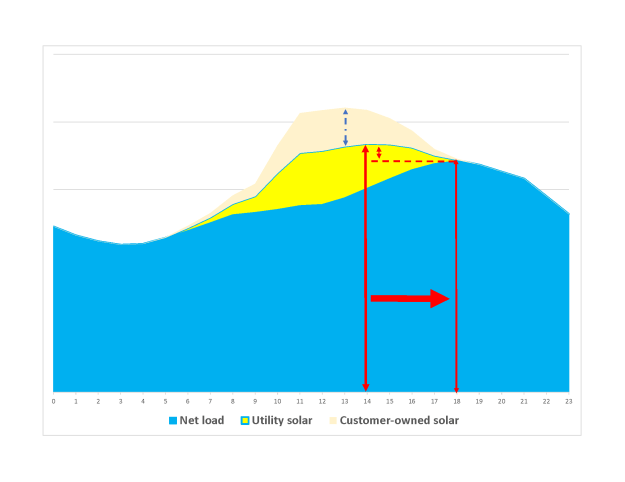
Utility peak shifted by solar graph

PG&E in its 2020 ERRA Forecast Proceeding testimony wrote “however, BTM DG [behind the meter distributed generation] has a limited impact to the annual system peak as customer-owned solar photovoltaic (PV) generation is minimal during the peak hour of 7 p.m.” Uh, how does PG&E know that customer-owned solar doesn’t contribute to reducing the system peak if PG&E does not meter that generation?

PG&E actually has it wrong. Customer-owned solar has in fact reduced the former pre-solar peak that used to occur between 2 and 4 p.m. The metered load that PG&E can see, which is customer usage minus solar output (BTM DG), has shifted its apparent peak from 4 p.m. to 7 p.m.–3 hours. The graphic above illustrates how this shift has occurred. (PG&E produced a similar chart of its 2016 loads in its TOU rate rulemaking.) So BTM DG has had a profound impact on the annual system peak.

A different turn in PG&E’s future

masthead3

M.Cubed partner Steven Moss wrote this editorial “Publisher’s View: Pacific Gas and Electric Company” in the Potrero View on how PG&E might move forward into the future.

Charging with the sun…really!

MITSUBISHI MOTOR SALES OF AMERICA, INC. CYPRESS CHARGING STATION

Severin Borenstein at the University of California’s Energy Institute at Haas posted on whether a consumer buying an electric vehicle was charging it with power from renewables. I have been considering the issue of how our short-run electricity markets are incomplete and misleading. I posted this response on that blog:

As with many arguments that look quite cohesive, it is based on key unstated premises that if called into question undermine the conclusions. I would relabel the “correct” perspective as the “conventional” which assumes that the resources at the margin are defined by short-run operational decisions. This is the basic premise of the FERC-designed power market framework–somehow all of those small marginal energy increases eventually add up into one large new powerplant. This is the standard economic assumption that a series of “putty” transactions in the short term will evolve into a long term “clay” investment. (It’s all of those calculus assumptions about continuity that drive this.) This was questionable in 1998 as it became apparent that the capacity market would have to run separately from the energy market, and is now even more questionable as we replace fossil fuel with renewables.

I would call the fourth perspective as “dynamic”. From this perspective these short run marginal purchases on the CAISO are for balancing to meet current demand. As Marc Joseph pointed out, all of the new incremental demand is being met in a completely separate market that only uses the CAISO as a form of a day to day clearinghouse–the bilateral PPAs. No load serving entity is looking to the CAISO as their backstop resource source. Those long term PPAs are almost universally renewables–even in states without RPS standards. In addition, fossil fueled plants–coal and gas–are being retired and replaced by solar and wind, and that is an additional marginal resource not captured in the CAISO market.

So when a consumer buys a new EV, that added load is being met with renewables added to either meet new load or replace retired fossil. Because these renewables have zero operating costs, they don’t show up in the CAISO’s “marginal” resources for simple accounting reasons, not for fundamental economic reasons. And when that consumer also adds solar panels at the same time, those panels don’t show up at all in the CAISO transactions and are ignored under the conventional view.

There is an issue of resource balancing costs in the CAISO incurred by one type of resource versus another, but that cost is only a subcomponent of the overall true marginal cost from a dynamic perspective.

So how we view the difference between “putty” and “clay” increments is key to assessing whether a consumer is charging their EV with renewables or not.

Using floods to replenish groundwater

ALMOND  ORCHARD FLOODING

M.Cubed produced four reports for Sustainable Conservation on using floodwaters to recharge aquifers in California’s Central Valley. The first is on expected costs. The next three are a set on the benefits, participation incentives and financing options for using floodwaters in wetter years to replenish groundwater aquifers. We found that costs would range around $100 per acre-foot, and beneficiaries include not only local farmers, but also downstream communities with lower flood control costs, upstream water users with more space for storage instead of flood control, increased hydropower generation, and more streamside habitat. We discussed several different approaches to incentives based on our experience in a range of market-based regulatory settings and the water transfer market.

With the PPIC’s release of Water and the Future of the San Joaquin Valley, which forecasts a loss of 500,000 acres of agricultural production due to reduced groundwater pumping under the State Groundwater Management Act (SGMA), local solutions that mitigate groundwater restrictions should be moving to the fore.

Don Cameron at Terranova Ranch started doing this deliberately earlier this decade, and working with Phil Bachand and UC Davis, more study has shown the effectiveness, and the lack of risk to crops, from this strategy. The Department of Water Resources has implemented the Flood-MAR program to explore this alternative further. The Flood-MAR whitepaper explores many of these issues, but its list of beneficiaries is incomplete, and the program appears to not yet moved on to how to effectively implement these programs integrated with the local SGMA plans. Our white papers could be useful starting points for that discussion.

(Image Source: Chico Enterprise-Record)


A counter to UC’s skepticism about CCAs

cce-pic

Kevin Novan from UC Davis wrote an article in the University of California Giannini Foundation’s Agriculture and Resource Economics Update entitled “Should Communities Get into the Power Marketing Business?” Novan was skeptical of the gains from community choice aggregation (CCA), concluding that continued centrally planned procurement was preferable. Other UC-affiliated energy economists have also expressed skepticism, including Catherine Wolfram, Severin Borenstein, and Maximilian Auffhammer.

At the heart of this issue is the question of whether the gains of “perfect” coordination outweigh the losses from rent-seeking and increased risks from centralized decision making. I don’t consider myself an Austrian economist, but I’m becoming a fan of the principle that the overall outcomes of many decentralized decisions is likely to be better than a single “all eggs in one basket” decision. We pretend that the “central” planner is somehow omniscient and prudently minimizes risks. But after three decades of regulatory practice, I see that the regulators are not particularly competent at choosing the best course of action and have difficulty understanding key concepts in risk mitigation.By distributing decision making, we better capture a range of risk tolerances and bring more information to the market place. There are further social gains from dispersed political decision making that brings accountability much closer to home and increases transparency. Of course, there’s a limit on how far decentralization should go–each household can’t effectively negotiate separate power contracts. But we gain much more information by adding a number of generation service providers or “load serving entities” (LSE) to the market.

I found several shortcomings with with Novan’s article that would change the tenor. I take each in turn:

  • He wrote “it remains to be seen whether local governments will make prudent decisions…” However, he did not provide the background which explains at least in part why the CCAs have arisen in the first place. Largely over the last 40 years, the utilities have made imprudent procurement and planning decisions. Whether those have been pushed on the utilities by the CPUC and Legislature or whether the IOUs have some responsibility, the fact is that neither institution sees real consequences for these decisions, neither financially or politically. In fact, the one time that a CPUC commissioner attempted to deliver consequences to the IOUs, she was fired and replaced by a former utility CEO. The appropriate comparison for local government decision making is to the current baseline record, not an academic hypothetical that will never exist. And by the way, government enterprise agencies, including municipal utilities, have a relatively good record as demonstrated as by lower electricity rates and relatively well managed, almost invisible capital intensive water and sanitation utilities. The current CCAs have a more extensive portfolio risk management system than PG&E—my calculation of PG&E’s implicit risk hedge in its renewables portfolio is an astounding 3.3 cents per kilowatt-hour.
  • Novan complains that CCAs have “dual objectives.” In fact they have “triple objectives,” the added one to encourage local economic development (sometimes through lower rates). I suggest reading the mission statements of the CCAs that have been created, including the local Valley Clean Energy Authority .
  • It’s not clear that “purchasing locally produced renewable energy will likely lead to more expensive renewable output” for at least two reasons. The first is that local power can avoid further transmission investment. The current CAISO transmission access charges range from $11 to $39 per megawatt-hour and is forecasted to continue to rise significantly (indicating transmission marginal costs are much above average costs). In a commentary on a UC Energy Institute blog, it was revealed that the Sunrise line may have cost as much as $80 per MWH for power from the desert. This wipes out much of the difference between utility scale and DG solar power. Building locally avoids yet more expensive transmission investment to the southeast desert. [I worked on the DRECP for the CEC.] In addition, local power can avoid distribution investment and will be reflected in the IOU’s distribution resource plans (DRP). And second, the scale economies for solar PV plants largely disappears after about 10 MW. So larger plants don’t necessarily mean cheaper, (especially if they have to implement more extensive environmental mitigation.) [I prepared the Cost of Generation model and report for the CEC from 2001-2013.]
  • It’s not necessary that more renewable capacity is needed for local generation. The average line losses in the CAISO system are about 6%, and those are greater from the far desert region. Whether increased productivity overcomes that difference is an empirical question that I haven’t seen answered satisfactorily yet.
  • Novan left unstated his premise defining “greener” renewables, but I presume that it’s based almost entirely on GHG emissions. However, local power is likely “greener” because it avoids other environmental impacts as well. Local renewables are much more likely to be built on brownfields and even rooftops so there’s not added footprints. In contrast there is growing opposition to new plants in the desert region. The second advantage is the avoidance of added transmission corridors. One only needs to look at the Sunrise and Tehachipi lines to see how those consequences can slow down the process. Local DG can avoid distribution investment that has consequences as well. Further, local power provides local system support that can displace local natural gas generation. In fact, one of the key issues for Southern California is the need to maintain in-basin generation to support imports of renewables across the LA Basin interface. [I assessed the need for local generation in the LA Basin in the face of various environmental regulations for the CEC.]

I was on the City of Davis Community Choice Energy Advisory Committee, and I am testifying on behalf of the California CCAs on the setting of the PCIA in several dockets. I have a Ph.D. from Berkeley’s ARE program and have worked on energy, environmental and water issues for about 30 years.


California already paid for utility assets once: Why do we have to do it again?

——renewablemix-cleangreengrid-642x300

Rather than focus on CCA procurement, the CPUC would better serve the state to use the provisions of AB 57 (e.g., PUC Section 454.5(b)(6)) and its other authorities, including those still in force from AB 1890 (1996). PG&E and SCE already collected $7 billion on an accelerated basis during the “competitive transition period” from 1998 to 2001 towards their legacy utility-owned generation resources such as Diablo Canyon, San Onofre and their hydropower generation.  SDG&E completely paid off its generation portfolio in 1999 this way. Further, PG&E had already recovered its entire investment in Diablo Canyon by December 31, 1997 prior to the start of the opening of the restructured market. (I tracked the CTC accounts throughout the period, reporting to the CEC in 2001, and calculated the return on investment in Diablo Canyon for settlement discussions in 1996.) If the Commission wanted to repay the debts incurred during the 2000-01 energy crisis, the better solution, which it did in part with SCE, would have been to simply establish a “regulatory asset” with no connection to the generating facilities which had already been paid off. As it is, customers-bundled and departed–are paying twice (and THREE times in the case of Diablo Canyon) for the same power plants.

The IOUs currently lack any real incentives to control their portfolio costs, as evidenced by their bundled portfolio plans for PG&E and SCE. Those plans say nothing about minimizing costs or managing risks except to avoid incurring shareholder penalties for missing the RPS mandates. In fact, PG&E has accrued a 3.3 cents per kilowatt-hour premium above the market value of its RPS portfolio to protect against a potential “price spike” between now and 2027. It is no wonder that customers have become unhappy with how the IOUs have managed their generation portfolios.

Why the CPUC has it wrong on the PCIA

Nick Chaset is the CEO of East Bay Community Energy which is a community choice aggregator (CCA) that serves Alameda County. He also was Commission President Michael Picker’s chief advisor until last year when he left for EBCE. He explains in this article how two proposed decisions that the CPUC is considering are fundamentally wrong and will shift cost onto CCA customers. (I testified on behalf of CalCCA in this proceeding. I’ll have more on this before the Commission’s scheduled vote October 11.)

Figure 1 – CPUC’s Proposed Resource Adequacy Value vs. True Market Values

image3_irdjgcc

Figure 2 – GHG Premium Value Missing from CPUC Proposed Decision

image1_pg37r4r

Figure 3 – Falling Utility Rates as Customers Depart Filed in Their ERRA Rate Applications

image2_ebxv9kg


Not so bad in our estimate…

fort-lauderdale-sprinklers-960x500_c

The University of California ARE Update published a short study that found that the drought emergency regulations adopted by the State Water Resources Control Board were only 18% more costly than the most “efficient” standards. In May 2015, the State Water Resources Control Board adopted Resolution No. 2015-0032 which imposed restrictions to reduce water use by local agencies by 4 to 36 percent depending on their circumstances. Northern California agencies were to reduce usage by 16.2 percent on average, while Southern California utilities were to reduce by 22.5 percent. In the end, Northern California utilities far exceeded their target with a 23.3 percent reduction, and Southern California’s just missed theirs with an average of 21.4 percent. M.Cubed conducted the economic study of the regulations, and found that the insurance benefits were likely substantial enough to justify the costs.

The real headline of the study should be “Drought regulations remarkably efficient!” Given that the regulations were developed in just a few months and that they were done on a prospective basis with uncertainties and unknowns (e.g., the price elasticities referenced in the study), missing the mark by only 18% is truly remarkable. In comparison, the California Air Resources Board may have missed the mark by more than 100% in setting out its AB 32 Greenhouse Gas Reduction Scoping Plan in 2008 by relying too heavily on mandated measures such as renewables generation and certain types of energy efficiencies instead of more effective market based measures.

Nevertheless, the study appears to the make mistake of making the classic economist’s joke “sure it works in practice, but does it work in theory?” Consumers are chastised for behavior that doesn’t fit the fitted values for price elasticities. The study compares the mandated and achieved reductions and notes that achieved reductions were more even across agencies than the mandates. Agencies with lower mandates achieved higher reductions, and those with higher mandates fell short on achievements. Instead of questioning the original price elasticity estimates–and such estimates commonly have a wide range and are often situation specific–the report just plows ahead as though these theoretical results should have driven human behavior.

The more interesting question the researchers should have asked given the consistent patterns in achieved versus mandated reductions is what factors caused these agencies to diverge from the mandates. Geography is clearly only part of the reason. It also appears that there is not as much “demand hardening” at the low end of use, and a higher premium put on water uses at the upper end. These factors have implications for how we should modify our price elasticity estimates.